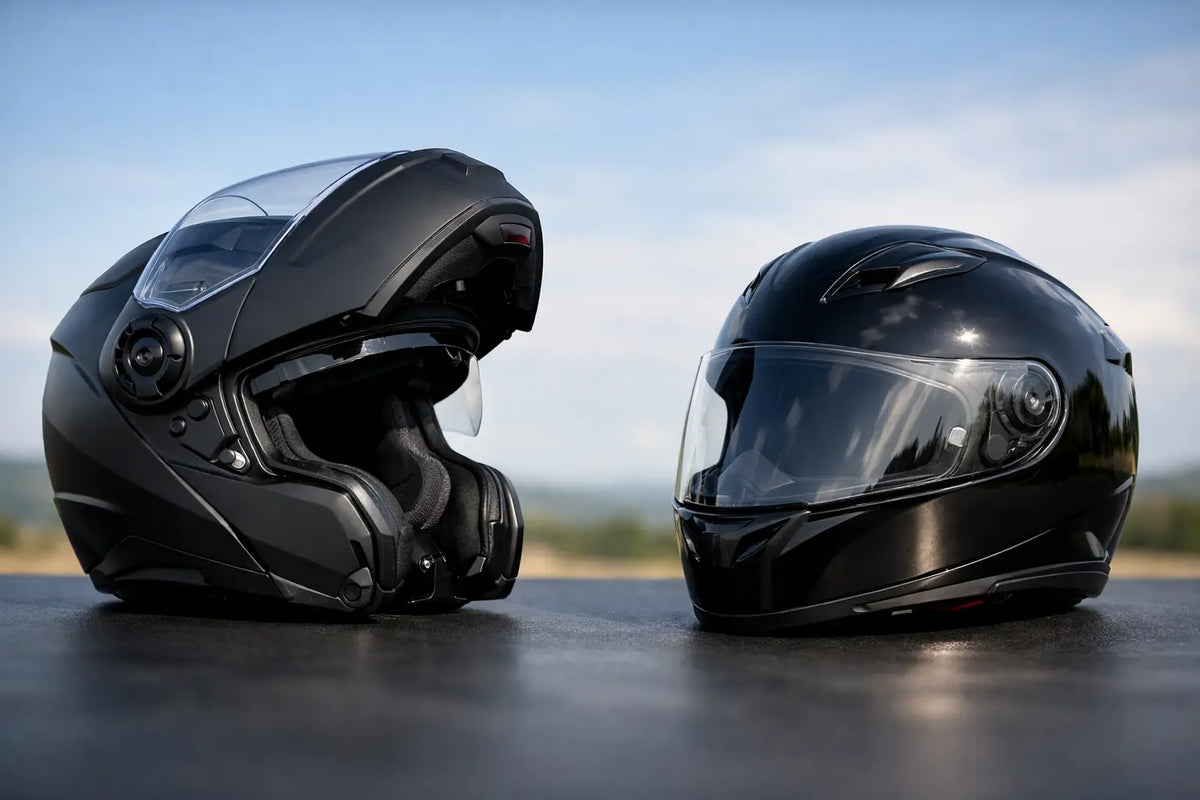
Pull up at a gas stop in the summer and you’ll see the split fast - one rider flips the chin bar up to talk, breathe, and grab a drink, while the next keeps a full face lid locked down like business. That’s the real modular vs full face helmets debate. It’s not about which one looks tougher on a shelf. It’s about how you ride, how long you ride, and what trade-offs you’re willing to make every time the wheels start rolling.
For a lot of riders, this choice gets boiled down too far. People say modular helmets are about convenience and full face helmets are about protection, then leave it there. That’s not wrong, but it’s not enough. If you ride a bagger across three states, commute every day, wear glasses, run cold-weather miles, or spend hours in the saddle, the details matter.
Modular vs full face helmets: The core difference
A full face helmet is one solid structure. The chin bar stays fixed, and the shell is built as a single protective unit. A modular helmet, sometimes called a flip-up helmet, has a chin bar and face shield section that lifts up on a hinge.
That hinge is the whole story. It’s what gives a modular helmet its biggest advantage and its biggest compromise. You get easier access when stopped, easier conversations, easier fueling, and usually a friendlier fit for riders who wear glasses. But you also add moving parts, extra weight, and another area that can affect noise, bulk, and overall feel.
A full face helmet keeps things simple. Fewer moving parts usually means a lighter, quieter, and more planted helmet at speed. For riders who care about stability and a locked-in fit, that matters more than the ability to flip the front open at a rest stop.
When a modular helmet makes more sense
If your rides involve frequent stops, a modular helmet can feel like the smarter tool for the job. Touring riders, commuters, and anyone logging long hours often appreciate being able to raise the front at a fuel pump, checkpoint, parking lot, or roadside stop without pulling the whole helmet off.
That convenience sounds minor until you live with it. On a hot day, being able to get quick airflow to your face is a real benefit. If you wear prescription glasses or sunglasses, a modular design can also be less annoying to put on and take off. For some riders, especially those moving between city traffic and highway stretches, that convenience adds up every single ride.
Passenger communication is another reason riders lean modular. So is stopping for directions, grabbing coffee, or handling small tasks without fully removing your helmet. If your riding life includes constant transitions, modular can feel more practical and less restrictive.
The trade-off is that modular helmets tend to be heavier. That extra hardware has to go somewhere. Over a long ride, that can mean more neck fatigue, especially if the fit isn’t right or the helmet is more budget-oriented. Premium modular helmets manage weight better, but the issue never fully disappears.
Why many riders still choose full face
A full face helmet is the straightforward choice for riders who want simplicity, lower weight, and a more planted feel. There’s a reason sport riders, aggressive street riders, and a lot of safety-focused riders still stick with full face designs. When everything is sealed into one fixed structure, the helmet often feels tighter, cleaner, and more stable in the wind.
Noise is a big factor here. While helmet noise depends on bike setup, windshield height, fit, and riding position, full face helmets often have an edge. Less flex, fewer seams, and fewer moving parts can mean less wind turbulence around the helmet. If you spend serious time at highway speed, that can make the ride less fatiguing.
A full face helmet also tends to have a slimmer profile. Some modular helmets feel bulkier, and riders notice that at speed or when turning their head repeatedly in traffic. It’s not always dramatic, but it’s real. If you like gear that feels lean and focused, full face usually wins that battle.
Protection: Be honest about the trade-off
This is where riders need to cut through marketing language. Both helmet types can be DOT certified, and some carry additional safety certifications. That matters. A quality modular helmet from a reputable maker is not automatically unsafe, and a cheap full face helmet is not automatically a smart buy.
Still, in a pure design sense, a full face helmet has the advantage of a fixed chin bar. That fixed structure is one reason many riders trust it more for maximum impact integrity. With modular helmets, the hinge and latch system introduce complexity. Good engineering can reduce the downside, but it doesn’t erase the basic fact that more moving parts create more variables.
For many cruiser, touring, and everyday street riders, that trade-off may be worth it because the convenience is so useful. For riders who prioritize the most locked-down structure possible, a full face helmet is usually the stronger play.
Comfort depends on your riding habits
Comfort is where this decision gets personal fast. A modular helmet can feel more livable off the bike or at stops. That matters if you’re in and out of traffic, running errands, or taking long-distance breaks. The ability to open the front can make the whole helmet feel less claustrophobic.
A full face helmet, though, may feel better once you’re moving. Lighter weight, better aerodynamics, and often better noise control can create less fatigue over time. Riders who spend most of their day actually riding rather than stopping often notice that difference.
Climate matters too. In cold weather, a full face helmet’s sealed feel can be a plus. In hot weather, a modular can feel more forgiving when you’re stopped in traffic or standing around in a parking lot. Venting design varies by model, but the basic use case still holds.
The best helmet for touring, commuting, and weekend rides
For touring riders, modular helmets are often hard to beat. Long days on the road involve toll booths, fuel stops, quick conversations, snacks, and map checks. Being able to flip the front up without removing the helmet is plain useful.
For commuting, it depends on your route. If you deal with stop-and-go city riding, lots of short stops, and daily convenience headaches, modular can be a strong fit. If your commute is mostly freeway miles and you want less noise and less weight, full face may serve you better.
For weekend riders, the answer often comes down to personality and priorities. Some riders want the freedom and practicality of a modular lid. Others want a classic, no-nonsense full face that feels tight, solid, and purpose-built. Neither choice is wrong if it matches how you actually ride.
Fit matters more than helmet style
A bad fit will ruin either option. Pressure points, helmet lift, cheek pad looseness, and forehead hotspots matter more than a lot of riders admit. The best modular helmet for one rider can feel terrible on another, and the same goes for full face models.
Head shape plays a major role. So does liner quality. A premium helmet that matches your shape can feel better than a cheaper model regardless of style. If you’re shopping, focus on fit first, then features. Don’t buy a modular because the flip-up front sounds cool if the helmet feels unstable. Don’t buy a full face just because it seems tougher if it gives you a headache after twenty minutes.
Price, features, and what you’re really paying for
Modular helmets usually cost more than comparable full face helmets because the design is more complex. You’re paying for the hinge system, latch mechanism, and the engineering needed to make it all work. That doesn’t mean every expensive modular is worth the money, but it does mean bargain-bin pricing should make you cautious.
Full face helmets often give you stronger value if your priorities are core protection, lighter weight, and aerodynamic performance. Modular helmets often give you stronger value if daily practicality is high on your list.
If you’re shopping gear at American Legend Rider, the smart move is to match the helmet to your miles, not your impulse. A flashy shell means nothing if it doesn’t fit your riding life.
So, which one should you buy?
Choose a modular helmet if you want convenience, easier on-off use, better flexibility for glasses, and a setup that works well for touring, commuting, and frequent stops. Choose a full face helmet if you want a lighter feel, fewer moving parts, a cleaner aerodynamic profile, and the confidence that comes with a fixed chin bar design.
The right answer usually isn’t about what wins online arguments. It’s about what works when the road gets long, the weather turns, and you still have another hundred miles to go. Buy the helmet that fits your ride, fits your head, and makes you want to keep twisting the throttle.


No comments yet. Be the first rider to weigh in.