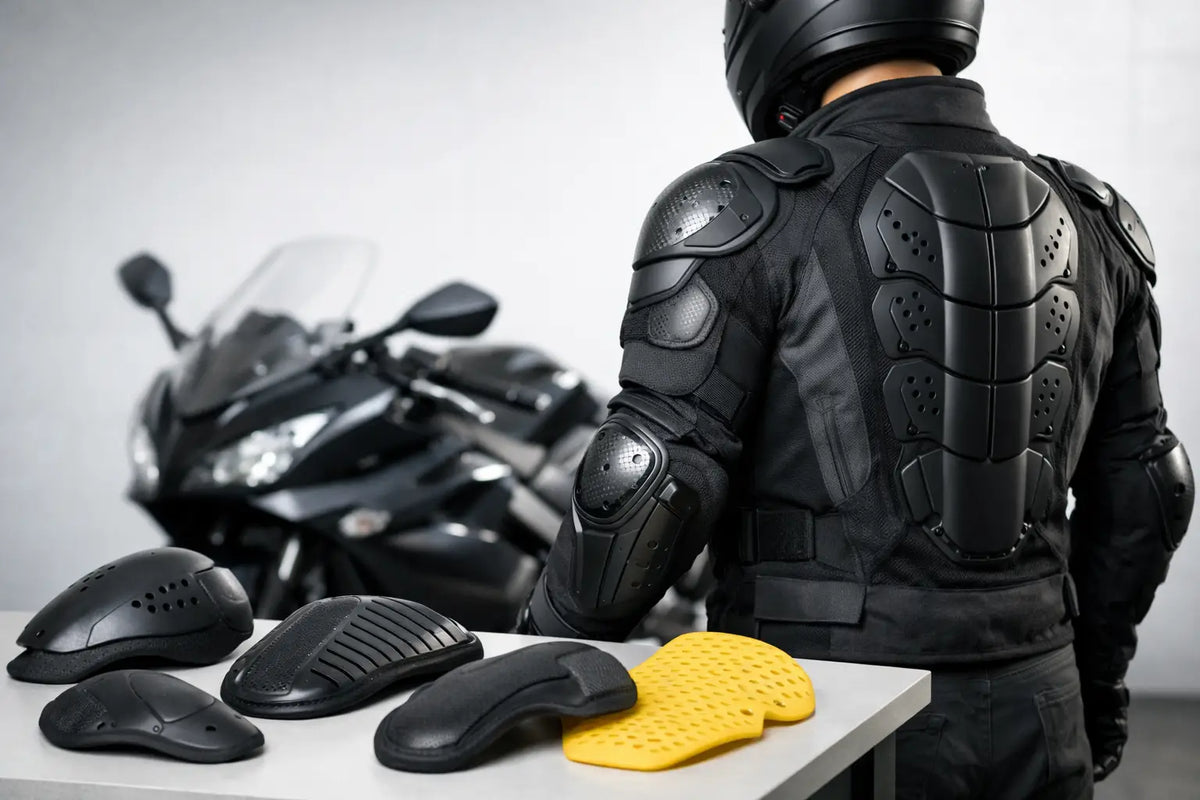
A jacket can look tough on the hanger and still leave you exposed where it matters. That’s why a real motorcycle armor placement guide starts with one hard truth - armor only helps when it stays over the impact zone during an actual crash, not just when you’re standing in the mirror.
Too many riders focus on armor ratings, brand names, or shell material and skip the fit check that decides whether that protection does its job. Good armor in the wrong spot is bad armor. If your shoulder pad drifts off the joint, your knee piece sits too low, or your back protector floats away from your spine, you’re wearing false confidence.
Why armor placement matters more than most riders think
Motorcycle armor is built to absorb and spread impact energy. But it can only do that if it covers the body part likely to hit first or take the hardest blow. In the real world, riding gear shifts when you reach for the bars, lean into a turn, stand on the pegs, or slide across pavement. That means placement has to be checked in a riding position, not a relaxed standing pose.
The biggest mistake riders make is buying gear that feels comfortable in the store but moves too much on the bike. Loose gear can be fine for airflow and casual wear, but there’s a trade-off. More room usually means more movement, and more movement means a higher chance that the armor rotates away from the target area in a wreck.
Motorcycle armor placement guide for the main impact zones
Every zone has its own fit rules. One general rule applies across the board - the armor should sit centered over the joint or bone it is meant to protect, with enough coverage to stay there when you move.
Shoulder armor
Shoulder armor should cap the shoulder joint, not hang down the upper arm and not sit too far inward toward the chest. When your jacket fits right, the pad covers the rounded outer point of the shoulder where impact often lands in a low-side or side hit.
Put the jacket on, zip it fully, and grip handlebars or mimic your riding position. The armor should still stay centered. If it slides backward or rotates off the shoulder point, the jacket is either too loose, the armor pocket is too large, or the cut just doesn’t match your body.
Elbow and forearm armor
Elbow armor needs to cup the elbow point and extend slightly above and below it. On many jackets, this piece also protects part of the forearm. The key is simple - when your arms are bent for riding, the armor should stay over the elbow, not drift down toward the wrist or ride up the bicep.
This is where pre-curved sleeves matter. Jackets designed for riding usually place armor better when your arms are forward. If a jacket only positions the elbow armor correctly when your arms are hanging straight, that’s a bad sign.
Back protector placement
Back protection should run along the center of your spine and cover from the upper back down toward the mid to lower back, depending on the design. It should not sit off to one side, and it should not stop too high.
A common weak point is the basic foam pad included in many jackets. Even when upgraded, the protector has to fit the pocket correctly. If it shifts around inside a loose pocket, coverage gets sloppy fast. The protector should sit flat against your back and stay close to the body. If there’s a gap big enough to slide around freely, it’s not where it needs to be.
Chest armor
Not every jacket includes chest armor, but if yours does, placement should cover the upper chest without interfering with breathing or arm movement. Chest pieces should sit symmetrically and stay in place when zipped. If one side rides higher than the other or pulls outward, the fit is off.
Chest armor is one of those it-depends categories. For some riders, especially aggressive street or sport riders, it adds worthwhile coverage. For others, bulk and comfort may affect whether they actually wear it every ride. Protection only works if it’s on your body.
Hip armor
Hip armor belongs over the outer hips, not the front pockets and not too far back toward the seat. In riding jeans and pants, this can be tricky because body shape and rise height change where the pocket lands.
Try the pants on in a seated position. If the hip pad moves above or behind the bony outer hip area when seated, coverage is off. Some pants allow height adjustment inside the pocket, and that can make a big difference.
Knee and shin armor
Knee armor should center over the kneecap when seated on the bike. That seated test matters because pants always shift when your knees bend. If the armor looks perfect standing up but slides too high once seated, it won’t protect the knee the way it should.
Some riding pants also extend coverage down the shin. That’s a plus, especially if you ride in positions where your lower legs are more exposed. Just make sure the pad does not bind badly when walking or bunch up under tall boots.
Fit decides placement
This is where most armor problems start. The gear can be premium quality, CE-rated, and built from strong materials, but if the fit is wrong, the placement is wrong.
Jackets should feel secure through the shoulders, upper arms, and torso without crushing your movement. Pants should stay planted at the waist and seat without sagging. If you can grab a big handful of loose material around armored zones, there’s a good chance those pads will move in a crash.
That does not mean every rider needs race-tight gear. Cruiser riders, touring riders, and everyday street riders often want room for comfort, layers, and long-haul wear. Fair enough. Just know there’s a line between comfortable and sloppy. Good gear gives you mobility while keeping the armor anchored.
How to check armor placement before you ride
The fastest way to sort good fit from bad fit is to test gear like you actually ride. Put everything on, close all zippers and closures, and get into a real riding posture. Reach for imaginary bars. Bend your elbows. Sit down. Move around.
Then press on each armor zone with your hand. You should feel the protective piece directly over the intended area. If you have to hunt for it, adjust it, or tug the gear back into place every time, that’s not road-ready fit.
A second check is motion. Twist your torso, crouch slightly, and simulate getting on and off the bike. Armor should stay close and centered through those movements. Minor shifting can happen, but major rotation is a red flag.
Pocket adjustability and upgrade traps
Many riders upgrade stock armor and assume bigger or thicker automatically means better. Not always. If the new piece does not match the pocket shape, it can fold, float, or sit crooked. That kills the benefit.
Adjustable armor pockets are worth paying attention to, especially at the knees, elbows, and hips. A small height adjustment can turn almost-right placement into proper coverage. If your gear gives you that option, use it. If it doesn’t, fit becomes even more important when you buy.
Also watch for armor that feels too small for the zone. Minimal coverage may improve comfort and airflow, but there is a trade-off. Smaller pads are easier to miss the impact point when gear shifts.
Common placement mistakes riders make
The most common mistake is choosing fashion fit over riding fit. A jacket that looks clean and relaxed off the bike may let armor wander all over once the wind hits and your body moves.
The second is ignoring body position. Cruiser ergonomics, sport ergonomics, and ADV stance all change how gear sits. Armor that works in one setup can feel wrong in another.
The third is forgetting the full system. Your jacket, pants, base layers, and even what’s in your pockets affect where armor lands. Stuffed cargo pockets, thick hoodies, and bulky layers can push pads out of place.
Choosing gear with armor placement in mind
When shopping, don’t just ask what armor is included. Ask how it sits, whether the pockets are adjustable, and how the garment is cut for riding. Road-tested gear earns its keep by holding protection where it belongs mile after mile.
That’s the smart way to shop at a store like American Legend Rider - not just by style, not just by price, but by whether the gear is built to stay locked in when things get ugly. You can still get the rugged look, the biker attitude, and the durable build. Just don’t let the look outrun the function.
The best armor setup is the one you’ll actually wear on every ride, and the right placement is what turns that gear from a costume into real protection.


No comments yet. Be the first rider to weigh in.