
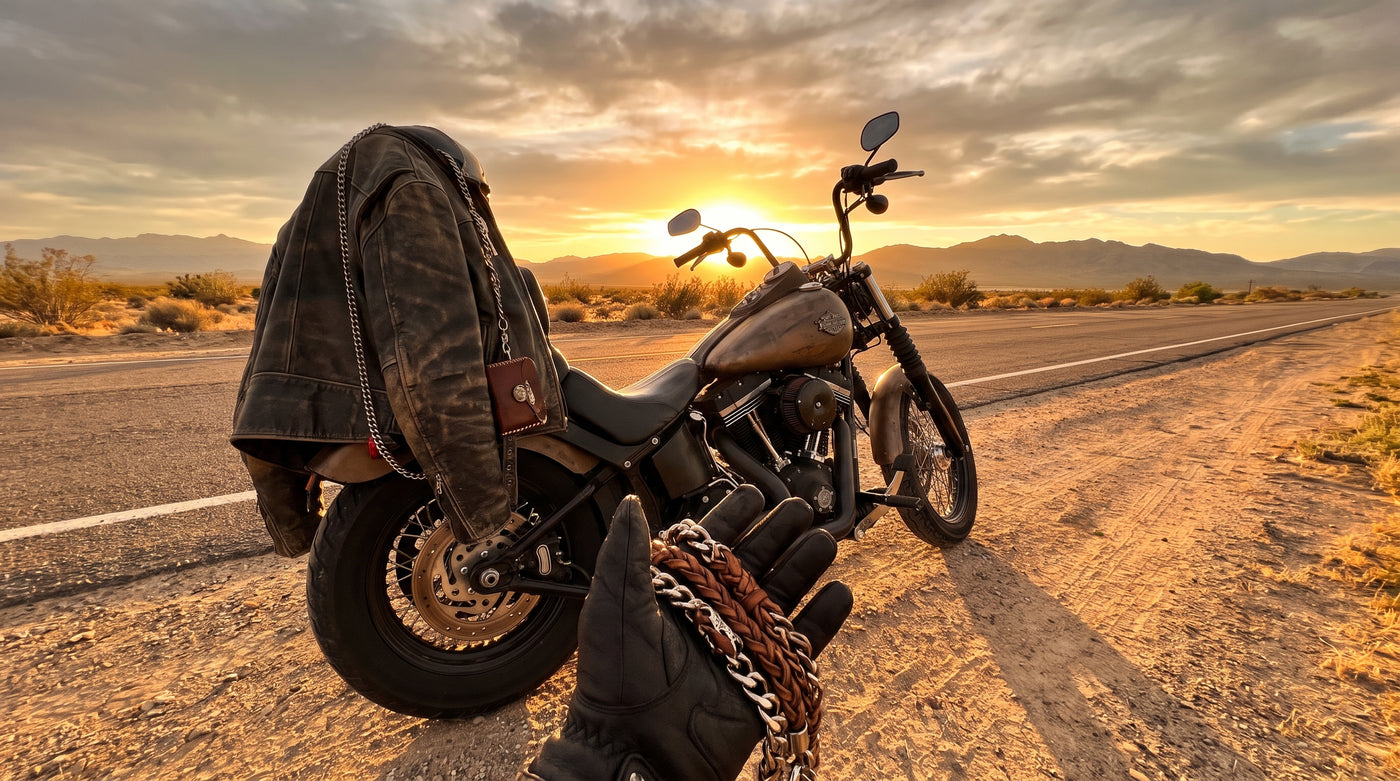
A pickpocket in a Sturgis crowd will clean out a back pocket in under two seconds. That stat alone explains why every serious rider clips a wallet chain to their belt loop before stepping off the bike. But wallet chains do more than prevent theft. They're one of the oldest pieces of biker culture still in daily use, and picking the right one matters more than most riders think.
This guide breaks down every style of biker wallet chain worth owning, the lengths that actually work for different body types, and the practical details of wearing one so it stays secure without catching on your seat or swingarm.
How Do Wallet Chains Work (and Why Riders Still Use Them)
A wallet chain connects your wallet to your pants using two attachment points: a clip or ring on the wallet end, and a lobster claw or trigger snap on the belt-loop end. The chain hangs in a loop along your hip.
The concept dates back to 1950s truckers and railroad workers who needed their wallets secured during physical labor. Bikers adopted them in the 1960s because highway speeds, vibration, and gas-station stops created the perfect conditions for losing a wallet. By the time the Hells Angels popularized them in Northern California, they were standard equipment.
Today, the functional reason is unchanged: at 70 mph with wind whipping your jacket open, a wallet in a back pocket is one bump away from hitting the asphalt. A 12-inch steel chain weighing 3.2 ounces solves that problem permanently. Beyond security, wallet chains signal tribe. They tell other riders you're not a weekend cosplayer. That dual purpose, functional and cultural, is why they've outlasted every fashion cycle since Eisenhower was president.
Wallet Chain Styles: Which Type Fits Your Ride
Not all wallet chains look or perform the same. Here's what actually exists in the market and what each style does best.
Cuban Link Chains
Flat, interlocking oval links that lay smooth against your leg. The standard biker chain. A quality Cuban link in stainless steel runs 18-22 inches and weighs around 4-6 ounces. These work for daily riders because the flat profile won't catch on a seat edge or snag your chaps. Daniel Smart MFG makes a popular heavy-duty version at 3/8-inch link width that handles years of abuse.
Bike Chain (Roller) Style
Miniature replicas of actual motorcycle drive chains. These are thicker, heavier (often 8-12 ounces), and make a statement. They work best for riders who want maximum visual impact at rallies or club events. The trade-off: weight. Wearing a 12-ounce chain on an 8-hour ride day gets noticed by your hip joint, not just bystanders.
Box Chain / Square Link
Squared-off links that create a rigid, geometric look. Less common in biker circles but gaining ground with riders who want something cleaner. Typically lighter at 2-4 ounces, making them practical for all-day wear. The angular shape means fewer snag points than round-link designs.
Leather Braided with Chain
A hybrid: braided leather cord with chain links woven through or chain segments connecting leather sections. These weigh almost nothing (1-2 ounces) and add a softer look. Popular with riders who wear their chain off the bike too. The downside is durability. Leather wears at the attachment points and typically needs replacement every 12-18 months of daily use, while an all-metal chain lasts decades.
Wallet Chain Length Guide: What Actually Works
Length is where most first-time buyers get it wrong. Too short and you can't pull your wallet out without unclipping. Too long and the chain catches on everything from your passenger's boot to your saddlebag latch.
| Chain Length | Best For | Hang Distance | Notes |
|---|---|---|---|
| 12 inches | Front pocket carry | Minimal loop | Tight, secure, barely visible |
| 18 inches | Standard back pocket (most riders) | 6-8 inch drop | The all-rounder. Works sitting or standing. |
| 22-24 inches | Taller riders (6'0"+) or style preference | 10-12 inch drop | More visible loop, slightly more snag risk |
| 28+ inches | Show/rally only | 14+ inch drop | High snag risk on a bike. Not recommended for riding. |
The 18-inch chain is what most riders at Daytona Bike Week are wearing, and for good reason. It gives enough slack to pull your wallet out at a gas pump without unclipping, but stays tight enough that it won't swing into your rear wheel or exhaust pipe. If you're between 5'8" and 6'0", start with 18 inches.
How to Wear a Wallet Chain on a Motorcycle
Attachment method matters as much as length. Here's the setup that works for actual riding, not just bar hopping.
Step 1: Wallet end. Use a chain with a solid ring attachment (not a flimsy split ring). Thread it through the grommet hole in your biker wallet or use a dedicated chain-loop wallet. The connection point should be reinforced leather or metal, not stitched fabric that will tear under tension.
Step 2: Belt loop. Clip the lobster claw to your front-left or front-right belt loop (same side as your wallet pocket). Some riders use a dedicated chain fob on their belt. Either works, but the belt-loop method keeps the chain closer to your body, reducing swing.
Step 3: Route the chain. The chain should drape from your front belt loop back to your rear pocket in a single smooth arc. No twists, no wrapping around other gear. On a bike, tuck any excess loop slightly under your jacket or vest so it doesn't flap in the wind.
Pro tip from long-distance riders: On rides over 200 miles, some riders clip the midpoint of their chain to a second belt loop. This splits the arc into two shorter loops, eliminating swing entirely. It looks less dramatic but it's dead practical on the highway.
Heavy Duty Biker Wallet Chains vs. Fashion Chains
There's a meaningful difference between a wallet chain built for riding and one sold as a fashion accessory at a mall.
A real heavy duty biker wallet chain uses stainless steel or nickel-plated brass links that are individually welded shut (not stamped open). The lobster claw has a spring tension of 2+ pounds, meaning it won't pop open from vibration. The total chain weight sits between 4 and 10 ounces. It won't rust in rain, won't weaken from UV exposure, and won't break if you accidentally sit on it wrong.
Fashion chains, typically sold on Amazon for $8-15, use pot metal or aluminum with chrome plating. The links are stamped (not welded), so any sharp pull separates them. The clips use weak springs that vibration loosens over a 30-minute ride. These chains break, and when they do, your wallet hits I-95 at 65 mph.
The price difference is real but justified. A quality biker wallet chain from a brand that serves actual riders runs $25-65 depending on style and weight. That's a one-time purchase that outlasts the wallet itself. The $12 Amazon chain is a recurring expense because you'll replace it every few months, plus the cost of replacing whatever was in the wallet you lost.
Best Wallet Chain Materials Compared
| Material | Weight (18" chain) | Rust Resistance | Durability | Price Range |
|---|---|---|---|---|
| Stainless Steel 316L | 4-6 oz | Excellent | Decades | $35-65 |
| Nickel-Plated Brass | 5-8 oz | Good (plating wears) | 5-10 years | $25-45 |
| Chrome-Plated Steel | 4-7 oz | Moderate (chips) | 3-7 years | $20-40 |
| Titanium | 2-3 oz | Excellent | Decades | $80-150 |
| Pot Metal / Zinc Alloy | 2-4 oz | Poor | Months | $8-15 |
For most riders, stainless steel 316L is the sweet spot. It's the same alloy used in marine hardware, meaning rain, sweat, and road salt won't touch it. The weight is noticeable enough to feel secure without dragging your pants down. If you ride in heavy rain regularly (Pacific Northwest riders, you know), 316L stainless is the only material that won't show wear after a season.
Common Mistakes Riders Make with Wallet Chains
Buying too long for actual riding. A 28-inch chain looks great in a mirror. On a bike, it swings into your rear brake lever, catches on passenger pegs, or tangles with your key lanyard. If you ride, keep it at 18-22 inches max.
Using a split ring instead of a solid ring on the wallet. Split rings (the kind on keychains) open under consistent tension. One hard tug, or repeated vibration over miles, and the ring spreads. Your wallet separates from the chain while still in your pocket. You won't notice until you reach for it.
Clipping to a rear belt loop. Rear loops sit right where your back presses against the seat. The constant pressure on the clip fatigues the spring mechanism. After a few weeks of daily riding, the clip opens under its own weight. Always clip to a front or side loop.
Ignoring the wallet attachment point. The chain is only as strong as the weakest link, and that's usually where it meets the wallet. A stitched fabric loop will fail. Look for wallets with a metal grommet or a riveted D-ring. Leather wallets built for chains have reinforced attachment points rated for 15+ pounds of pull force.
Choosing chrome for year-round riding. Chrome plating chips at flex points within 6 months of daily use. Every chip becomes a rust nucleation site. If you ride year-round, skip chrome and go stainless or nickel-plated.
Where Wallet Chains Fit in Biker Culture Today
Wallet chains never left. They faded from mainstream fashion around 2005, but in the riding community they remained standard kit. At any Harley dealership parking lot on a Saturday morning, count the chains. You'll see them on 60% or more of the riders there.
The resurgence in broader men's fashion (GQ ran a wallet chain feature in 2023) brought new buyers into the market, but it also flooded it with low-quality fashion pieces that don't serve riders. The distinction matters: a rider's wallet chain is functional equipment first and style second. It needs to handle vibration, weather, and the mechanical stress of sitting on a motorcycle seat for hours.
Clubs still consider them part of proper riding attire. Not a requirement in most organizations, but wearing one signals you understand the culture and take your gear seriously. Paired with a proper leather vest and sturdy boots, a wallet chain completes the functional rider kit that's looked the same since the 1970s.
Picking the Right Wallet Chain for Your Setup
Match the chain to how you actually ride:
- Daily commuter (under 30 miles): 18-inch Cuban link in stainless steel. Light, secure, low profile under work clothes.
- Weekend cruiser: 18-22 inch in your preferred style. More room for personal expression since you're not wearing it to an office.
- Long-distance touring: 12-18 inch with a double-clip setup. Minimal swing, maximum security over 500+ mile days.
- Rally and show: Go heavy, go long, go bold. Bike chain style at 24 inches makes a visual statement when you're walking, not riding.
If you're shopping for a quality biker wallet chain that won't quit on you mid-ride, the biker wallet collection is where I'd start. Chains matched to wallets built for the same purpose, with metal attachment points and lengths that work on an actual motorcycle.


No comments yet. Be the first rider to weigh in.