
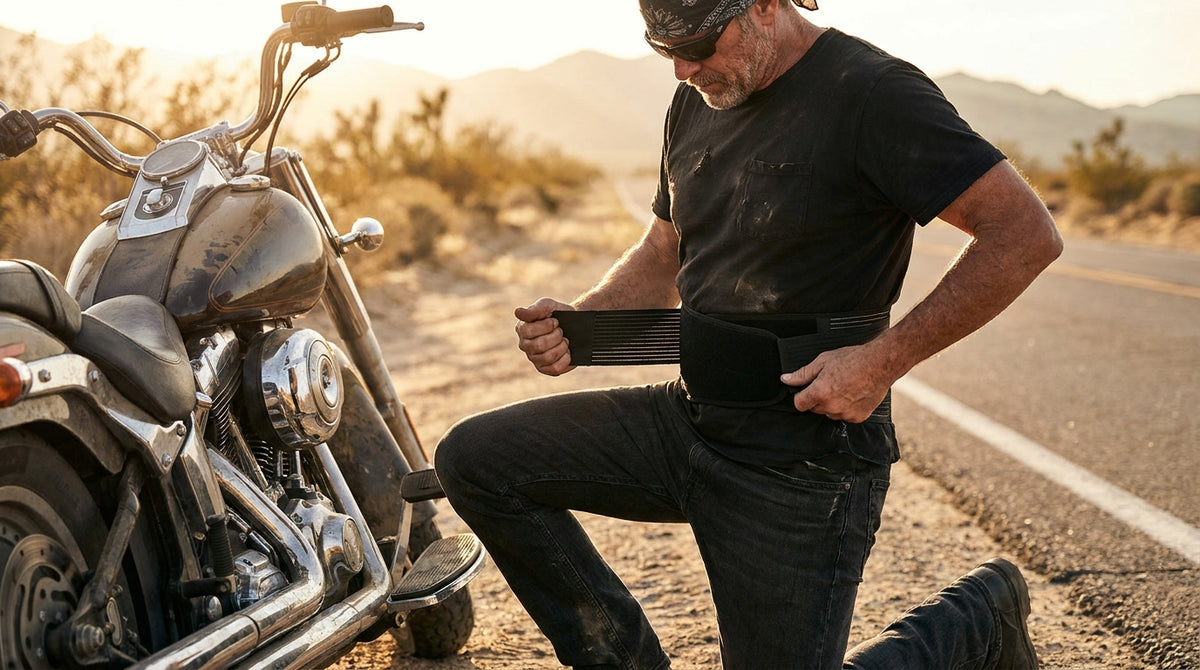
Pull up a back brace size chart and you hit a problem nobody warns you about. The American Legend Rider chart runs S at 18 to 27 in., M at 27 to 36 in., L at 37 to 45 in., and XL at 48 to 59 in. Look at the seams between those rows. There is a one inch hole between M and L, and a three inch hole between L and XL. Measure 46 in. and the chart has no row for you.
The second problem is bigger. The column header says chest circumference, but the sizing tip on the same page tells you to start your measurement at the belly button. Those are two different places on your body, and on most riders they are four to six inches apart. Guess wrong and you order a belt that either slides up under your ribs or will not close.
This back brace size chart guide fixes both. You get the real numbers straight off the ALR size guide, the exact spot to put the tape, what to do when you land in a gap, and why the waist size on your jeans is the worst possible thing to size a brace from. Everything here is the chart ALR actually publishes, not a generic one copied off a supplier sheet.
The back brace size chart, straight off the product page
Four sizes, one measurement. This is the chart that governs the Back Brace Posture Corrector, copied exactly as published on the ALR size guide page.
| Size | Circumference (chart) | Centimeters | Who it fits |
|---|---|---|---|
| S | 18 to 27 in. | 46 to 69 cm | Small frames and teens, rarely the right call for an adult rider |
| M | 27 to 36 in. | 69 to 91 cm | The most common adult size, roughly a 30 to 34 in. jean waist |
| L | 37 to 45 in. | 94 to 114 cm | Roughly a 36 to 40 in. jean waist once you measure at the navel |
| XL | 48 to 59 in. | 122 to 150 cm | 42 in. jean waist and up, or anyone wearing the brace over a jacket |
One more number matters and it is not on the chart. The belt itself adjusts through a range of 45 to 90 cm, which is 17.7 to 35.4 in. of strap travel. That adjustment range is why the size rows overlap the way they do, and it is why a brace that measures tight on the table can still close on you once the elastic is stretched out.

Where to put the tape measure
The chart says chest. The sizing tip on the same page says belly button. Follow the tip, not the column header. A lumbar support belt sits across the lower back and wraps around the navel, so the navel is the circumference it has to close around. Measuring at the chest on a 5 ft 10 in. rider can read five or six inches smaller than the navel, which is exactly how people end up one size short.
The four step measurement
- Stand normal, shirt off or in a thin tee. Do not suck in. The brace has to close on the body you ride in, not the one you hold your breath for.
- Find your belly button and run the tape around at that exact height. Keep the tape level front to back. A tape that rides up at the back reads one to two inches short.
- Snug, not tight. You should be able to slide one finger under the tape. Pulling the tape into your skin costs you a full size.
- Write the number in inches and read it off the chart above. Do not round it, and do not translate it into a shirt or jean size first.
Here is the rider specific part. Sit on the bike in your normal riding position and measure again. Most people pick up one to two inches at the navel when they fold forward over the tank, because your abdomen compresses forward instead of down. If you plan to ride in the brace rather than wear it around the garage, use the seated number.
What to do when you land in one of the two gaps
The chart has two dead zones. If you measure 36.5 in. you are between M and L. If you measure 46 or 47 in. you are between L and XL, and that one is three inches wide. Both have the same answer, and it runs against instinct.
| Your measurement | Gap | Pick | Why |
|---|---|---|---|
| 36 to 37 in. | Between M and L | L | M tops out at 36 in. unstretched, so you would be riding at the very end of the strap with no adjustment left |
| 45 to 48 in. | Between L and XL | L up to 46 in., XL at 47 in. and above | L is built for 37 to 45 in. and the elastic will stretch roughly an inch under tension, XL starts too loose below 47 in. to compress anything |
The reason sizing down into a gap works at all is the second tip on the ALR guide: the belt must be stretched as you wrap it. A support belt that goes on slack does nothing. It is a cloth band sitting on your waist. The compression comes from the elastic being under tension when the closure lands, which is why a brace at the top of its range still works and a brace at the bottom of its range does not.
The failure mode to avoid is sizing up for comfort. An XL on a 44 in. waist has so much strap left over that the closure overlaps itself, the panel bunches at the side, and the brace rolls up under your ribs by the second fuel stop.
Why your jean size is the wrong input
This is the single most common sizing mistake and it is worth its own section. A 34 in. jean waist is a garment measurement taken at the waistband, and on most men that waistband sits at or below the hip bone, two to four inches below the navel. Jean sizing is also vanity sized across most brands, so a tagged 34 often measures 35 or 36 in. of actual fabric.
Put a tape at the navel on that same rider and you frequently read 38 to 40 in. On this chart that is a solid L. If he had ordered off his jean tag he would have bought M, which stops at 36 in., and he would have sent it back.
| Tagged jean waist | Typical navel measurement | Brace size |
|---|---|---|
| 30 to 32 in. | 32 to 35 in. | M |
| 34 in. | 36 to 38 in. | M at 36 in., L at 37 in. and up |
| 36 to 38 in. | 39 to 42 in. | L |
| 40 in. | 43 to 45 in. | L |
| 42 in. and up | 47 in. and up | XL |
Treat that table as a sanity check, not a substitute for the tape. It tells you whether the number you measured is plausible. If you wear a 34 and the tape says 46, you measured at the wrong height or pulled the tape crooked.
Size it for riding, not for standing in the kitchen
A brace sized off a standing measurement in a tee shirt fits a rider standing in a tee shirt. Three things change the number once you are geared up and moving.
What goes under it
Wearing a base layer under the brace is the right call in cold weather, because the brace is made of soft breathable sponge composite cloth that holds sweat against your skin on a long day. A fleece lined set adds roughly half an inch of circumference. That is inside the overlap on every size, so it does not change your pick, but it does mean you should not size down to the absolute bottom of a row if you ride through winter.

Over or under the jacket
Under the jacket is the only version that works. Over a leather or a textile shell the brace has nothing to grip, it slides on the jacket instead of on you, and the compression goes nowhere. The one exception is a hot day in a tee, where the brace goes directly on skin or over a thin shirt. If you ride in an armor jacket, the brace goes under that too, sitting below the back protector so the two do not stack on the same vertebrae.

Your belt buckle
A heavy biker buckle sits right where the front closure of the brace lands. Either move the buckle off center or run a flat buckle free belt on days you wear the brace. Two layers of hardware on the same spot is how riders end up with a pressure point above the hip after 90 minutes.
Back brace, armor, or seat cushion: what each one actually fixes
Riders search for a back brace when the real complaint is lower back fatigue on long rides, and a brace is only one of three tools that address it. They solve different problems and they size differently.
| Gear | What it does | How it is sized | Price at ALR |
|---|---|---|---|
| Back brace / lumbar belt | Compresses and supports the lower back while you are flexed forward over the bars | Navel circumference, S to XL | $26.94 to $42.94 |
| Armor jacket with back protector | Impact protection for spine, shoulders, elbows and chest in a crash, not fatigue | Chest and torso, S to XXXL | $134.45 |
| Armor pants | Impact padding at hips, tailbone, thighs and knees | Waist and inseam, S to 3XL | $66.97 |
| Gel seat cushion | Removes the vibration and pressure load that causes the fatigue in the first place | Pad footprint, 25x25x1 cm or 25x25x2 cm | $76.99 |
A brace manages the symptom at your waist. A cushion attacks the input, because the road shock travelling up through a stock saddle is what loads the lower back over a 300 mile day. Plenty of riders run both. We dug into whether the belts hold up in do lumbar support belts work for motorcycle riding, and the broader causes are covered in the motorcycle back pain guide.


On the quality question, be blunt about it. A no name marketplace brace at eight dollars uses a single layer of thin neoprene with no stay in the back panel, so it stretches permanently after a few wears and stops compressing anything. The structural difference worth paying for is a composite panel that holds its shape and a strap that still has tension in it after a season.
Five sizing mistakes to skip
- Measuring at the chest because the column says chest. The header is wrong for how this belt is worn. It wraps the navel. Follow the tip, not the header.
- Sizing up to be safe. A belt that closes with three inches of slack has no tension in the elastic, and tension is the entire mechanism. Too big does nothing at all, while too small at least still compresses.
- Ordering off the jean tag. Tagged 34 is usually 36 in. of fabric sitting four inches below where the brace goes. That is a two size error on this chart.
- Putting it on without stretching it. The ALR guide states this directly: the belts must be stretched when putting them on. Wrap it under tension and close it there, otherwise a correctly sized L behaves like an XL.
- Wearing it over the jacket. It slides on the shell and the compression never reaches you. Under the jacket, against a thin layer or skin, every time.
Worth saying plainly: a support belt is a comfort and fit tool for riding, not a treatment. NIOSH reviewed workplace back belts and found no evidence that wearing one prevents back injury. If your back pain is persistent or getting worse, that is a conversation with a doctor, not a size chart.
Your size in one line
Tape at the belly button, standing, one finger of slack, read the number in inches. Under 27 is S, 27 to 36 is M, 37 to 46 is L, 47 and up is XL. Ignore your jean tag, stretch the belt as you wrap it, and wear it under the jacket.
Two more size charts on the site follow the same measure first logic if you are kitting out: the chaps size chart and the leather jacket size chart. For posture on the bike itself, which is upstream of all of this, read how to adjust your posture during a long ride.
If you have your number and you are ready to order, the brace lives in motorcycle protective gear alongside the armor that handles the other half of the job. Measure once at the navel and you will only buy it once.



No comments yet. Be the first rider to weigh in.