
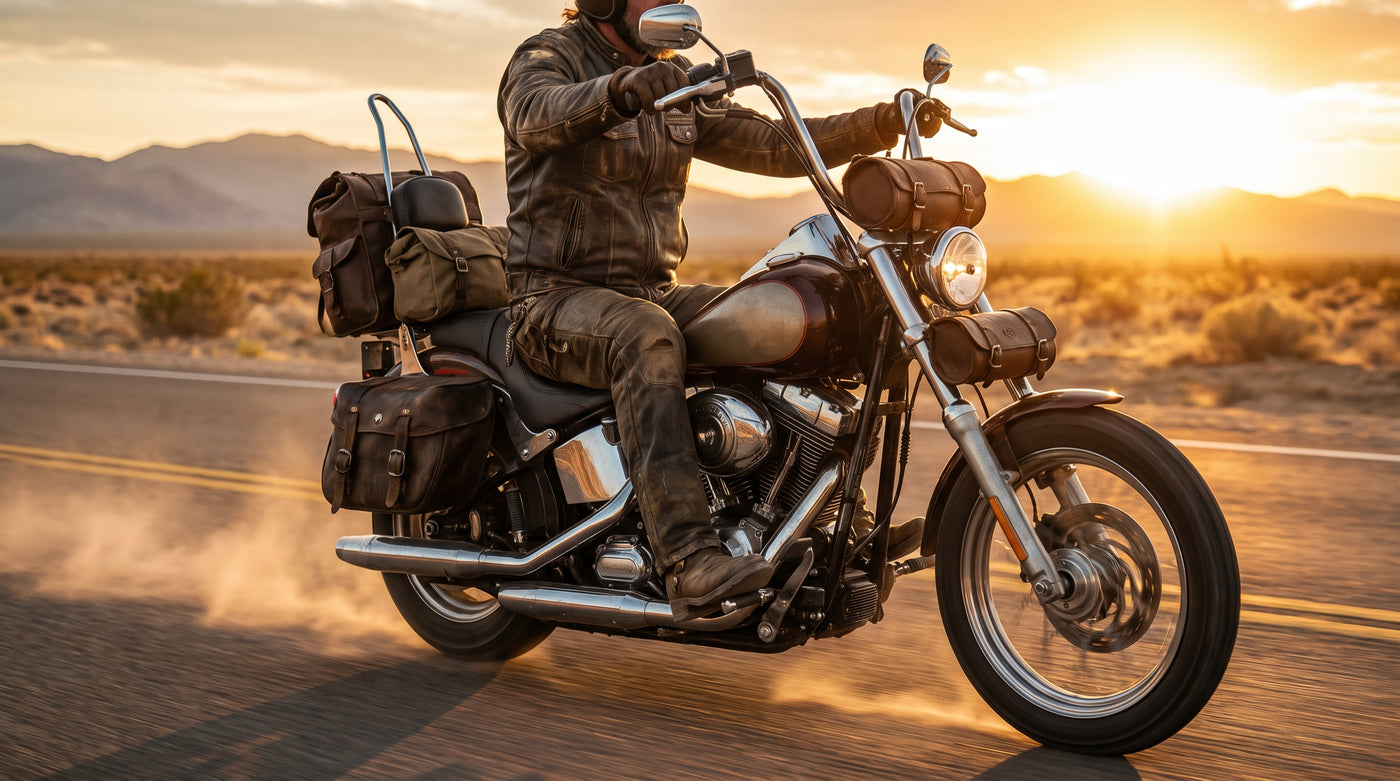
A $1,200 phone sliding off a tank at 60 mph ends the storage debate fast. If you ride without a proper biker bag, you are either cramming gear into jacket pockets or strapping a backpack to your shoulders and sweating through every mile. Neither works. And neither keeps your stuff safe when you park at a gas station and walk inside for two minutes.
This guide breaks down the five main types of biker bags, compares real specs in a side-by-side table, and walks through the mistakes that cost riders money and comfort. By the end, you will know exactly which bag fits your ride, your gear list, and your budget.
What Makes a Biker Bag Different from a Regular Bag
A regular backpack is designed for walking. A biker bag is built to handle 70 mph wind, rain, engine heat, and vibration for hours. The construction difference is measurable. Most motorcycle-specific bags use Cordura 1000D nylon or full-grain leather with reinforced stitching at every stress point. A typical daypack uses 600D polyester and single-stitch seams that start pulling apart after one season of riding.
Mounting hardware matters just as much as materials. Biker bags come with throw-over brackets, quick-release buckles, or magnetic mounts rated for sustained highway speeds. A regular bag strapped on with bungee cords shifts under braking and can block your tail light. That is not a minor annoyance. NHTSA data shows that obscured rear lighting is cited in roughly 6% of multi-vehicle motorcycle crashes.
The easiest way to figure out what you need: start with what you carry. A rain layer, phone, wallet, and a water bottle? A tank bag covers that. Tools, overnight clothes, and a laptop? You need saddlebags. Riding to the gym or a quick meetup? A leg bag holds the essentials and nothing else.
Construction quality also affects resale. A well-made leather biker bag from a known brand holds its value far better than a no-name import. Riders on forums consistently report cheap bags failing at the zipper or stitching within 3,000 miles.
Saddlebags: The Workhorse for Long Hauls
Saddlebags sit on either side of the rear wheel and remain the standard for touring riders. Harley's Heritage Classic factory saddlebags hold 1,579 cubic inches of storage per side. That is enough for a full weekend's worth of clothes, rain gear, a tire repair kit, and a first-aid bag with room left over.
Hard saddlebags lock shut and protect your gear in a slide or drop. Soft saddlebags, typically made from leather or heavy-duty nylon, are lighter, easier to remove when you park, and do not add as much width to the bike. The trade-off: hard bags resist impact better, while soft bags flex on contact and rarely crack.
Mounting is where riders get into trouble. Universal-fit soft saddlebags need a support bracket to keep them from swinging into the rear wheel. A set of Kuryakyn saddlebag supports runs about $65 and takes 20 minutes to install with basic hand tools. Skip them, and you risk a bag melting against the exhaust or, worse, catching in the spokes at speed.
For cruisers and touring bikes, a pair of leather saddlebags is tough to beat. They hold everything you need for a multi-day ride and look right on any V-twin. If you want throw-over convenience without brackets, look for bags with built-in stiffeners that hold their shape away from the wheel.

Tank Bags: Quick Access at Every Red Light
A tank bag sits on top of your fuel tank, right in front of you, so you can grab your phone, toll pass, or sunglasses without dismounting. Most models hold between 5 and 12 liters and attach with either magnets or a strap system. Expandable versions stretch to 15 liters or more for day trips.
Magnetic tank bags like the SW-Motech Engage series hold tight on steel tanks but will not stick to aluminum. If your bike has an aluminum tank (most sport bikes and adventure models from BMW, Ducati, and KTM use aluminum), you need a strap-mount or ring-mount system. Ring mounts bolt around the fuel cap and give you a secure, quick-release base that works on any tank material.
The one real downside: a fully loaded tank bag can block your view of the gauges or restrict handlebar movement at full lock. Look for a bag with a low-profile design that sits below your sight line, and never pack it taller than 6 inches above the tank surface. Some riders prefer a compact motorcycle bag with a clear map pocket on top, which doubles as a phone mount for GPS navigation.
For commuters, a small tank bag eliminates the need for a backpack entirely. Phone, wallet, keys, sunglasses, and a rain jacket fit with room to spare. And because the weight sits low between your arms, it barely affects handling.

Biker Leg Bags: On-Body, Hands-Free Storage
A biker leg bag straps to your thigh and holds your phone, wallet, keys, and maybe a multi-tool. Capacity is small, usually 1.5 to 2.5 liters, but the convenience is hard to beat. You walk into a gas station or diner with everything on you. No fumbling through saddlebags at the curb, no leaving valuables on the bike.
The best leg bags use a wide waist belt plus a thigh strap to distribute weight and keep the bag from bouncing at speed. Cheap ones skip the thigh strap and flop around after 50 mph, which gets annoying in about 10 minutes. Look for a bag with a YKK zipper and at least two compartments so your phone screen does not scratch against your keys. A dedicated phone pocket with a soft lining makes a real difference on long rides.
Leather leg bags look great paired with a cruiser and leather jacket. Nylon leg bags are lighter and hold up better in rain without any treatment. Both come in sizes built for biker bags for men and for women, with the main difference being strap length, belt width, and overall bag depth.
One practical tip: mount the leg bag on your non-kickstand side. When you put a foot down at a stop, the bag will not press into your thigh against the frame.

Leather Biker Bags vs. Synthetic: The Real Difference
Full-grain leather weighs around 4 to 5 ounces per square foot and lasts 20 years or more with basic care. Synthetic bags weigh roughly half that and cost 40 to 60 percent less upfront. Both materials work, but they serve different riders.
Leather wins on durability and style. A well-made leather biker bag develops character over time, resists punctures better than nylon, and matches the look of a classic cruiser or chopper in a way no synthetic material can replicate. A quality leather saddlebag from a brand like American Legend Rider is a one-time purchase, not something you replace every two seasons.
Synthetic wins on weather resistance and weight. A Cordura nylon bag shrugs off rain without any treatment. Leather needs a waterproofing conditioner like Obenauf's LP every three to four months, or it dries out and cracks. For sport touring and adventure riding where you are crossing through rain and mud regularly, synthetic bags are the practical choice. For cruiser and vintage builds, leather biker bags are part of the whole look and feel.
Watch out for one common trap: the label "genuine leather." That sounds premium, but genuine leather is actually a grade below top-grain and well below full-grain. It splits, peels, and wears through faster than you would expect for the price. Always ask about the leather grade before paying premium money. Full-grain or top-grain is what you want. Anything labeled "bonded leather" is essentially scraps glued together and will not survive a single riding season.

Biker Bags for Men vs. Women: What Actually Differs
Most biker bags are unisex in function. The gear you carry does not change based on gender. What does change is strap fit, bag proportion, and mounting clearance on smaller frames.
Biker bags for men tend to have wider shoulder and waist straps (starting around 26 inches at the shortest setting) and deeper main compartments. Biker bags for women usually start with shorter straps (around 22 inches) and slimmer profiles that sit closer to the body without interfering with riding position or restricting arm movement.
Some brands make women's-specific saddlebags with a narrower throw-over measurement for bikes with lower seats and shorter rear fenders. The Sportster S, for example, has a 29.6-inch seat height, and a standard-width throw-over set can drag or rub on it. If you ride a bike with a low seat, always check the saddlebag throw-over width, not just the listed volume.
Beyond sizing, a bag is a bag. Pick based on capacity, mounting method, and material before worrying about whether the tag says "men's" or "women's." A well-fitted bag is a well-fitted bag.

Biker Bag Comparison: Types at a Glance
| Type | Capacity | Mounting | Best For | Price Range |
|---|---|---|---|---|
| Hard Saddlebags | 25-40L per side | Bolt-on brackets | Touring, road trips | $150-$500 |
| Soft Saddlebags | 15-30L per side | Throw-over or brackets | Cruising, weekends | $80-$300 |
| Tank Bag | 5-12L | Magnetic or strap | Day rides, commuting | $40-$150 |
| Leg Bag | 1.5-2.5L | Waist + thigh strap | Essentials only | $25-$80 |
| Sissy Bar Bag | 20-50L | Sissy bar straps | Passenger + luggage | $50-$200 |
| Tool Roll | 0.5-1L | Handlebar or fender tie | Emergency tools | $20-$60 |
If you are not sure where to start, the two most popular setups are saddlebags plus a tank bag for touring, or a single leg bag for short rides and daily commutes.
5 Mistakes Riders Make When Picking a Biker Bag
1. Ignoring weight distribution. Loading all your weight on one side pulls the bike off balance at low speeds and in crosswinds. Split heavy items evenly between left and right saddlebags. A 3-pound difference side to side is noticeable on a 600-lb touring rig. Never go past the manufacturer's weight limit per bag.
2. Forgetting about exhaust clearance. Soft bags that hang below the saddlebag support can contact the exhaust pipe and melt within minutes. A 2-inch gap is the minimum safe clearance between the bottom of the bag and any exhaust surface. Measure before you mount, and check again after loading.
3. Buying for looks instead of fit. A vintage leather saddlebag looks great on a Dyna, but if the throw-over width does not match your bike's rear fender, it rubs the paint or blocks the turn signal. Universal-fit bags work on some bikes and fail on others. Always verify compatibility with your specific year and model before buying.
4. Skipping rain covers. Even treated leather soaks through in a 30-minute downpour. Most quality biker bags include a rain cover in the box. If yours did not come with one, a $12 waterproof dry bag liner from a camping store saves hundreds in ruined electronics and soaked clothes. Pack the liner even on clear days, because weather changes fast on a 200-mile ride.
5. Over-packing a tank bag. A heavy tank bag shifts your center of gravity forward and makes the front end feel vague and unstable at highway speeds. Keep tank bag weight under 5 lbs for anything over 45 mph. If you need to carry more, move the extra weight to saddlebags where it sits lower and closer to the bike's center of mass.
Picking the Right Biker Bag for Your Ride
Choosing the right biker bag comes down to three things: what you ride, what you carry, and how far you go. A leg bag handles daily commutes and quick runs. Saddlebags handle everything from weekend trips to cross-country tours. And a good leather bag will outlast the bike it is mounted on.
If you are ready to pick one up, the motorcycle bags collection is a solid place to start. Leather saddlebags, leg bags, and travel bags, all built for real riding and made to last.

No comments yet. Be the first rider to weigh in.