
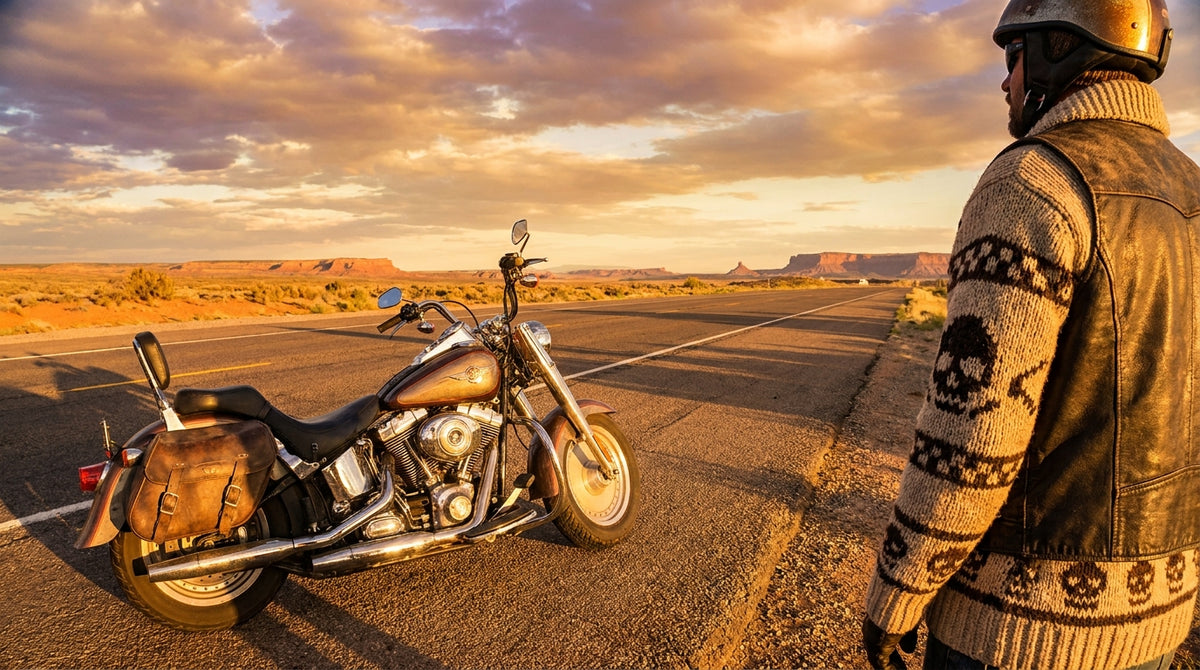
Pull on a cheap knit with a skull on the front and you find the problem in about ten minutes. The pattern is printed, not knitted, so it cracks at the first wash. The body is 100% acrylic at a loose 5 gauge, so it traps sweat under a jacket and holds nothing when the temperature actually drops.
A good skull cardigan is a different garment. The skull is knitted into the structure with a jacquard or intarsia pattern, so it cannot peel. The gauge is tight enough to block wind, and the front opens so you can dump heat at a gas stop instead of wrestling a pullover over your head.
This guide covers what separates the two. You will know how to read knit gauge, which fibers hold shape after 30 washes, how a skull cardigan should actually fit under a riding jacket, and seven styles worth the money. There is a comparison table for fabrics and a list of the five mistakes that waste the most cash.
Knit gauge is the number that decides everything
Gauge is needles per inch on the knitting machine. It is the single most useful spec on a knit, and almost nobody selling one will tell you the number, so you learn to read it by eye.
- 3 to 5 gauge (chunky): thick, visible stitches you can count from across a room. Warm, heavy, and far too bulky to zip a jacket over. Off-bike wear only.
- 7 gauge (mid): the sweet spot for a skull cardigan. Enough density to cut wind, thin enough to layer.
- 12 gauge and finer: a smooth surface where individual stitches almost disappear. Layers beautifully but needs a shell over it below 50°F.
Hold the knit up to a window. If daylight pours through the gaps, it is a fashion piece, not a layer. If the light barely passes, you have something that will hold heat on a 45°F morning ride.
The second tell is how the skull is made. Run a thumbnail over it. A knitted-in jacquard skull has texture and shows a mirrored ghost of the pattern on the inside. A printed skull is smooth and the inside is blank. Printed designs on knit stretch and crack, because the knit moves and the ink does not.

Skull cardigan vs skull sweater: they solve different problems
People search both terms as if they are interchangeable. They are not, and the difference matters more on a bike than it does anywhere else.
A pullover skull sweater is warmer at the same weight because it has no front opening to leak air. It is also all-or-nothing. When you stop for fuel and the sun comes out, your only move is to take it off, which means removing your jacket first in a parking lot.
A cardigan gives you a thermostat. Three buttons open drops your core temperature noticeably without stopping. That is the whole argument, and for anyone who rides in shoulder season it is a strong one. October mornings that start at 42°F and hit 68°F by noon are exactly the conditions a cardigan was built for.
The trade is wind. A button placket is a seam with gaps, so a cardigan on its own is worse in a headwind. Under a jacket that difference disappears completely. If the knit will always live under a shell, take the cardigan. If you want one warm layer for the bar and the bonfire after, take the pullover. Our guide to skull sweaters for women covers the pullover side in more detail.
Fiber content: what survives a real winter
Fiber is where the price differences live, and where most shoppers guess. Here is the honest comparison.
| Fiber | Warmth | Holds shape | Warm when damp | Watch out for |
|---|---|---|---|---|
| Merino wool | Excellent | Excellent | Yes | Price, and moths in storage |
| Wool / acrylic blend | Very good | Good | Partly | Pilling at the cuffs |
| Cotton knit | Moderate | Fair, stretches out | No | Stays cold and wet once soaked |
| 100% acrylic | Fair | Poor after 20 washes | No | Traps sweat, melts under heat |
| Cashmere blend | Very good, very light | Good | Partly | Fragile, pills fast, hates abrasion |
Two things worth knowing. Merino graded finer than about 19.5 micron is the stuff that does not itch on bare skin, and that grading is why merino costs what it does. Acrylic is a plastic, so it will soften and glaze against a hot exhaust pipe or a heated grip rather than just scorching.
People search "skull cashmere cardigan" a lot, and cashmere is genuinely the warmest fiber per gram you can buy. It is also the worst choice for riding. Cashmere fibers are short and smooth, so anything that rubs, a backpack strap, a jacket lining, a seat back, raises pills within a few wears. Save it for off the bike.
A wool-blend knit is the practical answer for most riders. It gets you most of wool's recovery and damp-warmth at a price that does not hurt when it eventually snags.
7 skull cardigan and skull knit styles worth buying
1. The knitted jacquard skull cardigan
This is the benchmark. The skull is built into the knit rather than printed on it, the front buttons, and the mid-gauge body layers under a jacket without bunching at the elbow. If you buy one skull knit this year, buy this shape. It reads as a sweater to people who do not look closely and as a statement to the ones who do.
2. The heavyweight 3D-print skull pullover
All-over print skull pullovers hit a different note. The graphic wraps the whole body instead of sitting as a panel on the chest, which photographs well and works as an outer layer on a mild day. Treat it as a hoodie-weight piece, not a winter layer.

3. The death skull biker pullover
A darker, more aggressive take for riders who want the skull to read from fifty feet. The value here is that heavy graphic pullovers hide road grime far better than a light knit, so it stays presentable through a long weekend on the road.

4. The colorful skull layer
Not everything has to be black. A colorful skull knit solves a real problem, which is that an all-black rider in an all-black jacket is genuinely hard to see at dusk. Color on your torso is cheap visibility that does not look like safety gear.

5. The Santa skull holiday knit
The ugly-sweater category is a real December purchase, and the skull versions sell out first every year. If you ride to a holiday run or a club party, this is the one piece of gear that gets you talked to all night.

6. The skeleton holiday sweater
Same season, drier humor. A full skeleton graphic reads better under bad indoor lighting than a small chest print does, which is the actual test for a party garment.

7. The matching knit skull beanie
A cardigan leaves your neck and head exposed, and that is where most heat leaves. A thin knit beanie fits under a half helmet and finishes the look without adding bulk anywhere that matters. Ours pairs with any of the knits above, and our beanie and knit cap guide covers helmet fit in detail.

Womens skull cardigan fit: the three measurements that matter
"Womens skull cardigan" and "skull cardigan women" are two of the most common ways people search this, and fit is where most of the returns come from. Knitwear sizing is unreliable across brands because knit stretches, so size by measurement instead of by letter.
- Chest, laid flat: take a cardigan you already like, button it, lay it flat, and measure armpit to armpit. Match that number within an inch. This beats any size chart.
- Body length: a cardigan that stops at the natural waist rides up every time you reach for the bars. Look for a back length that clears your hips by at least two inches.
- Sleeve length: arms extend forward on a bike, so a sleeve that hits your wrist standing will sit mid-forearm riding. Add an inch over your normal sleeve length, or buy one with a ribbed cuff that grips.
A ribbed cuff and hem are not decoration. Ribbing is a knit structure that pulls back after it stretches, and it is the reason a good cardigan still has shape at the wrists after a year while a plain-hem one hangs open.
Longer, open-front skull cardigans are the most-searched shape for women right now, and they work over a fitted tee with a vest or on their own. The longer body is also more forgiving on a bike because it stays put when you lean forward.
Layering a skull cardigan for actual riding
The order matters more than the pieces. Three layers, each doing one job.
- Base: a synthetic or merino tee against skin. Never cotton. Cotton holds sweat, and wet cotton against your chest at highway speed is how a 55°F ride starts to feel like 40.
- Mid: the skull cardigan. This is the layer that traps air, and trapped air is what actually keeps you warm.
- Shell: leather or textile to stop the wind. Without it the cardigan is doing maybe a third of its job.
Leave room. A mid layer compressed flat inside a tight jacket has no trapped air left, so it stops insulating. If you are buying a cardigan to ride in, try it on inside the jacket you actually wear and check that you can still pinch loose fabric at the ribs.
One more thing riders get wrong. Button the cardigan before you zip the jacket. An open cardigan bunches into a ridge down your sternum and you will feel it for the next hundred miles.
5 mistakes that waste money on skull knits
- Buying by the photo instead of the fiber tag. The same skull graphic appears on a $19 acrylic knit and a $90 wool one. The photo cannot tell you which is which. The composition label can.
- Machine washing wool on warm. Wool fibers have microscopic scales that lock together with heat and agitation. That is felting, it is permanent, and it is how a large becomes a medium in one cycle. Cold water, gentle, lay flat.
- Hanging a heavy knit. A wet or heavy knit on a hanger stretches under its own weight and the shoulders grow points. Fold knits. Always.
- Sizing up for layering. People buy a size larger to fit over things and end up with sleeves past their knuckles. Buy your measured size and layer thinner underneath instead.
- Treating a knit as a wind layer. Any knit is thousands of small holes by definition. It is insulation, never a shell. Pair it with something windproof or accept being cold.
The pilling question comes up constantly. Pills are normal on any wool blend and are not a defect. They are short fibers working loose from friction. A $12 fabric shaver removes them in five minutes and the garment looks new again. Do not pull them off by hand, because that takes good fiber with them.
Care: making a skull cardigan last five winters
Knitwear fails from washing far more often than from wearing. Most people wash sweaters two or three times more often than they need to.
Wool is naturally odor resistant because the fiber structure does not give bacteria much to hold. Airing a wool cardigan overnight does more than a wash cycle does, and costs nothing. Wash it when it is visibly dirty, not on a schedule.
When you do wash it, cold water and a wool-safe detergent. Regular detergents contain enzymes that break down protein, and wool is protein. Squeeze water out, never wring. Lay flat on a towel and reshape to the measurements you bought.
For storage, fold with cedar rather than mothballs. Clothes moth larvae eat keratin, so they go for wool and cashmere and completely ignore acrylic. Store it clean, because they are drawn to body oils and food residue more than to the wool itself.
Where to start
If you want one skull cardigan that earns its place, get a mid-gauge knitted-in design in a wool blend, sized to your flat chest measurement, in black or charcoal. That single piece works under a jacket in October, over a tee in a bar in December, and still looks right in March.
Skip 100% acrylic unless the budget is genuinely tight, and skip cashmere unless it never goes near a bike. The knitted-in skull is the detail that separates a piece you wear for five years from one that cracks by February.
If you are shopping for one now, the skull knits and sweatshirts collection is where we would start, and it is worth buying before the December run when the good sizes go first.


No comments yet. Be the first rider to weigh in.