
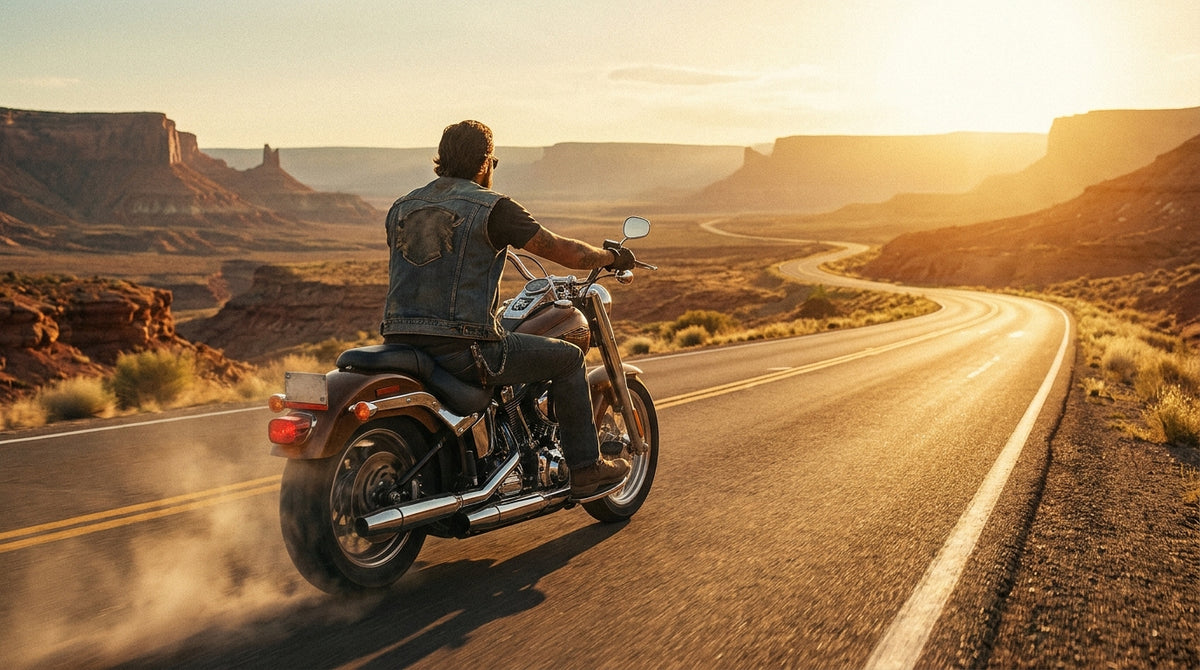
You spent months picking the right bike. You dialed in the exhaust note, swapped the grips, maybe added a custom seat. But the first time you throw on a flimsy denim vest from some random online marketplace, the whole look falls apart. The stitching pops after three rides, the fit bags out at highway speed, and the snap buttons corrode before fall. A denim motorcycle vest should hold up to real miles, not just look good in a parking lot photo.
This guide breaks down what separates a quality denim motorcycle vest from cheap junk. You will learn exactly what oz-weight denim to look for, how club-style vests differ from casual riding cuts, and which specific vests riders trust for long hauls. Every pick here is verified in stock and built by manufacturers with actual biker-gear track records.
Why Riders Pick a Denim Motorcycle Vest Over Leather
Leather vests have been the default for decades, and they still look great. But denim motorcycle vests have carved out a real niche, especially for warm-weather riding and club use. A 14 oz raw denim vest typically weighs 30-40% less than a comparable leather piece. That matters when you are doing 200+ miles on a summer day in Texas or Arizona.
Denim also breaks in differently. Where leather molds to your torso over months, denim softens faster and breathes better from day one. Riders who wear a biker vest over a t-shirt in July know the difference. Denim wicks sweat instead of trapping it.
There is a practical angle too. Denim vests cost less to produce than genuine leather, so the price point sits lower without sacrificing structure. A well-made denim biker vest in the $200-$250 range delivers the same silhouette and patch-ready layout as leather vests twice the price. The tradeoff: denim offers zero abrasion protection in a slide, so it is a style and comfort piece, not armor.
What to Look for in a Quality Denim Biker Vest
Not all denim is the same. Here is what separates a vest that lasts five years from one that falls apart in five months.
- Denim weight: Look for 12 oz minimum. The sweet spot is 14 oz, the same weight Levi's uses for their 501 Shrink-to-Fit jeans. Anything under 10 oz will sag and stretch at highway speed.
- Stitching: Double-needle lockstitch on all stress points (armholes, shoulder seams, pocket edges). Single-stitch construction is a red flag. Check the thread color too. Contrast stitching looks sharp but shows wear faster.
- Hardware: YKK or equivalent brass/nickel snaps and zippers. Cheap zinc-alloy hardware greens up and seizes in rain. Press each snap before you buy. It should click firm, not wobble.
- Patch layout: Club riders need a clean back panel (at least 14" x 11") for a three-piece patch set. Side laces or adjuster straps let you dial fit over layers. Interior pockets should sit flat without printing through the denim.
- Collar style: Mandarin (band) collars sit cleaner under a helmet. Spread collars flap at speed unless you button them. No-collar cuts are gaining ground for a streamlined, modern club look.
5 Best Denim Motorcycle Vests for 2026
These are the vests riders actually buy and re-order. Every one listed here is verified live, in stock, and ships from a real biker gear retailer. No random marketplace listings, no bait-and-switch.
1. 49/51 Men's Denim Motorcycle Vest
The 49/51 is a workhorse. Built by First Manufacturing, it pairs heavyweight denim body panels with leather trim at the collar and armholes. The reinforced shoulder seams handle the weight of a full back patch without sagging. Four exterior snap pockets and two interior concealment pockets round it out. At $217.95, it sits right in that sweet spot where you get genuine quality without the leather-vest price tag. This is the denim motorcycle vest most riders in the ALR community start with.

2. 49/51 No Collar Leather/Canvas Vest
Same 49/51 chassis, but with the collar removed for a cleaner club-style profile. The canvas-and-leather build splits the difference between pure denim and full leather. Canvas panels breathe well in heat, and the leather reinforcements at stress points add durability where it counts. At $249.95, you are paying a small premium over the standard denim cut for that hybrid construction. Riders who want the custom denim vest look without the collar bulk gravitate here.
3. 49/51 Leather/Canvas Vest (Standard Collar)
This is the collared version of the same leather-and-canvas build. The standing collar gives a more traditional biker vest silhouette and blocks some wind at the neck. Same dual-material construction, same concealed carry pockets, same reinforced stitching. If you like the look of a collar on your vest, this is the same quality at the same $249.95 price. The collar snaps down flat when you want it out of the way.
4. 49/51 Wolf Pack Limited Edition
First Manufacturing's limited-run Wolf Pack version adds a custom embossed wolf graphic on the back panel and upgraded antique brass hardware. The base construction is identical to the standard 49/51 canvas/leather, but the finishing details stand out. At $300.95, it is the premium option in the lineup. Worth it if you ride with a crew and want something that does not look like every other vest at the rally. Limited runs tend to sell through and not come back.
5. 12 Gauge Men's Motorcycle Leather Vest
Not denim, but included here as the benchmark comparison. The 12 Gauge is a full-leather build from First Manufacturing, with 1.1-1.2mm cowhide panels and a satin liner. At $320.95, it shows what the top of the vest market looks like. If you want maximum durability and do not mind the weight, leather is still king. But for summer riding, club events, and daily wear, the denim and canvas options above deliver 80% of the durability at 60% of the cost and half the weight.
Denim vs. Leather vs. Canvas: Side-by-Side Comparison
| Feature | Denim (14 oz) | Canvas/Leather Hybrid | Full Leather (1.1mm) |
|---|---|---|---|
| Typical Weight | 1.5 - 2.0 lbs | 2.0 - 2.5 lbs | 3.0 - 4.0 lbs |
| Breathability | High | Medium-High | Low |
| Abrasion Resistance | Low | Medium | High |
| Break-in Period | 1-2 weeks | 2-4 weeks | 1-3 months |
| Price Range | $150 - $250 | $200 - $300 | $250 - $500+ |
| Best For | Summer, club, daily | Year-round, touring | Cold weather, max durability |
| Patch-Friendly | Yes (easy sew-on) | Yes (needs heavy needle) | Yes (needs leather needle) |
How to Customize a Denim Motorcycle Vest with Patches and Pins
One of the biggest reasons riders pick denim over leather is how easy it is to customize. Sewing patches onto 14 oz denim takes a standard sewing machine with a size 16 (100) needle and heavy-duty polyester thread. Leather needs a specialized leather needle, more force, and often a trip to an upholstery shop.
For a three-piece club patch set, position the top rocker 1" below the collar seam, the center patch 1" below that, and the bottom rocker 2" above the hem. Use a fabric chalk pencil to mark placement before you start stitching. Iron-on backing alone will not hold at highway speed. Always sew through both the patch and the vest fabric.
Pins and vest extenders add functionality too. Motorcycle vest extenders clip onto the front snaps and give you 2-4" of extra room, useful when layering over a hoodie in cooler weather. They snap on and off in seconds, so you do not need a separate vest for different seasons.
How to Size a Motorcycle Denim Vest for the Right Fit
Vest sizing trips up a lot of first-time buyers. A denim motorcycle vest should fit snug over a t-shirt but still allow a hoodie or flannel underneath. Here is the sizing method that works:
- Measure your chest at the widest point (around the nipple line, arms relaxed). Use a fabric tape, not a metal one.
- Add 2-4 inches for layering room. If your chest measures 42", order a 44"-46" vest.
- Check the back length. The vest hem should hit at or just below your belt line. Too short and it rides up when you lean forward on the bars. Most men's vests run 26"-29" from collar to hem.
- Try it with your riding position. Sit on the bike (or a chair in riding posture) before you decide. Vests that feel perfect standing up can bind across the shoulders when you are reaching for the bars.
Side laces or elastic side panels solve most fit issues. The 49/51 line uses adjustable side straps that give you about 3" of play in either direction. That means one vest fits across seasons and layers.
5 Common Mistakes When Buying a Denim Motorcycle Vest
- Buying by price alone. A $35 vest from a random marketplace seller uses 6-8 oz denim with single-stitch seams. It will not survive a full riding season. The thread alone on a quality vest costs more than that entire product.
- Ignoring hardware quality. Cheap zinc snaps corrode after a few rides in rain. Look for brass or nickel-plated hardware. YKK zippers are the industry standard for a reason.
- Skipping the fit check in riding position. You do not wear a vest standing upright in a mirror. You wear it leaning forward on a motorcycle. If it binds at the shoulders or rides up at the back when you reach for the bars, it is the wrong size.
- Forgetting about patches. If you plan to sew a club patch, measure the back panel before you buy. A three-piece patch set needs at least 14" wide by 11" tall of clean space. Some vests have seams, pockets, or logos right where your bottom rocker should go.
- Treating it like armor. A denim vest is a style piece and an identity piece. It is not protective riding gear. Pair it with a proper armored jacket underneath if you are doing highway miles.
Where to Start Shopping for a Denim Motorcycle Vest
If you are looking for a denim motorcycle vest that holds up to actual riding, start with manufacturers who specialize in biker gear. First Manufacturing has been building motorcycle-specific vests for over two decades, and their 49/51 line is one of the most re-ordered vest series in the market. The motorcycle vests collection at American Legend Rider carries the full range, from pure denim to leather-canvas hybrids, all verified in stock and ready to ship.
Skip the generic fashion vests. Skip the marketplace listings with stock photos and no real specs. A good denim motorcycle vest is an investment in how you look on the bike and how long your gear lasts. Get one that is built for the road, not the clearance rack.



No comments yet. Be the first rider to weigh in.