
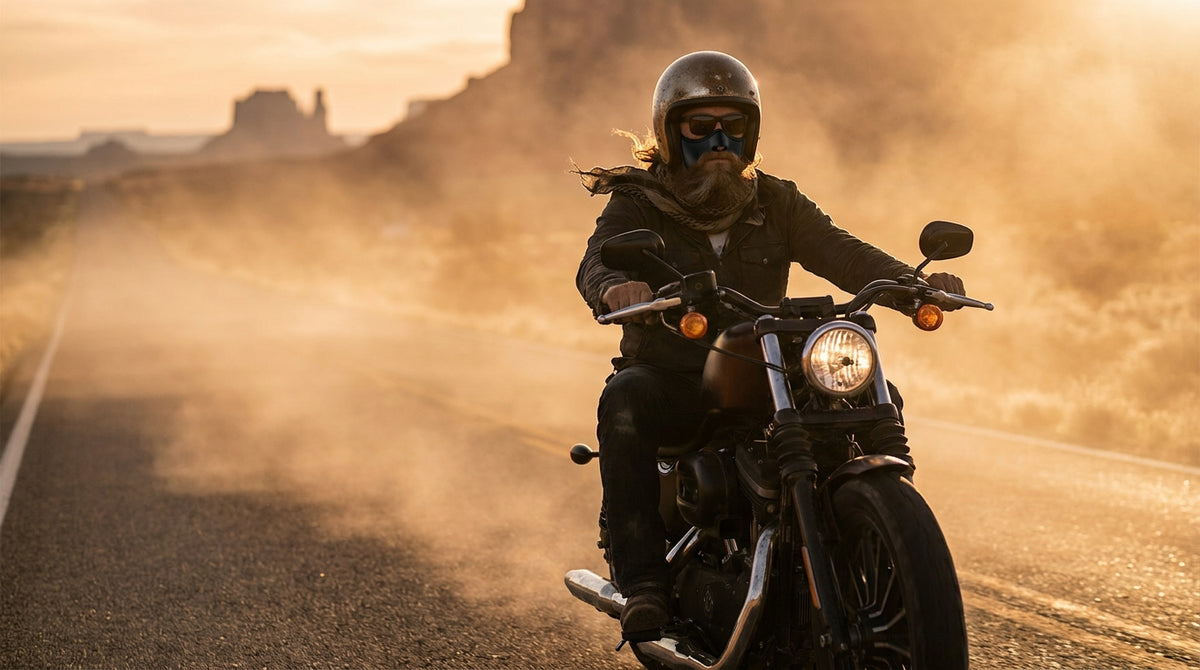
At 60 mph on a 40 degree morning the air hitting your face feels like 25 degrees. That is not a guess, it is what the National Weather Service wind chill chart says, and it is why riders who swear they do not need a face covering still come off the bike with watering eyes and a numb chin. The right motorcycle face covering fixes that in about four seconds of setup.
The problem is the category is a mess. Balaclava, neck gaiter, tube, half mask, full face mask, headwrap. They get sold under the same search term and they are not interchangeable. This guide breaks down what each one actually does, which fabric belongs on which ride, how to stop fogging your visor, and how to pick a motorcycle face covering that still fits under the helmet you already own.
What a motorcycle face covering actually is
Strip out the marketing and there are four shapes. Everything else is a variation on one of them.
- Balaclava: one piece, pulls over the head, covers skull, ears, neck and usually nose and mouth. Eye opening only. Built to live under a helmet.
- Neck gaiter (tube): a stretch fabric tube with no seams, roughly 19 to 21 inches long on most brands. No head coverage unless you pull it up. Converts into a headband, do-rag or half mask.
- Half face mask: covers nose, mouth and chin only, held on by ear loops or a velcro strap. The ALR dual color biker half mask measures 9.4 by 9.8 inches, which is the standard footprint for the style.
- Full face mask: a half mask extended up over the cheeks and back around the head, usually neoprene. Cold weather gear, not a summer item.
Shape decides coverage. Fabric decides comfort. Riders get this backwards constantly and end up with a thermal fleece balaclava in August.
Balaclava: the one that works under any helmet
A balaclava is the only face covering that also solves helmet liner sweat. It sits between your head and the padding, so the fabric takes the salt instead of the foam. That alone extends the usable life of a helmet liner by a season or two, because helmet liners break down from sweat, not miles.
The trade off is layers. A thin lycra balaclava adds roughly 1 to 2 mm of material around your skull. A fleece winter balaclava adds closer to 4 mm, and on a helmet that already fits snug that is enough to turn a comfortable lid into a headache at mile 30. If you ride a tight fitting helmet, buy the thin one and add a gaiter for warmth instead of a thick balaclava.
For three season riding, a breathable lycra balaclava is the default. It wicks, it dries fast, and it pulls down around the neck at a gas stop without coming off your head.

Skull balaclavas and the look
Skull prints are the best selling graphic in this category by a wide margin, and they read very differently depending on shape. A printed skull balaclava under an open face helmet is the classic outlaw silhouette. The same print on a half mask is softer, because your eyes and forehead stay visible. If you want the full effect, go balaclava. If you want to still look approachable at the fuel pump, go half mask.

Neck gaiter: the most useful piece you will own
A motorcycle neck gaiter is a tube of stretch fabric with no seams and no hardware. That sounds basic until you count the configurations. Pulled up over nose and mouth it is a face covering. Pushed down it is a wind collar. Twisted and folded it becomes a beanie, a headband or a helmet liner. One piece, eight or nine usable positions.
Summer is where the gaiter separates itself. Ice silk and cooling polyester gaiters work by evaporation. Sweat moves into the fabric, highway air pulls it out, and the surface against your skin drops a few degrees below ambient. A UPF 50 plus rated gaiter also blocks about 98 percent of UV, which matters more than most riders think on a left arm and left cheek that face the sun all afternoon.
The weakness is wind sealing. A gaiter has no nose bridge and no strap, so at highway speed it slides down. Riders solve this by tucking the top edge under the bottom of their sunglasses or goggles. If you already ride with goggles over a face mask, the gaiter is the easiest piece to combine with them.

Half face mask: wind protection without the sauna
The half face mask is the answer for riders who want their nose and mouth covered and nothing else. Neoprene half masks are typically around 2 mm thick, which is enough to stop wind cold but thin enough that you are not cooking in traffic. Most use a hook and loop rear strap rather than ear loops, because ear loops fight with helmet straps.
Coverage stops at the cheekbone, so your ears stay clear for a Bluetooth headset and your peripheral vision is untouched. This is why half masks dominate on cruisers with half helmets and open face lids. Pair one with a DOT half helmet and you get wind protection without giving up the open air feel that made you buy that helmet.
One practical note. Neoprene traps moisture. On a 90 degree day a neoprene half mask is the wrong call and a mesh or lycra tube is the right one.

Skull half masks worth knowing
ZANheadgear built most of this category, and their neoprene half masks are the reference point for fit. The prints that hold up on the road are the ones where the teeth line up with where your actual mouth sits, so the effect stays convincing when you turn your head. A polyester tube style skull mask like the USA flag Motley Tube does the same job in warm weather, since it breathes where neoprene does not.

Full face neoprene: cold weather only
A full neoprene face mask is the heaviest option in this guide and the most misunderstood. It is not a year round piece. Below about 45 degrees it is excellent, because neoprene is closed cell foam and closed cell foam does not let wind through at all. Above 60 degrees it becomes a steam room in under ten minutes.
Buy one if you ride into November. Do not buy one as your only face covering.

Motorcycle face covering comparison
| Type | Best season | Wind blocking | Fits under full face helmet | Fog risk |
|---|---|---|---|---|
| Lycra balaclava | Spring to fall | Medium | Yes | Medium |
| Fleece balaclava | Winter | High | Tight fit only | High |
| Ice silk neck gaiter | Summer | Low | Yes | Low |
| Neoprene half mask | Fall and spring | High | Poor, made for open face | High |
| Neoprene full mask | Winter | Very high | No | Very high |
| Cotton headwrap or bandana | Summer | Low | Yes | Low |
Read the fog column before the style column. Fogging is the single most common reason a face covering ends up in a saddlebag after two rides.
Fabric decides whether you keep wearing it
Four materials cover almost everything on the market.
- Lycra and spandex blends: thin, stretchy, breathable, dries in minutes. The all rounder. Weak against real cold.
- Neoprene: closed cell, windproof, water resistant. Zero breathability, which is the whole point in winter and the whole problem in summer.
- Microfleece: warm, soft, bulky. Best as a neck and chin layer, worst as a full head layer under a snug helmet.
- Ice silk and cooling polyester: slick, light, evaporative, usually UPF rated. Summer only.
A useful rule: if the fabric feels warm in your hands in the store, it will feel hot at 70 mph in July. Air moving at highway speed does not make a thick fabric breathe.
How to stop your face covering from fogging your visor
Fog happens for one reason. Warm breath escapes upward instead of forward, hits cold plastic and condenses. Every fix is about redirecting that breath.
- Pull the top edge under your glasses or goggles, not over. Fabric on the outside of the lens routes breath straight up the inside of it.
- Pick a covering with a shaped nose panel or a stitched nose seam. A flat tube has nothing to seal against the bridge of your nose.
- Use mesh at the mouth in warm weather. Mesh lets breath exit forward instead of forcing it up.
- Do not layer two coverings over your mouth. Double fabric doubles trapped moisture.
If you ride a full face helmet, a thin lycra balaclava with a low mouth line beats every other option, because the helmet chin curtain is already doing the wind work.
Getting the fit right under a helmet
Try the covering and the helmet together before you commit. A helmet that fits correctly should take firm hand pressure to roll onto your head, and adding a fleece layer changes that meaningfully. Three checks that take one minute:
- Put the covering on, then the helmet. If you have to fight the helmet on, the covering is too thick for that lid.
- Turn your head fully left and right. The covering should stay put. If the helmet turns and the covering does not, the fabric is slipping and it will slip on the road.
- Check the ear area. Any seam or bunched fabric over your ear becomes painful at hour two and will also muffle a Bluetooth speaker.
Most ZANheadgear and Hot Leathers pieces are sold OSFM, one size fits most, which is genuinely fine for tubes and half masks. Balaclavas are where sizing matters, because they have to sit flat under the helmet shell.

Five mistakes riders make buying a face covering
- Buying one covering for all four seasons. Neoprene in July and ice silk in January both fail. Two pieces cost less than one helmet liner replacement and cover the whole year.
- Choosing by print instead of shape. The same skull graphic exists on a tube, a half mask and a balaclava. The shape is what determines whether it stays on at 70 mph.
- Ignoring ear coverage with a half helmet. Half helmets leave ears fully exposed. A half face mask does nothing for them. A balaclava or a pulled up gaiter does.
- Wearing it over the glasses. This is the number one cause of fogged lenses and it is free to fix.
- Buying no name marketplace fabric. Unbranded coverings shed elasticity after a handful of washes, and a stretched out covering slides down over your eyes at speed. Branded headwear from ZANheadgear or Hot Leathers holds its shape through a full season because the fabric weight and the stitching are specified, not guessed.
What to buy for how you actually ride
- Open face or half helmet, spring to fall: neoprene half mask plus sunglasses.
- Full face helmet, any season: thin lycra balaclava.
- Hot weather, long highway days: ice silk cooling neck gaiter, UPF rated.
- Cold weather commuting: fleece or neoprene full face mask plus a windproof balaclava layer if temperatures drop under 35 degrees.
- Dusty back roads: tube plus goggles, since a tube seals better against the lower edge of a goggle frame than a strapped mask does.
If you only buy one piece, make it a convertible tube. It is the cheapest item in the category and the only one that can pretend to be all the others.
Where to start
A motorcycle face covering is a 20 dollar decision that changes how a 300 mile day feels. The gear that keeps working is the gear with a real brand behind the fabric weight and the stitching, not the three pack that arrives in a plastic sleeve with no label. If you are shopping, the motorcycle face mask collection is where I would start, and the balaclava lineup if you ride a full face helmet and want the helmet liner protection too.
Pick the shape for your helmet, the fabric for your season, and keep a second one in the saddlebag. Weather changes faster than you can turn around.
Wind chill figures referenced from the National Weather Service wind chill chart.
No comments yet. Be the first rider to weigh in.