
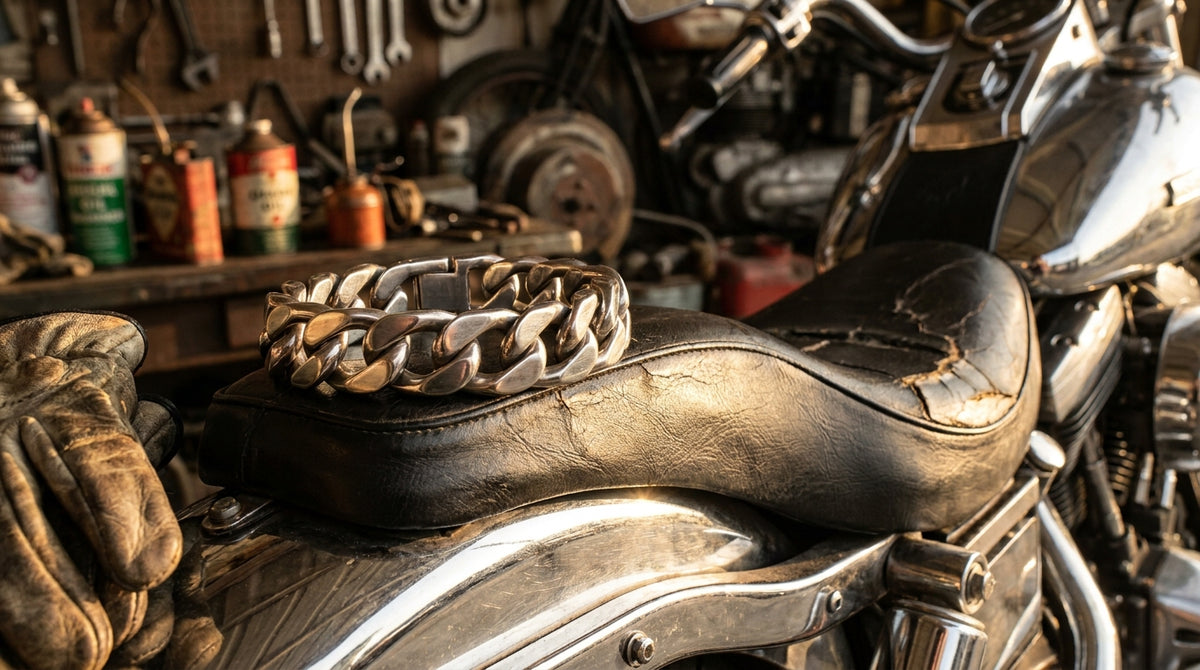
A plated chain bracelet costs about twelve dollars and lasts about two weeks of real riding. Sweat gets under the plating, the brass underneath oxidizes, and the rider ends up with a green wrist and a clasp that pops open at a gas stop. The chain itself almost never breaks. It is the plating, the clasp spring, and the cheap jump ring holding the whole thing together that quit first.
A motorcycle chain bracelet is one of the few pieces of biker jewelry that takes actual abuse: glove cuffs, handlebar grips, rain, chain lube, and 90 degree sun on a tank bag. This guide covers the four things that decide whether one survives that, which is steel grade, link weight, clasp design, and fit. Then seven picks, from a sub twenty dollar everyday chain up to a heavy skull link that reads as a statement piece.
What a Motorcycle Chain Bracelet Actually Is
The style borrows from the drive chain, the part that puts engine power to the rear wheel. A common cruiser drive chain is a 530, which means a 5/8 inch (0.625") pitch between pins and a 3/8 inch inner width. Chain bracelets copy that look at a smaller scale: interlocking flat links with visible pins, usually 12mm to 20mm wide, often finished with a buckle or a box clasp instead of a master link.
Riders searching for bike chain bracelet meaning are usually asking whether it signals anything. It does not carry club affiliation. A chain motif references durability and the mechanical side of riding, nothing more. That matters practically: unlike a three piece patch or a 1%er diamond, a chain bracelet is safe to wear anywhere without implying membership in something you are not part of. If you want the deeper background on which biker symbols do carry weight, we broke that down in what biker jewelry symbols actually mean.
316L vs 304 vs Plated: The Steel Grade Decides Everything
This is the single spec worth checking before anything else. Stainless steel is not one material. The two grades used in jewelry behave very differently once sweat and road salt get involved.
316L contains roughly 2 to 3 percent molybdenum. That addition is what resists chloride pitting, and chloride is exactly what sweat and winter road salt deliver. It is the same grade used in surgical implants and marine hardware, and it releases very little nickel, which is the most common contact allergen in jewelry.
304 has no molybdenum. It still looks like stainless and costs less, and for a bracelet worn to dinner it is fine. Worn daily under a leather glove cuff through a humid summer, 304 will eventually show dull grey pitting along the pin edges where moisture sits.
Plated brass or zinc alloy is the trap. The chrome or rhodium layer is often only a fraction of a micron thick. Once a link edge wears through, the base metal underneath corrodes, and copper salts from brass are what stain skin green. No amount of polishing brings it back, because there is nothing left to polish.
If a listing will not say which grade, treat it as 304 at best. Anything described as stainless steel without a number is usually 201 or 304.
Link Weight and Width: How Heavy Is Too Heavy
Heavy chain bracelets in this category typically run 60 to 120 grams. For reference, a standard AA battery is about 24 grams, so a 110 gram bracelet is roughly four and a half of them on one wrist.
Weight is not just comfort. On a bike it is a snag question. A wide, high profile link sits proud of the wrist and catches on glove gauntlets, throttle grips, and jacket cuff zippers. Riders who wear gauntlet gloves usually end up happier with a lower profile chain.
- 12mm to 14mm wide, 60 to 80g: disappears under a jacket cuff, works with gauntlet gloves.
- 15mm to 18mm wide, 80 to 100g: the sweet spot for most riders. Visible, still practical.
- 19mm and up, 100g plus: a statement piece. Expect it to catch on a glove cuff and to feel it on a four hour ride.
One more practical note. A heavier chain needs more slack to sit right, which changes how you size it. More on that below.
Clasp Types, Ranked by How They Fail
Every lost bracelet has a clasp story. Three designs dominate this category, and they fail in different ways.
Box clasp with a safety latch is the strongest of the three. The tongue snaps into a housing and a hinged latch folds over the top, so it takes two independent failures to open. This is what heavier chains should use, and on a 100 gram bracelet it is not optional.
Fold over toggle or buckle clasp spreads load across a wide hinge instead of one spring. Very hard to pop open by accident. The weak point is the hinge pin, so check that the pin is a solid rivet and not a bent wire.
Lobster clasp is the most common and the weakest for this use. A small internal spring holds it shut, and springs fatigue. Worse, most failures are not the clasp at all but the thin jump ring connecting it to the chain, which is often open wire that spreads under load. On a heavy chain, a lobster clasp is a matter of when, not if.
How to Size a Motorcycle Chain Bracelet
Most adult men measure 7 to 8 inches around the wrist, right below the wrist bone. Wrap a tape measure or a strip of paper there, mark it, and read the flat length.
Then add slack based on the chain weight:
- Light chain, snug fit: wrist + 0.5 inch.
- Medium chain, standard fit: wrist + 0.75 inch. This is the default most riders want.
- Heavy chain, 100g plus: wrist + 1 inch. A heavy chain needs room to rotate and hang, otherwise it pinches on the underside of the wrist every time you roll the throttle.
So a 7.5 inch wrist wanting a medium chain buys an 8.25 inch bracelet. If it only comes in 8 inch or 8.5 inch, size up. A chain that is slightly long can be shortened by removing a link. A chain that is short cannot be fixed.
Wear it on the non throttle wrist if you can. On the right hand it sits directly against the throttle grip and takes more contact wear.
7 Motorcycle Chain Bracelets Worth Wearing
These are pulled from the full biker bracelet lineup, sorted by what each one is actually best at rather than by price.
1. Best Overall: Stainless Steel Motorcycle Chain Bracelet
The straightforward interpretation of the style: flat interlocking links, visible pins, stainless construction, no skulls or charms competing for attention. At $34.95 it sits in the middle of the category, and the mid width link profile is the one that plays best with gloves. If you only own one chain bracelet, this is the shape to own.

2. Best Heavyweight Statement: Heavy Skull Link Bracelet
At $75.95 this is the most substantial piece here and the widest link profile. It reads across a room, which is the point. Two honest caveats: it will catch on a gauntlet glove cuff, and you should size it a full inch over your wrist measurement so the extra mass has somewhere to go. Best worn on the clutch hand.

3. Best Everyday Chain: High Quality Chain Bracelet
$39.95 for a clean chain link with no theme to it. This is the one to wear to work on Tuesday and to a rally on Saturday. Plain chain designs also age better than themed pieces, because there is no detailed relief for grime to collect in and no painted or enameled surface to chip.

4. Best Low Snag Profile: Double Side Snake Chain
Snake chain is built from tightly stacked links that form a smooth, almost continuous tube. That smooth outer surface is the reason to pick it: there are no protruding pin heads or link edges to grab a jacket cuff zipper. At $34.95 it is the best choice for riders in gauntlet gloves or anyone who wears a bracelet under a sleeve most of the year.

5. Best Skull Link: Men's Skull Biker Link Chain
$44.95, and the skulls are worked into the links themselves rather than hung off the chain as charms. That construction detail matters, because a charm dangles, rattles against the tank at idle, and gives a failure point at the attachment ring. Integrated relief links have no such point. Pairs well with a matching biker ring if you want the set.

6. Best Vintage Look: Stainless Vintage Charm Link Bracelet
$34.95 for an aged, darker finish rather than a mirror polish. The practical upside of a brushed or antiqued finish is real: it hides micro scratches. A high polish chain shows every scuff from a handlebar within a month, while a matte finish looks the same at month twelve as it did on day one.

7. Best Budget Pick: High Quality Classic Bracelet
$19.95, and it is the answer to the twelve dollar marketplace chain that started this article. Under twenty dollars you are not getting a 120 gram heavyweight, and that is fine. You are getting stainless instead of plated brass, which is the difference between a bracelet that fades and one that stains your wrist. Good first chain, good second chain to keep in a saddlebag.

Worth a Look: The Leather Alternative
Not everyone wants metal against the wrist in July. A braided leather cuff with a steel accent runs $16.95 and solves two problems steel does not: it does not conduct heat, and it does not clink against a chrome tank. The tradeoff is that leather absorbs sweat and will stiffen if you soak it and let it dry in the sun.

Materials Compared
If you are weighing a motorcycle chain bracelet against the other materials in the category, this is the short version.
| Material | Corrosion Resistance | Typical Weight | Skin Staining Risk | Price Range |
|---|---|---|---|---|
| 316L stainless steel | Excellent, resists salt and sweat | 60 to 120g | Very low, minimal nickel release | $20 to $80 |
| 304 stainless steel | Good, can pit at pin edges | 60 to 120g | Low | $15 to $45 |
| Titanium | Excellent | 25 to 50g | Very low | $60 to $200 |
| Leather with steel accents | Good if kept dry | 20 to 45g | None from the leather | $15 to $40 |
| Plated brass or zinc alloy | Poor, plating wears through | 50 to 100g | High, turns skin green | $5 to $20 |
Titanium is the outlier. It is roughly 45 percent lighter than steel at the same size, which some riders love and others find cheap feeling, because weight is part of why a chain bracelet feels like a chain. We compared the rest of the metal options in which men's biker jewelry lasts on the road.
5 Mistakes Riders Make Buying a Chain Bracelet
1. Buying by photo instead of by weight. A 40 gram chain and a 110 gram chain look nearly identical in a product shot on a white background. If a listing gives a gram weight, that number tells you more about how the piece will feel than any image will.
2. Pairing a heavy chain with a lobster clasp. The clasp is not rated for the mass. Anything over about 80 grams wants a box clasp with a safety latch or a fold over buckle.
3. Sizing to the wrist measurement. A bracelet cut to exactly 7.5 inches on a 7.5 inch wrist does not fit, it binds. Add the slack.
4. Cleaning it with chain lube or degreaser still on your hands. Chain lube carries metal particles from the drive chain, and those particles scratch a polished finish. Solvent based degreasers also attack the adhesive in any glued stone or enamel inlay.
5. Assuming stainless means it cannot rust. Stainless resists rust because of a thin chromium oxide layer on the surface. Park that layer against wet steel, like a chain bracelet left sitting on a damp tool bench overnight, and you can get contact rust transferred onto it.
Keeping the Steel Bright
Stainless needs almost nothing, which is most of its appeal. Warm water, a drop of dish soap, and an old toothbrush along the pin lines takes about two minutes and handles a season of grime. Dry it fully, because water sitting in the link gaps is the one thing that will dull a finish.
Skip ultrasonic cleaners if the piece has any glued inlay, since the vibration works adhesive loose. For a polished chain that has gone hazy, a jewelry polishing cloth restores it. Do not use metal polish compound on a brushed or antiqued finish, because it will cut through the finish and leave shiny patches you cannot undo.
Take it off before you wash the bike. Wheel cleaners are often acidic, and acid is one of the few things that will visibly etch stainless.
The Short Version
Check the steel grade first, because 316L is the only one that shrugs off sweat and road salt indefinitely. Match the clasp to the weight, since a heavy chain on a lobster clasp is a bracelet you will lose. Size to your wrist plus three quarters of an inch, or a full inch if the chain is heavy. Everything after that is taste.
If you are shopping for a motorcycle chain bracelet and want the safe first buy, the mid width stainless chain at $34.95 is the one that fits the most riders and the most situations. The biker bracelets collection is where I would start, and it is worth filtering by weight rather than by design, because the design is the part you will still like in a year either way.


No comments yet. Be the first rider to weigh in.