
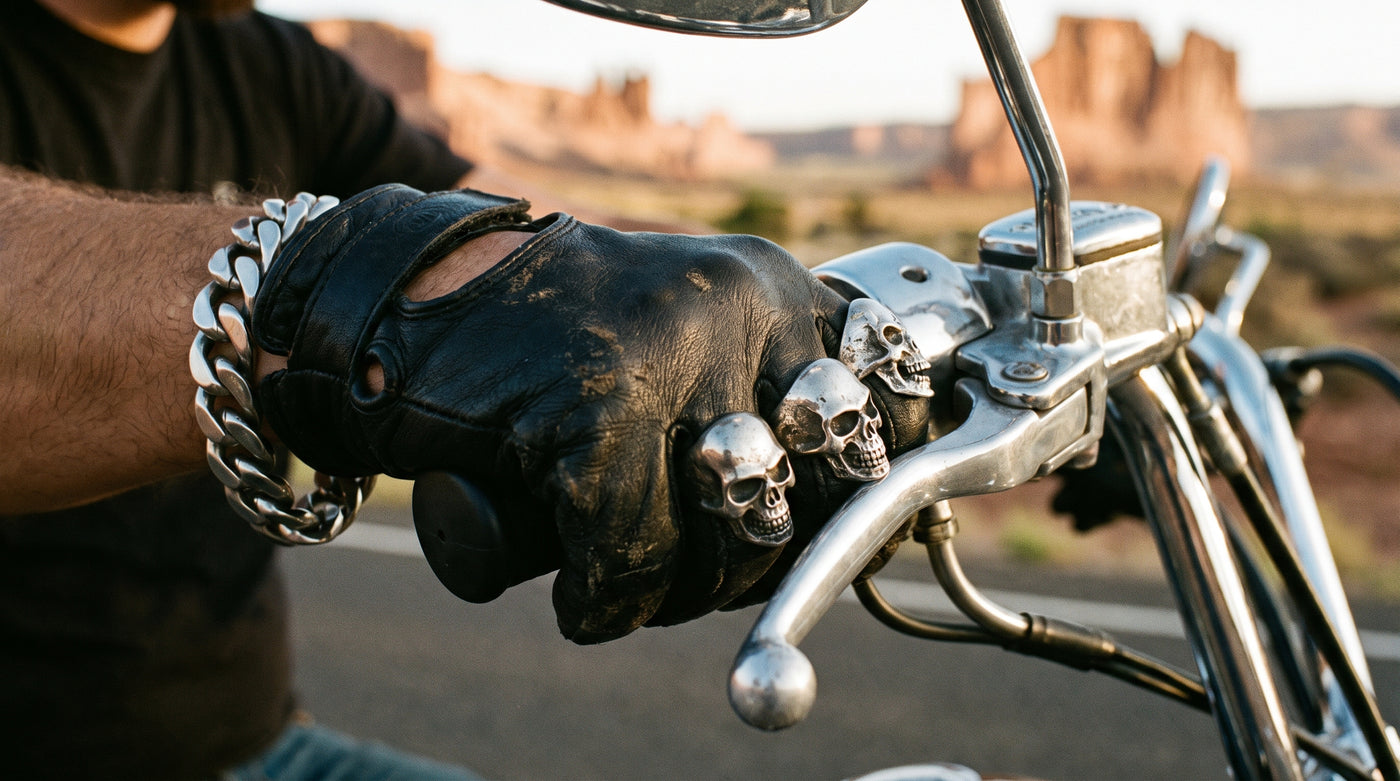
A skull ring on a rider's right hand says more than most people think. In the 1960s, outlaw motorcycle clubs turned surplus military jewelry into identity markers. The Iron Cross came from army surplus shops and flea markets. Skull rings were hand-carved in prison workshops and traded between members like currency. Today those same designs sit in glass cases at fashion boutiques. But the riders who started the trend are still wearing the real thing, and the outlaw biker jewelry they built a culture around still carries weight on every ride.
This guide covers the 7 core outlaw biker jewelry styles, what each symbol actually stands for, which metals survive years of highway riding, and the buying mistakes that waste your money.
What Makes Biker Jewelry "Outlaw" (It Started in Hollister, 1947)
The word "outlaw" in biker culture traces back to the 1947 Hollister motorcycle rally in California, when the AMA declared that 99% of riders were law-abiding citizens. The remaining 1% wore the label like a badge. Their jewelry followed the same attitude: heavy military surplus rings, hand-cast skull pendants, and chain wallets that served a real purpose. At 70 mph on a Panhead, a wallet in a back pocket vibrates right out. A 14-inch steel chain kept it attached to your jeans.
What separates outlaw biker jewelry from generic skull accessories comes down to two things: weight and detail.
A solid 316L stainless steel skull ring weighs 30 to 50 grams. A gas-station novelty ring weighs about 8. You feel the difference the second you pick one up. The other marker is carving depth. Outlaw-era designs feature deep relief work: jawbones with individual teeth, eye sockets with real depth, crossbones with visible texture. Mass-produced copies flatten those details into a smooth blob. If the skull on a ring looks like a cartoon emoji, skip it.
7 Pieces of Outlaw Biker Jewelry Worth Owning
These are the core pieces you will find in any serious rider's collection. Each one has roots in real MC culture, and each one does more than look good on a shelf.
1. The Skull Ring
The skull ring is the single most recognizable piece of biker jewelry on earth. The Hells Angels made it iconic in the early 1960s, but skull rings go back further than that. Victorian mourning rings and military signet rings both used skull motifs centuries earlier. A proper outlaw-style skull ring in 316L stainless steel runs 18 to 25mm wide across the face and weighs at least 30 grams.
Look for deep eye sockets and defined jawlines. The classic outlaw look has teeth individually carved, not just a smooth curve. Avoid rings with rhinestones or colored enamel unless you are going for something deliberately different.

2. The Chain Bracelet
Chain bracelets in MC culture started as practical items. Riders looped heavy-gauge chain around their wrists as emergency repair links. A chain link can substitute for a missing cotter pin on the road, and that tradition stuck. Today, a quality biker chain bracelet uses 8mm to 12mm curb links in polished stainless steel.
The right length for most riders is 8.5 to 9 inches. Shorter than that cuts into your wrist under a glove. Longer catches on the throttle grip. If you ride with gauntlet-style gloves, test the bracelet fit with gloves on before you commit to a size.

3. The Pendant Necklace
Biker pendants fall into three camps: skulls, crosses, and club-specific designs. For independent riders with no club patch, skull and cross pendants are the standard. A good pendant hangs on a 3mm to 5mm ball chain or box chain and sits at mid-chest level, roughly 22 to 24 inches for most riders.
Stay away from thin chains. A 1.5mm chain snaps the first time it catches on a jacket zipper. Go 3mm minimum and use a stainless steel chain rather than plated base metal that greens up after a few weeks of sweat.
4. The Wallet Chain
Wallet chains are the most practical piece of outlaw biker jewelry ever made. At highway speed, a wallet in a back pocket vibrates loose in under 20 minutes. A 12-inch to 18-inch wallet chain ends that problem permanently. The classic style is a byzantine or box chain in brushed steel, and it doubles as a visual statement that reads "rider" from 30 feet away.
The attachment matters more than the chain itself. A lobster claw clasp rated for at least 50 pounds of pull holds strong season after season. Spring-ring clasps bend open within a few months of daily use. Always check the clasp hardware before you check the chain design.
5. The Cross Ring
Iron Cross and Celtic cross rings carry heavy visual weight without the skull's direct association with death imagery. The Iron Cross entered biker culture through WWII surplus. GIs brought them home as trophies, and riders adopted them in the 1950s as symbols of rebellion against mainstream America. Modern versions in 316L steel hold up better than the original zinc alloy military pieces ever did, and they pair well with a skull ring on the opposite hand.
6. The Signet Ring
MC members traditionally wear signet rings engraved with their club's initials or patch design. For independent riders, a blank signet or one with a personal symbol works the same way. It marks identity without claiming false membership. Signet rings look best in US sizes 10 to 13 with a flat face of at least 15mm across. Anything smaller reads more like a class ring than mens biker jewelry.
7. The Cuff Bracelet
Stainless steel or sterling silver cuff bracelets with skull or tribal engraving round out most biker jewelry collections. A 25mm-wide cuff in 316L steel flexes enough to slip over the wrist bone without needing a clasp. No moving parts means nothing to break on the road. And unlike chain bracelets, cuffs sit flat against the skin inside a riding glove, so they never catch or snag.
What the Symbols on Outlaw Biker Rings Mean
Every symbol in MC jewelry carries a specific meaning. Some date back centuries. Others were created by clubs in the postwar era. Here is what the most common ones stand for:
| Symbol | Origin | What It Signals |
|---|---|---|
| Skull | Victorian mourning jewelry | Mortality, fearlessness, "live fast" mindset |
| Iron Cross | WWII German military surplus | Rebellion against the mainstream |
| 1% Diamond | AMA's 1947 Hollister statement | Outlaw club membership (earned, not bought) |
| Snake / Serpent | Ancient mythology | Cunning, danger, "don't tread on me" |
| Grim Reaper | Medieval European art | Acceptance of risk, no fear of death |
| Eagle | American military heritage | Patriotism, freedom, the open road |
| Fleur-de-lis | French heraldry | Honor and loyalty between riders |
One important note about the 1% diamond: wearing a 1%er ring or patch without actual club membership creates real problems. Legitimate outlaw MCs treat it as stolen valor. If you are not patched in, stick with skulls, crosses, and eagles. Those designs belong to the broader biker community, not to any single club.
316L Stainless Steel vs Sterling Silver: Which Metal Survives Riding
This is the single most important material decision when buying outlaw biker jewelry. Both metals work, but they behave very differently after thousands of highway miles.
| Factor | 316L Stainless Steel | Sterling Silver (925) |
|---|---|---|
| Weight | Heavy, 30 to 50g per ring | Medium, 20 to 35g |
| Rain and sweat | Zero corrosion | Tarnishes over time |
| Scratch resistance | High, keeps polish for years | Low, scratches within months |
| Price (ring) | $15 to $45 | $60 to $200+ |
| Skin reaction | Hypoallergenic | Safe for most riders |
| Maintenance | Wipe with a cloth | Polish every few weeks |
For daily riding, 316L stainless steel wins on every practical measure. Sterling silver looks incredible when freshly polished, but highway grit and rain dull it fast. If you ride three or more days a week, go with steel. Save the silver for rally nights and events where you want that bright flash.
5 Mistakes Riders Make Buying Biker Jewelry Online
1. Buying by photo instead of weight. Online jewelry photos hide the biggest quality gap: mass. A 12-gram ring and a 40-gram ring can look identical in a product listing. Always check the listed weight. Under 20 grams for a skull ring means it is hollow or thin-walled, and it will feel like a toy on your hand.
2. Ignoring ring width for glove fit. A 28mm-wide ring face will not slide under most riding gloves. If you wear gloves on every ride (and you should), keep the ring face at 20mm or narrower. Or size up half a size to account for the compression.
3. Choosing plated metal over solid. Gold-plated or chrome-plated biker rings peel within weeks of regular riding. The plating breaks down under vibration, sweat, and UV exposure combined. Solid stainless steel costs the same as plated fashion rings and lasts years longer. If a listing does not specify "solid 316L" or "solid sterling silver," assume it is plated.
4. Wearing club-specific symbols without affiliation. The 1%er diamond, specific club logos, and chapter-specific designs are earned through membership, not purchased off a shelf. Wearing them as fashion accessories invites confrontations that no piece of jewelry is worth. Stick with community-wide symbols like skulls and crosses.
5. Buying from sellers with no return policy. Ring sizing for wide-band biker rings is tricky. The band width affects fit differently than a standard 6mm wedding band. You may need to go up a full US size. Always buy from a store that offers free exchanges. A ring sitting in a drawer because it does not fit is money wasted.
How to Size an Outlaw Biker Ring (Wide Bands Fit Different)
Standard jewelry sizing charts assume a narrow band. A ring with a 20mm face fits tighter than a standard 6mm wedding band in the same listed size. The general rule: go up one full US size for rings wider than 15mm. If you normally wear a size 10, order an 11 in a wide skull ring.
Temperature matters too. Your fingers swell in summer heat and shrink in cold weather. If you are ordering during winter, size for summer fit. A ring that slides off at 95 degrees on a July ride is worse than one that feels slightly snug in January.
The simplest way to measure: wrap a strip of paper around the base of your ring finger at the end of the day (when fingers are widest). Mark where it overlaps, measure the length in millimeters, and divide by 3.14 to get diameter. Match that to a US ring size chart. Or walk into any jewelry store and use their sizing mandrel for free.
Outlaw biker jewelry has been part of riding culture for over 70 years. The best pieces today are better built than anything from the original MC era: solid 316L steel, deep relief carving, and a weight you can actually feel on your hand. If you are building a collection or filling a gap, the biker rings at American Legend Rider ship with full specs and hassle-free size exchanges.
No comments yet. Be the first rider to weigh in.