
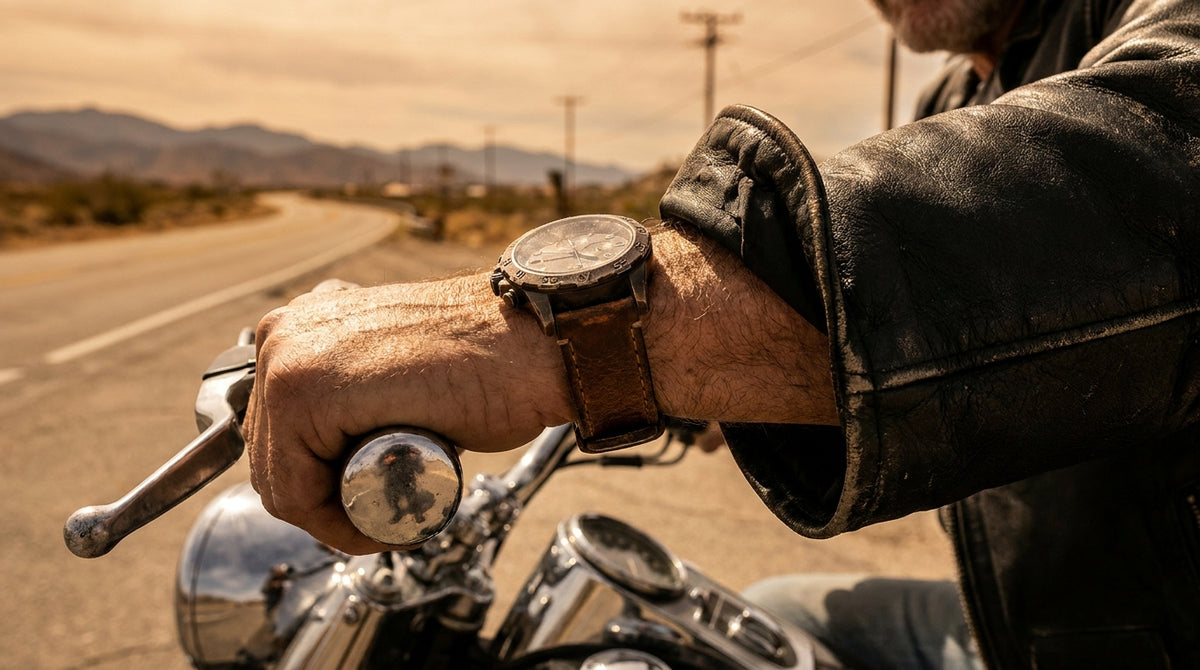
Most watches die on a motorcycle for one boring reason. The rider never takes it off. Eight hours of handlebar buzz goes straight up the forearm and into a movement designed for a desk. A Harley Milwaukee-Eight 114 puts out 122 lb-ft of torque, and the vibration that comes with that twin is relentless at highway speed. Pair it with a 42mm steel case strapped tight over a jacket cuff and something eventually gives: the crown, the pins, or the strap.
Good biker watches are built around that abuse instead of ignoring it. This guide covers the five things that decide whether a watch survives: movement type, case size, strap, water rating and legibility behind a tinted visor. By the end you will know exactly which spec to check before you buy, and which numbers are marketing noise.
Why biker watches take abuse a desk watch never sees
A wrist on a handlebar is a vibration path. Engine pulses travel through the bars, into the grips, through the glove and into the case. On a big twin cruising at 3,000 rpm that is roughly 25 pulses per second hitting the movement, hour after hour.
Three failure points show up again and again:
- Spring bars. The 1.78mm pins that hold the strap to the case are the cheapest part of the watch and the first to let go. A lost watch at 70 mph is gone for good.
- Crown and pushers. A screw-down crown stays put. A push-pull crown can creep out against a jacket cuff and open the case to water.
- Crystal edges. Mineral glass chips when a bar-end or a mirror stem catches it while you wheel the bike into the garage.
None of that has anything to do with how the watch looks, which is why the best watches for motorcycle riders tend to be plain, thick and slightly overbuilt.
Quartz or automatic: what actually survives the ride
This is the first real decision, and the honest answer is that quartz wins on a bike more often than riders want to admit.
A standard quartz movement runs to about 15 seconds per month and has one moving part under power, the stepper motor. An entry-level automatic like Seiko's old 7S26 is rated from minus 20 to plus 40 seconds per day, and it keeps time using a weighted rotor that spins every time your wrist moves. Constant one-direction handlebar vibration is not what that rotor was designed for.
| Movement | Typical accuracy | On a motorcycle | Service interval |
|---|---|---|---|
| Quartz | ±15 sec / month | Best choice. No rotor, shrugs off buzz | Battery every 2 to 5 years |
| Automatic | -20 to +40 sec / day | Works, but gains error and wears faster | Full service every 5 to 7 years |
| Hand-wound mechanical | -20 to +40 sec / day | Weakest. Fine balance, no shock bracing on cheap calibers | Every 5 years |
| Solar quartz | ±15 sec / month | Excellent. No battery swaps, no rotor | Capacitor at roughly 10 years |
If you want a mechanical watch anyway, look for a movement with shock protection on the balance staff. Nearly every modern Swiss and Japanese caliber has it, but the no-name movements inside marketplace knockoffs often do not.
Case size and cuff clearance: the fit most riders get wrong
Buy a biker watch the way you buy a helmet. Measure first.
The sweet spot for riding is a case 40mm to 44mm wide and under 13mm thick. Anything thicker starts fighting a leather jacket sleeve, and a 48mm slab will not slide under a gauntlet glove cuff at all. That matters in October when you are stopping every hour to pull gloves on and off.
Wrist size sets the ceiling. On a 7 inch wrist a 44mm case sits edge to edge with no lug overhang, which is exactly where you want it. Go wider and the lugs catch on the sleeve every time your arm comes off the bars.
Two measurements people skip:
- Lug-to-lug length. Keep it under 50mm. This, not case diameter, decides whether the watch sits flat or tips when you lean on the tank.
- Lug width. 20mm and 22mm are the standards. Both mean cheap, instant strap replacements for years. An odd 19mm or 23mm lug locks you into one supplier.
Straps: leather, steel or silicone
The strap is the part you will replace, so pick the material you actually ride in.
Leather is the classic biker wrist watch look and the most comfortable in cold weather, because it does not pull heat out of your skin the way a steel bracelet does. The tradeoff is rain. Untreated vegetable-tanned leather darkens and stiffens after two or three soakings. A pin buckle with a single sturdy tang beats a deployant clasp here, since there is less hardware to rattle loose.
Stainless steel survives everything and cleans up with soap and water, which is why it dominates on adventure bikes. Watch for pinching: a folded-link bracelet can grab arm hair when it flexes, and that gets old fast on a 300 mile day.
Silicone or rubber is the no-drama option. It sheds rain, wipes clean after a chain lube job and costs about $15 to replace. It just reads sporty rather than classic, which is why fewer cruiser riders choose it.
Same logic as picking gloves: material decides comfort long before the branding does. Our guide to leather motorcycle gloves walks through the same break-in question for the leather on your hands.
Water resistance ratings, decoded
This is where watch marketing misleads riders the most. The depth number on the dial is a pressure rating from a static lab test, not a promise about swimming. The standard behind it is ISO 22810.
| Marking | Depth | What it really handles on a bike |
|---|---|---|
| 3 ATM | 30 m | Hand washing and light drizzle. Not a rainstorm |
| 5 ATM | 50 m | Steady rain and washing the bike |
| 10 ATM | 100 m | Anything weather throws at you. The practical minimum for riding |
| 20 ATM | 200 m | Overkill for a road bike, useful if you also swim or dive |
Target 10 ATM. A 3 ATM watch that spends two hours in highway rain at 65 mph is being pushed well past its lab rating, because moving water multiplies the pressure on the gaskets. One soaked movement costs more to repair than the step up to 100 m would have cost you.
Legibility behind a tinted visor
At 70 mph you get a glance, not a reading. Design decides whether that glance works.
What helps: high contrast, wide hands, big applied numerals, and lume that is actually charged. Luminous paint such as Super-LumiNova is photoluminescent, so it needs daylight before it glows and it fades over a few hours. Tritium gas tubes glow on their own for 10 to 25 years as the gas decays, which is why they show up on military-style watches.
What hurts: dense chronograph subdials, date windows smaller than 2mm, and a polished bezel that throws sunlight straight into your eyes. A skeleton dial looks incredible parked at the bar and is the hardest thing on earth to read through a smoked visor, so treat it as a style pick rather than a riding tool.

Handlebar clocks versus a biker wrist watch
Plenty of riders search for a handlebar watch or a bike watch motorcycle clock instead, and for good reason. Checking a bar-mounted clock never means taking a hand off the grip.
Bar-mount clocks clamp to the two standard sizes, 7/8 inch (22mm) and 1 inch (25.4mm), with adapters for the 1.25 inch fat bars on bagger builds. Most are quartz and sealed, so weather is not an issue.
The honest comparison:
- Handlebar clock. Readable without moving your hand, cheap, and it only tells time when you are on the bike. Vibration also kills bar-mounted units faster than wrist units, because they are bolted rigidly to the frame instead of cushioned by your arm.
- Wrist watch. Works at the gas station, at dinner and at work. Doubles as the one piece of jewelry most riders will actually wear every day.
If you ride a lot and travel light, the wrist watch is the better single purchase. If your bike is already loaded with gauges and you just want a glanceable clock, the bar mount does the job for less than $30.
Biker watch styles and who they suit
Style still matters, because a watch you do not like wearing ends up in a drawer. Four looks cover nearly all biker watches for men:
- Retro punk leather. Aged leather strap, antiqued case, roman or skeleton dial. Suits cruisers and classic builds. Dress it up or down.
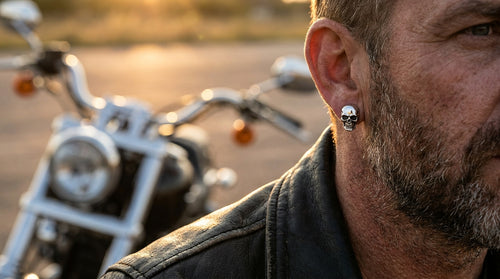
- Skull and gothic. Sculpted skull cases, chain-link straps, blackened steel. This is the loudest option and reads best alongside other biker jewelry like rings and chains.
- Field and military. 38mm to 42mm, matte case, big numerals, canvas or leather strap. The most legible category and the easiest to wear under a work sleeve.
- Industrial skeleton. Exposed gears, transparent dial, steel case. Pure conversation piece. Poor legibility, high impact.
Pick the look you want first, then filter by the specs above. A beautiful 3 ATM watch is still a beautiful watch you cannot ride in the rain.
5 mistakes riders make buying biker watches
- Buying by case diameter alone. A 44mm case with 52mm lug-to-lug overhangs a 7 inch wrist and snags every sleeve. Lug-to-lug is the measurement that decides fit.
- Trusting a 30 m rating in the rain. 3 ATM is a splash rating. Highway rain pushes water at the gaskets with real force, and the movement is what pays.
- Skipping the spring bar upgrade. Stock pins are the weak link. Fat spring bars or a screw-bar strap system cost a few dollars and stop a watch from launching off your wrist.
- Wearing it over the jacket cuff. It looks tough and it is the fastest way to crack a crystal, because the case is now the outermost thing on your arm.
- Buying a no-name marketplace copy. No stated water rating, no movement maker, no warranty and no parts. A real watch with a known quartz movement and a 100 m rating lasts a decade. A $12 lookalike with unknown internals is a season.
What to buy
If you only remember one line from this guide: quartz, 42mm or under, 10 ATM, 22mm lug width, and a strap you can replace in two minutes. That combination covers rain, vibration, gloves and years of daily wear, and it rules out almost every watch that fails on a bike.
Leather for cruiser style and cold-weather comfort. Steel or silicone if you ride in all weather and want zero maintenance. Then let the dial be as loud as you want it.
If you are shopping for one, the premium rider gear collection is where I would start, and the biker rings range is worth a look if you want the watch and the rest of the hand to match. Buy the one built to last, wear it every day, and replace the strap instead of the watch.

No comments yet. Be the first rider to weigh in.