
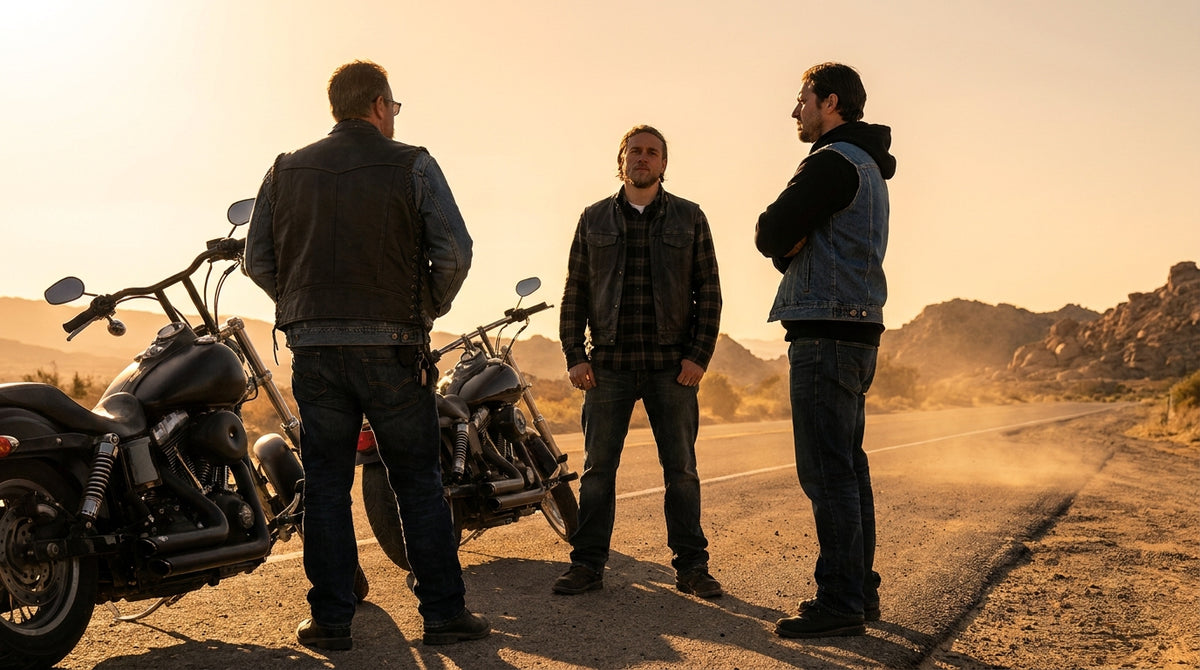
Most riders buy a vest one size too big, then spend every ride tugging it back down at stoplights. The second mistake costs more: a thin split-leather cut that goes shiny and cracked after one summer, so the patches you paid to sew on get retired with it. A vest is sized gear, not a loose layer, and the material decides whether you keep it three years or three months.
This is a buying guide to the best motorcycle vests you can actually get on your back right now, sorted by job: club cut for patches, denim for summer, textile for pockets, cowhide for the long haul. Every pick below is a live vest with a real price and a real size range, from S to 8XL and chest sizes 40 through 60. You will walk away knowing which material fits your riding, how to size it so it sits flat at speed, and where patches go.
How these picks were judged
Four things separate a vest that lasts from one that does not, and none of them show up in a product photo.
- Hide and weave. Premium cowhide and buffalo hold their shape for years. Bonded or split leather with a heavy top coat looks identical on day one and cracks at the shoulder seam first.
- Back panel. A club cut has a clean, unbroken back with no center seam, so a three-piece patch set sits flat. Fashion vests put a seam or a zip straight through it.
- Closure. Snaps alone gap at highway speed. Snap-over-zipper stays shut at 75 mph and blocks the wind that gets under a vest and balloons it.
- Size range. A vest line that stops at 2XL was built for a mannequin. The picks here run to 5XL, 6XL and in two cases 8XL.
Price is not the tiebreaker, but it is worth knowing the honest spread. Solid club vests start near $70 and run to about $115. A USA-cut premium piece like the 12 Gauge leather vest sits at $320.95, and that gap is almost all hide quality and construction, not branding.
Leather, denim or textile: pick the material first
Choose the material for the riding you actually do, then choose the style. A rider doing 95F July miles in a heavy cowhide cut will leave it at home, and a vest in the closet protects nothing.
| Material | Best for | Patch-friendly | Typical sizing | Watch out for |
|---|---|---|---|---|
| Premium cowhide leather | All-season riding, club colors, abrasion | Yes, clean club back | S to 5XL or chest 40 to 58 | Split or bonded leather sold as genuine |
| Buffalo leather | Heavier wear, pebbled look that hides scuffs | Yes | S to 4XL | Breaks in slower than cowhide |
| Denim | Hot weather, graphic backs, everyday wear | Yes, sews easily | S to 8XL | Lightweight denim frays at the armhole |
| Textile and canvas | Pockets, conceal carry, wet climates | Yes, patch-holder panels | S to 8XL | Thin shells with no leather reinforcement |
| Reflective textile | Night and commuter visibility | Limited back space | S to 4XL | Reflective print wears off in the wash |
If you ride year round in one vest, leather wins. If you ride summer evenings and want a back graphic, denim wins, and our guide to picking a denim motorcycle vest covers the weave details. Browse the full lineup in men's motorcycle vests once you know the material you want.
The 12 best motorcycle vests right now
Each pick below is here for one specific job. Read the job, not the ranking.
1. Vance SOA club style leather vest with side laces, best overall
This is the default club cut: black leather, plain unbroken back, side laces that let you take in or let out roughly two inches without a tailor. At $70.95 across S through 5XL it is the cheapest honest leather club vest on this list, which matters because most riders sew patches on the first vest they buy and then regret the base. The side laces also let it fit over a hoodie in October and cinch down over a tee in June.

2. Vance textile patch holder vest, best for patches
Built for one purpose: holding colors. The back panel is a flat patch-holder surface with no seam running through it, so a top rocker, center patch and bottom rocker all sit level. It is sized by chest measurement from 40 to 60 instead of S to 5XL, which is the more accurate way to buy a vest you will sew into. Price runs $95.95 to $101.95 depending on size.

3. Blue denim SOA club vest with leather trims, best denim
Denim body with leather trim on the collar and front panels, so it breathes in summer but does not look like a cut-off jacket. The reason it is on the list: sizing goes S all the way to 8XL, the widest range of any vest here, and the leather trim stops the front edges from curling the way plain denim does. $95.95 to $104.95.

4. Premium black textile 10 pocket vest, best conceal carry
Ten pockets, two of them dual conceal carry pockets with ambidextrous access, which is the detail most CCW vests get wrong by putting one pocket on one side only. The textile shell wipes clean after a wet ride and also runs to 8XL. $85.95 to $91.95. If carrying is the main reason you want a vest, read the conceal carry motorcycle vest guide before you pick a size, because a loose vest prints.

5. Vance heavy duty textile club vest with leather accents, best all-rounder
The compromise pick, and a good one. Heavy duty textile body for breathability, leather accents at the wear points, and both snaps and a zipper so it stays flat at speed. Sizes run M to 5XL at $99.95 to $102.95. This is the vest to buy if you want one that works in 90F and in 45F over a flannel.

6. ALR denim vest, Native Skull graphic, best back graphic
For riders who want the back to say something without sewing a single patch. The Native Skull graphic is printed on the panel, so there is nothing to re-sew after a wash and nothing to catch wind. At $164.95 it is the priciest denim piece here and it runs M to 6XL. The honest tradeoff: a printed graphic means that back is spoken for, so this is a second vest, not your colors vest.

7. Vance blue denim collarless vest, best for layering
Collarless is the detail to look for if you ride in a full-face helmet or wear a neck tube. A standing collar pushes into the helmet base every time you check your mirrors, and after 200 miles you notice. This one is $95.95 to $98.95 in S through 5XL and sits flat under a jacket collar too.

8. Vance gambler style premium cowhide vest, best western cut
Gambler cut means a wider, pointed western collar and a straight bottom hem, and in premium cowhide it is the vest that still looks right off the bike. Chest sizing 40 to 58 at $105.95 to $111.95. Premium cowhide is the part worth paying for here: it softens and takes the shape of your shoulders instead of staying board-stiff like a coated split hide.

9. Vance bulletproof style leather vest, best value leather
The bulletproof style is a tactical silhouette with a squared front and a high closure, and this is the only vest on the list that starts at XS and still reaches 5XL, which makes it the pick for smaller-framed riders who keep ending up in a vest that hangs. One price across every size: $70.95.

10. Women's premium cowhide vest with white stitching, best women's leather
Cut for a woman's frame rather than a small men's vest relabeled, with contrast white stitching along the panels. Premium cowhide, sizes S to 4XL, $110.95 to $113.95. The shaped side panels are the functional part: they stop the hem from flaring out in the wind, which is the usual complaint about unisex vests.

11. Vance textile vest with reflective skull, best for night riding
The skull on the back is reflective, so a vest that reads as plain black in daylight lights up in headlights behind you. $84.95 in S through 4XL. This is the commuter pick. If most of your miles are after dark, visibility on the back panel does more for you than another leather cut, and there are more options in textile vests.

12. Grey denim collarless club vest with conceal carry pockets, best budget CCW
Conceal carry pockets in a denim body at $85.95, S to 5XL, collarless so it clears a helmet. Grey denim is also the most forgiving color for patches, because white and red thread both read clearly against it where black-on-black disappears.

How to size a motorcycle vest so it sits flat
Vest sizing splits into two systems and mixing them up is the single most common ordering mistake. Letter sizes like L or 3XL are cut off a shirt size. Number sizes like 44 or 52 are the chest measurement in inches, and a 44 is roughly a large.
- Measure your chest at the fullest point, over the shirt you normally ride in, with the tape level under your arms.
- Add nothing for leather. It stretches. Add 2 inches only if you plan to ride over a hoodie all winter.
- Check that it closes. It should snap shut with no gap and no pull line across the chest. A vest that only looks right unsnapped is too small.
- Check the armhole. Reach forward to the bars. If the armhole bites, size up one, because that is the point that never breaks in.
If you are between sizes or the chest is snug but the shoulders fit, vest extenders solve it instead of a return. A set like the Aces and Eights extenders runs $57.95 and adds a couple of inches across the front without touching the fit of the back panel. Our biker vest sizing guide walks through the measurements with numbers.

Patches: what goes where
Patch placement has rules, and they are not decoration rules. On a club back the top rocker sits highest, the center patch sits in the middle of the back panel, and the bottom rocker sits lowest, and the three-piece set together is reserved for members of a chartered club. Independent riders wear a single center patch or a one-piece back and stay clear of trouble.
Practical points worth knowing before you sew:
- Front left chest is for a name tag or small patch. Front right is usually left for club position.
- Sew, do not iron. Iron-on glue fails in summer heat and the patch lifts at the corners.
- Sew before you wear it in. A broken-in leather panel pulls differently and the patch goes on crooked.
- Buy the vest for the patches, not the other way round. A seamed or heavily zipped back panel limits what you can add later.
The full breakdown is in our motorcycle vest patch placement guide.
5 mistakes that ruin a vest buy
- Buying a size up to be safe. A loose vest lifts off your back at 60 mph and flaps. Leather gives about half a size on its own, so the snug one is the right one.
- Taking genuine leather at face value. Split and bonded leather are both technically genuine. Look for premium cowhide or buffalo named outright, which is why the cowhide picks above cost $105 and up rather than $40.
- Snaps only, no zipper. Snap-only fronts gap in wind and the gap is where cold air gets in. Snap over zipper is the fix.
- Ironing patches on. The adhesive softens in direct sun on a parked bike and the corners curl inside a month.
- Treating a vest as armor. A vest covers your torso and nothing else. It is style, wind blocking and abrasion on one panel, not a substitute for a DOT helmet and a real jacket.
Where to buy, and what to avoid
The gear worth owning is named: premium cowhide or buffalo hide, heavy duty textile with leather reinforcement, size ranges that go past 2XL, and a size guide per product. A $45 no-name marketplace vest usually lists no hide grade at all, which is the tell, and there is no size guide to check before you sew $60 of patches onto it.
Budget synthetic vests are not worthless. If you ride a handful of weekends a year and want the look, a textile or PU vest does the job for a season. Just buy it knowing that the shell will crease at the shoulders and the patches will outlive it.
The best motorcycle vests all come down to the same two decisions. If you are shopping now, the men's motorcycle vest collection is where I would start, filtered by material first and size second. Pick the hide, measure your chest once, and you end up with the one vest you actually keep wearing.

No comments yet. Be the first rider to weigh in.