
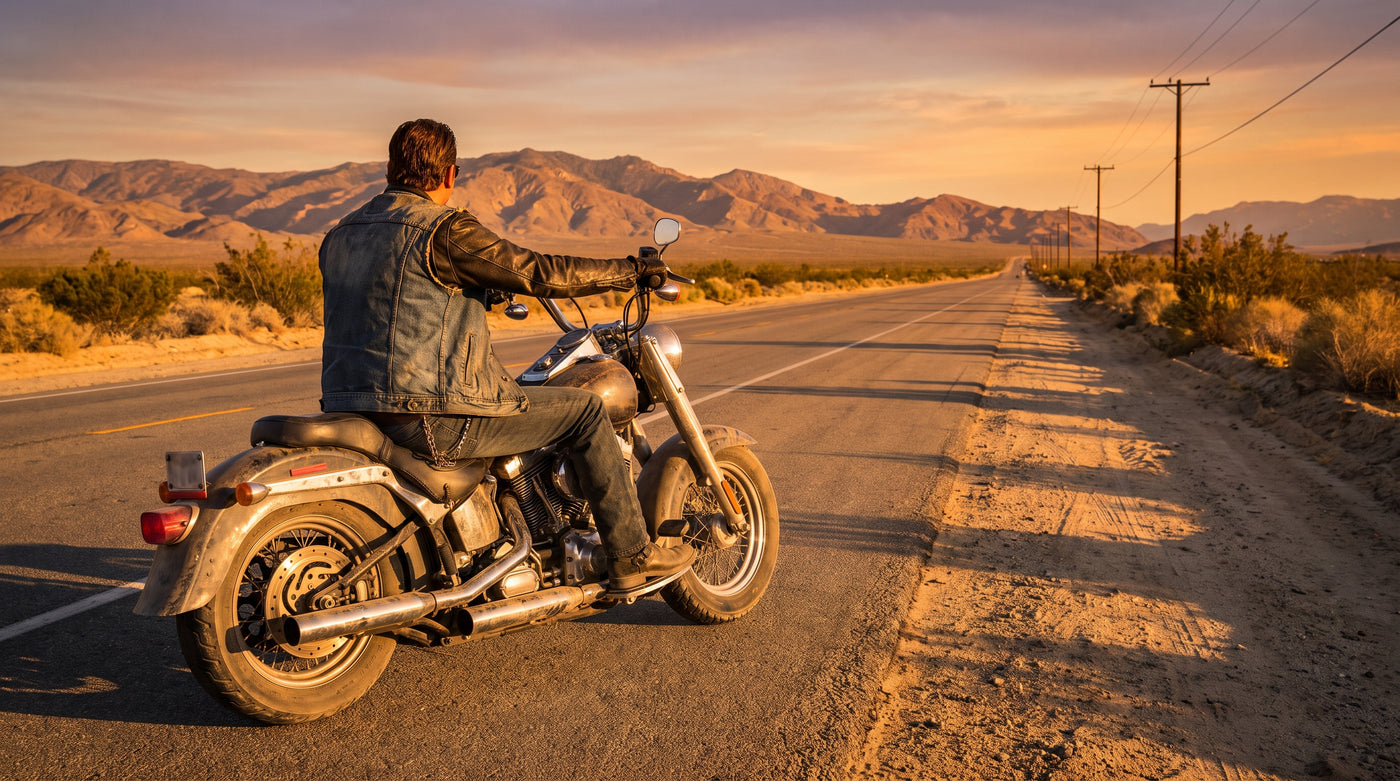
A cheap denim motorcycle vest starts falling apart around month three. The stitching pops at the armholes, the snap closures bend out of shape, and the whole thing fades to a washed-out gray after a handful of rides in summer sun. Meanwhile, a well-made denim vest breaks in like a good pair of boots and looks better with every season on the road. The difference between these two outcomes comes down to about five details most buyers never check before ordering.
This guide covers everything you need to pick a denim motorcycle vest that holds up on real rides and real roads. You'll learn what denim weight and weave to look for, whether armor inserts make sense for your style of riding, how to set up a custom cut for club patches, and where denim actually stacks up against leather for daily use. No filler here. Just the stuff that matters when you're about to spend your money on gear you'll wear for years.
What Makes a Denim Motorcycle Vest Worth Buying
Denim weight is measured in ounces per square yard, and it's the single biggest indicator of how long a vest will last. For a motorcycle denim vest that sees regular use, 12 to 14 oz is the sweet spot. Anything under 10 oz is fashion-grade denim, the same stuff used in lightweight summer shirts. It wears thin at friction points within weeks of regular riding and starts looking tired by fall.
Wrangler's 13.75 oz "Cowboy Cut" denim set the durability standard decades ago. Good motorcycle vests use a similar weight range, typically ring-spun or selvedge cotton. Ring-spun denim is smoother and stronger than open-end spun because the fibers are twisted tighter before weaving, creating a denser, more abrasion-resistant fabric.
Beyond weight, check three things before buying:
- Stitching: Double or triple rows at the shoulders, armholes, and pocket corners. Single-stitch vests pop under load, especially where the vest flexes during riding.
- Hardware: YKK zippers or solid brass snaps. Avoid plastic snap backs and zinc-alloy closures that corrode after exposure to rain and sweat.
- Hem finish: Rolled and stitched hems hold their shape. Raw-cut hems fray within a single season of riding and look ragged fast.
One more thing to check: bar tacking. Those small reinforcement stitches at the top and bottom of zipper runs, pocket openings, and strap attachments take the most stress. A vest with bar tacks at every stress point will outlast one without them by at least two seasons.

Denim Motorcycle Vest With Armor: Is It Worth the Extra Weight?
A growing number of riders want protection in their denim vest, especially those who use it as their primary upper-body layer during highway commuting. CE-rated back and chest inserts add about 1.5 lbs total to the vest, but they can be the difference between a bruise and a fractured rib at 25 mph.
D3O is the go-to brand for flexible armor inserts used in motorcycle gear. Their Level 1 back protector measures about 8mm thick and weighs under 200 grams. The material stays soft and pliable during normal wear, then stiffens on impact. Several vest manufacturers now build internal pockets sized for standard D3O or SAS-TEC inserts, so you can add or remove protection depending on the ride.
Here's a practical breakdown of when armor makes sense in a denim vest:
- Highway riding: Speeds above 40 mph mean significantly higher impact forces in a slide or tip-over. Armor is a genuine safety gain at these speeds.
- Daily commuting: If the vest is your only upper-body layer over a t-shirt, armor fills a real protection gap that denim alone cannot.
- Weekend club rides and around-town cruising: At 20 to 30 mph, the added bulk may not be worth it. That's a personal call based on your comfort level.
If you go the armor route, make sure the vest's internal pockets hold each insert flat against your body. Loose armor shifts on impact and loses a significant portion of its effectiveness. The pocket should be snug, with a closure (Velcro or zipper) that keeps the insert from migrating during a ride.
Custom Denim Motorcycle Vest: Patches, Cuts, and Club Layout
In MC culture, the vest itself is called a "cut." A custom denim motorcycle vest for club use follows a specific three-piece patch layout on the back: top rocker (club name), center patch (club logo), and bottom rocker (territory or chapter location). The standard three-piece back patch set measures roughly 12 by 14 inches total, so the back panel needs to be flat, un-seamed, and large enough to display the full set without crowding the edges.
For patch work, denim weight matters again. Heavy 12+ oz denim holds thick embroidered patches without sagging or distorting the fabric. Lightweight denim puckers under the thread tension of a large embroidered back patch, and the whole panel starts to warp after a few washes. If you plan to run patches, this is reason enough to avoid cheap, thin vests.
Standard placement rules for most clubs:
- Back panel: Reserved for the three-piece set. No other patches go here unless you ride independent (no club affiliation).
- Front left chest: Club rank or office designation (President, Vice President, Road Captain, Sergeant-at-Arms).
- Front right chest: Personal patches, memorial patches, or riding philosophy (e.g., "Ride Free").
- Lower front panels: Event pins, rally patches, riding milestones, and charity ride patches.
If you're building a custom cut from scratch, start with a plain vest in the right weight. Pre-patched "biker vests" from online marketplaces usually use 6 to 8 oz denim with cheap iron-on graphics that peel off after one wash. A proper custom cut uses sew-on patches on quality cloth. Check out ALR's motorcycle vest collection for blanks built to take patches and hold them for years.
Biker Denim Vest vs Leather Vest: The Real Trade-Offs
This is one of the most common questions riders ask when shopping for a vest, and both materials have genuine advantages depending on how and where you ride. Here's a direct side-by-side comparison.
| Feature | Denim Vest (12+ oz) | Leather Vest (1.0-1.2mm cowhide) |
|---|---|---|
| Weight | 1.5 to 2 lbs | 2.5 to 4 lbs |
| Breathability | High, good airflow in summer heat | Low, traps body heat |
| Abrasion resistance | Moderate, wears through on slides | High, 2 to 4 seconds at 30 mph |
| Break-in period | 2 to 3 rides | 2 to 4 weeks of regular wear |
| Typical price range | $50 to $170 | $80 to $300+ |
| Weather resistance | Poor when wet, dries slowly | Good if treated, blocks wind |
| Patch sewing | Easy to stitch through | Harder, needs leather needle |
| Aging character | Fades and softens naturally | Develops patina over years |
For summer riding and club use where patches are the priority, denim wins on comfort, breathability, and ease of customization. For year-round riding and real crash protection, leather has a clear edge in abrasion resistance and weather handling. Many serious riders own both and swap depending on the season, the weather, and the occasion. If leather is more your speed, the vest lineup covers both materials in sizes that fit over riding jackets.

How to Size a Denim Motorcycle Vest for the Ride, Not the Mirror
The most common sizing mistake is measuring yourself in a t-shirt. If you plan to layer a biker denim vest over a riding jacket, flannel, or hoodie, you need those extra inches accounted for. Measure your chest over whatever you'll actually wear underneath the vest, then add 2 to 3 inches for comfortable arm movement at highway speed.
The Harley-Davidson sizing chart adds a full 4 inches to chest measurement for their "relaxed fit" vests. That's a solid benchmark for any brand. A vest that fits snug in the store or in your living room will feel restrictive once you're gripping handlebars with your arms extended forward and wind pressing the fabric against your body.
Three fit checkpoints to test before you commit:
- Shoulder seam: Should sit at or just past the shoulder bone. Too narrow and the armhole binds your movement, especially on long rides.
- Armhole cut: Wide enough to raise your arm to shoulder height without the vest riding up on the opposite side. Sit on your bike (or mimic the position) and reach forward to test this.
- Hem length: Should sit right at belt level. Too long and it bunches up against the seat back. Too short and it rides up above your waistline once you're in a forward lean at speed.
Breaking In and Caring for Your Denim Vest
Raw or unwashed denim needs 2 to 3 rides before it softens up and starts to mold to your torso. During this break-in phase, skip the washing machine entirely. The stiffness you feel is the fabric's sizing, a starch coating applied during manufacturing. It washes out naturally with sweat and body movement over those first few wears.
Once you do need to wash your vest, follow these steps to keep it from shrinking or fading prematurely:
- Cold water only. Hot water shrinks denim 3 to 5 percent per wash, which can mean losing a full size after just two or three washes.
- Turn inside out to protect the outer surface from agitation fading and hardware scratching.
- Hang dry, never machine dry. Tumble drying accelerates shrinkage and weakens fibers at every stress point, especially the armholes and shoulder seams.
- Wash sparingly. Levi's raw denim care guide recommends washing after every 10 wears. Same principle applies to a riding vest.
For sun fade protection, store the vest out of direct sunlight when you're not wearing it. UV radiation breaks down indigo dye faster than anything else, and a vest left hanging on a porch hook all summer will look three years old in six months. A closet or gear bag is all it takes to preserve the color.
5 Common Mistakes When Buying a Denim Motorcycle Vest
- Buying under 10 oz denim and expecting durability. Fashion-weight denim is not built for the combination of friction, sweat, sun exposure, and wind that riding puts on a vest. It frays and thins out within a single riding season, no matter the brand name on it.
- Sizing too tight for patch panels. If you plan to run club patches, you need a flat, un-stretched back panel. A vest that's too tight pulls the back panel taut and warps large patches. Size up one if patches are in the plan.
- Ignoring the armhole cut. Narrow armholes restrict arm movement at highway speed and cause fatigue on rides longer than 30 minutes. If you can't comfortably reach forward and grip the bars without the vest binding under your arms, the cut is wrong for riding.
- Machine washing in hot water right away. This is the fastest way to shrink a vest you just spent good money on. Cold water, inside out, hang dry. Follow that formula every single time.
- Buying pre-patched marketplace knockoffs. Those $25 "biker vests" with screen-printed graphics use 6 oz denim and iron-on patches that peel after the first wash. A real biker denim vest is a blank canvas you build yourself, with sew-on patches on solid cloth. That's how it's always been done.
If you're shopping for a men's denim motorcycle vest that's sewn right and built for actual riding, the motorcycle vest collection is where I'd start. Heavy denim, real stitching, and a flat back panel ready for whatever patches you bring to it.

No comments yet. Be the first rider to weigh in.