
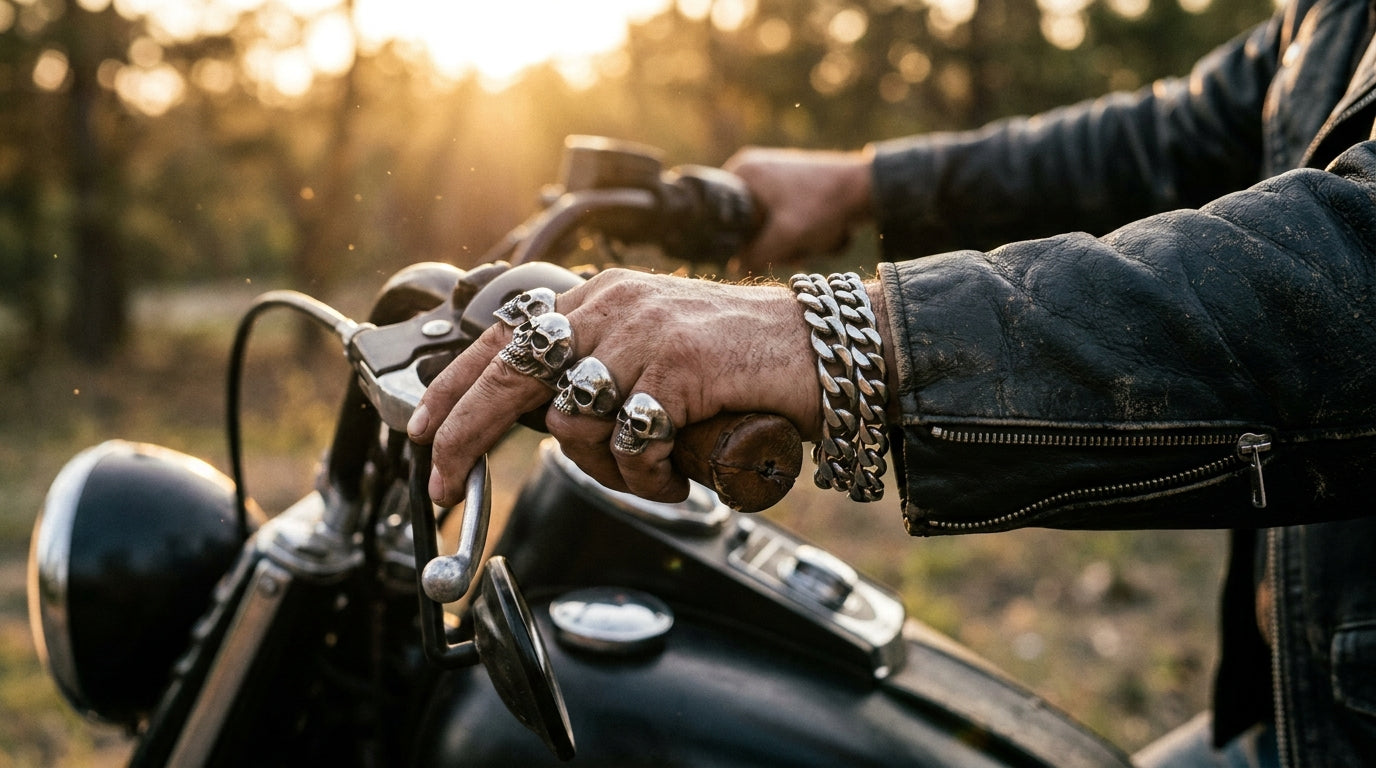
A rider pulls up to a gas station in a black leather jacket. No patches, no club colors. But the thick stainless steel skull ring on his right hand, the heavy chain bracelet catching the light, and the small winged pendant tucked under his collar tell you everything you need to know. Mens biker jewelry is not fashion jewelry. It is identity jewelry, built from metals that survive road grime, engine heat, and years of daily wear.
This guide covers the main types of mens biker jewelry, the metals that hold up and the ones that do not, how to tell quality pieces from disposable marketplace junk, and the specific mistakes that cost riders money. Whether you are building your first set or replacing a piece that finally gave out, this is what matters.
What Counts as Mens Biker Jewelry
Biker jewelry falls into four main categories: rings, chains and necklaces, bracelets, and smaller pieces like wallet chain clips and pendant keychains. The common thread is heavy construction, bold design, and metals chosen for durability over delicacy. A typical biker ring weighs 25 to 45 grams, roughly 5 to 8 times heavier than a standard men's fashion ring.
Design-wise, the vocabulary is consistent across the riding world. Skulls, eagles, crosses, flames, and engine motifs dominate. These are not random choices. Each symbol connects to a specific piece of motorcycle culture. The skull represents fearlessness on the road. The eagle ties to American freedom and the open highway. Engine and piston motifs are self-explanatory for anyone who has rebuilt a V-twin in their garage.
The key difference between biker jewelry and general men's jewelry is purpose. Biker pieces are built to be worn every day, on and off the bike, in rain, sweat, and UV exposure. A piece that tarnishes after one wet ride is not biker jewelry. It is costume jewelry with a skull on it.
Biker Rings: The Foundation of Every Rider's Look
Rings are where most riders start. A single skull ring or signet-style biker ring on the right hand is the most common piece of motorcycle jewelry worldwide. At Sturgis, Daytona Bike Week, and Laconia, you will see more rings than any other accessory on the hands gripping the bars.
The best biker rings are cast or machined from 316L stainless steel. This specific alloy contains 16% chromium and 2% molybdenum, which makes it nearly immune to rust, sweat corrosion, and the road salt that destroys lesser metals. A 316L skull ring will look the same after 5 years of daily riding as it did the day you put it on. Standard zinc alloy rings with chrome plating start peeling within 3 to 6 months of regular use.

Sizing matters more with biker rings than regular bands because of the weight. A 35-gram ring that is half a size too loose will spin on your finger at highway speed and catch on the grip. Most riders go a quarter size tighter than their measured ring size to keep heavy pieces locked in place. For ring style breakdowns and what each design actually means in riding culture, the outlaw biker jewelry guide covers every major symbol.

Chains and Necklaces: What Works Under a Jacket
A biker necklace serves a different purpose than a ring. Rings are visible. Necklaces sit under your jacket, close to the body, and only show when you unzip at a stop. That makes the pendant choice more personal. Riders tend to pick symbols with specific meaning to them: a winged skull for a lost riding partner, an eagle for military service, a cross for faith.
Chain thickness matters for durability. Anything under 3mm will eventually snap from the constant vibration of a running motorcycle engine. A 4 to 6mm curb chain or Figaro chain in stainless steel hits the sweet spot. Heavy enough to resist breakage, light enough to forget it is there under a leather collar.

Pendant weight is the second factor. A pendant over 40 grams on a thin chain will stress the clasp and eventually pull it open. Match heavy pendants with heavy chains. A 30-gram eagle pendant on a 5mm stainless curb chain is a solid pairing. That same pendant on a 2mm box chain will not last a season. For more on biker necklace styles, there is a full breakdown of pendant types and chain pairings.

Bracelets: Chain Links, Cuffs and What Stays On at Speed
Biker bracelets come in two main styles: chain link and solid cuff. Chain link bracelets use interlocking metal links, usually 8 to 12mm wide, with a toggle or lobster clasp. Solid cuffs are one-piece bands, often stamped or engraved with skull or flame motifs.
For riding, chain link bracelets are the safer choice. They flex with your wrist movement on the throttle and do not restrict grip. A rigid cuff can press into the base of your palm during long rides and cause numbness, especially on bikes with forward controls where your wrists stay extended.
The heaviest chain bracelets weigh around 80 to 120 grams, which is noticeable. A quality stainless steel snake chain bracelet in that weight range runs $30 to $50 from a gear-focused brand. The same style from a no-name marketplace listing at $8 will use zinc alloy links with a thin chrome wash that flakes off inside 90 days.


Biker Jewelry Metals Compared
The metal determines everything: weight, durability, skin reaction, and whether the piece survives real riding conditions. Here is how the main options stack up.
| Metal | Weight Feel | Corrosion Resistance | Skin Safe | Price Range | Best For |
|---|---|---|---|---|---|
| 316L Stainless Steel | Heavy, solid | Excellent (rain, salt, sweat proof) | Yes (hypoallergenic) | $15-$50 | Daily riding, all-weather wear |
| Titanium | Light for size | Excellent | Yes | $25-$80 | Riders who want bold designs without heavy weight |
| Sterling Silver (925) | Medium | Fair (tarnishes, needs polishing) | Usually | $40-$200+ | Collectors, special occasion pieces |
| Zinc Alloy (plated) | Light, hollow feel | Poor (plating chips in weeks) | No (nickel reactions common) | $5-$15 | Temporary use, costume only |
| Tungsten Carbide | Very heavy | Excellent | Yes | $20-$60 | Rings only (too brittle for bracelets/chains) |
316L stainless steel wins for most riders. It handles sweat, rain, and gasoline contact without any degradation. The "L" in 316L stands for low carbon, which improves weld strength in cast designs and reduces the risk of corrosion at seam points. This is the same alloy used in marine hardware and surgical instruments.
Sterling silver looks great but demands maintenance. After a few rainy rides, silver tarnishes to a dull grey-brown. Polishing it back takes silver cloth and 10 minutes per piece. Some riders like the tarnished patina. Most do not. If you want silver aesthetics without the upkeep, look for stainless steel pieces with an antique silver finish, a chemical treatment that gives the same dark-recessed look permanently.
5 Common Mistakes When Buying Mens Biker Jewelry
- Buying plated zinc alloy and expecting it to last. Those $8 skull rings on marketplace sites use a base zinc alloy with a thin chrome or silver plating. The plating peels within weeks of regular wear, exposing a dull grey metal that turns skin green. If the listing does not specify 316L stainless steel or titanium by name, assume it is zinc.
- Ignoring ring weight before buying. A 45-gram ring feels completely different on your hand than a 15-gram ring. If you have never worn heavy jewelry, start with a piece in the 20 to 30 gram range and work up. Jumping straight to the heaviest skull ring in the shop is like buying a 900-lb cruiser as your first bike.
- Choosing a rigid cuff bracelet for riding. Cuffs look good parked at a rally. On a two-hour highway ride, a stiff metal band pressing into your wrist joint causes discomfort and can reduce grip strength. Chain link bracelets flex with your wrist and do not create pressure points against the grip.
- Wearing a long pendant without securing the chain. A pendant that hangs below your sternum will swing forward when you lean into a turn and can catch on the tank, the zipper pull, or the jacket snap. Tuck pendants inside your shirt or shorten the chain to keep everything close to the body at speed.
- Skipping the clasp test. The clasp is the weakest point on any bracelet or necklace. Lobster clasps with spring-loaded gates last longer than toggle clasps, which can slip open under vibration. Before buying, open and close the clasp 20 times. If it feels loose or the spring is weak on try number 5, it will fail on the road.
How to Build a Starter Set Without Overspending
A complete mens biker jewelry set does not need to cost $300. Here is a practical starting point that covers the essentials in 316L stainless steel, the metal that handles daily riding without any maintenance.
The Three-Piece Starter
- One statement ring (skull, eagle, or signet style), 25 to 35 grams, $15 to $25. This is the piece people see first.
- One chain bracelet, 8 to 10mm links, toggle or lobster clasp, $30 to $45. Wear it on your non-throttle hand to avoid grip interference.
- One pendant necklace, 20 to 30mm pendant on a 4 to 5mm chain, $20 to $30. Keep it short enough to stay under a jacket collar.
Total for all three in quality stainless steel: roughly $65 to $100. That is less than a single tank bag and these pieces will outlast most of the gear in your closet. For a proven starting point, the biker rings collection has stainless steel pieces in every major style, and the bracelets are built from the same 316L alloy.
Caring for Biker Jewelry on the Road
Stainless steel needs almost zero maintenance. Wipe it down with a damp cloth after a muddy ride and it is done. For deep cleaning, soak pieces in warm water with a drop of dish soap for 15 minutes, scrub recessed areas with an old toothbrush, and air dry. Do not use abrasive cleaners or steel wool on polished surfaces.
Sterling silver needs more attention. Store it in a sealed bag when you are not wearing it to slow tarnish. Use a dedicated silver polishing cloth every 2 to 3 weeks if you ride in humid conditions. A tarnished silver ring is not damaged, just oxidized. Ten minutes with a polishing cloth brings it back to full shine.
For all metals, remove rings before working on your bike. A ring caught between a wrench and a bolt can deglove a finger. This is not a scare tactic. The American Society for Surgery of the Hand documents thousands of ring avulsion injuries annually. Ride with your rings on. Wrench with them off.


No comments yet. Be the first rider to weigh in.