
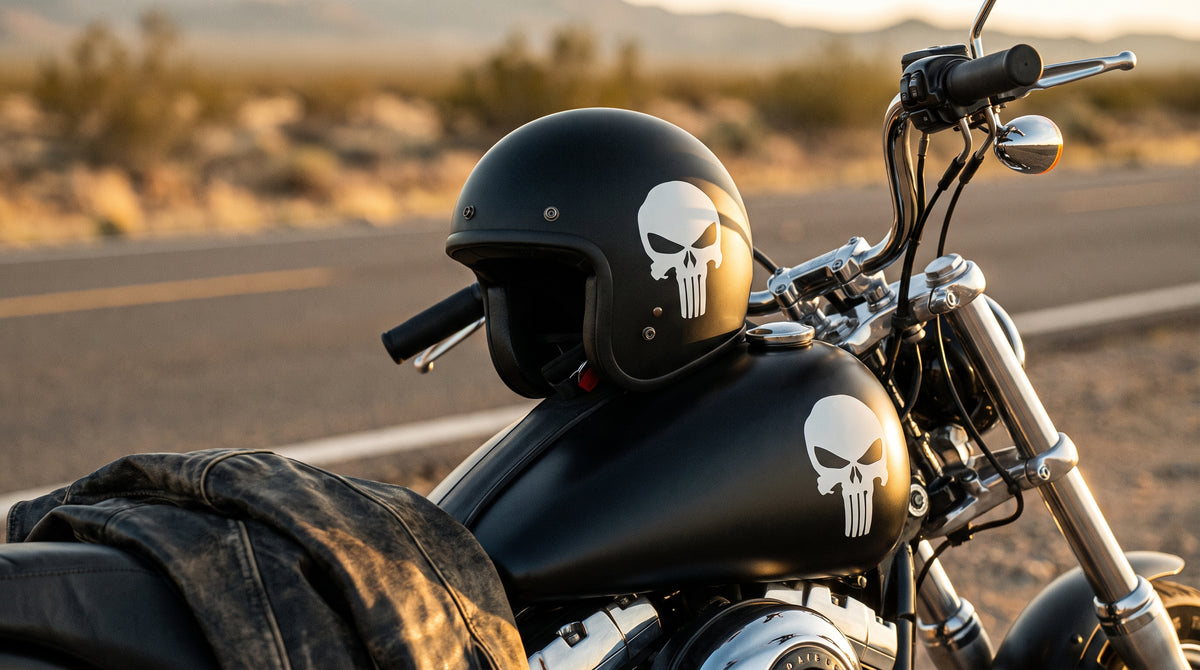
Walk through any bike night parking lot and you will count a dozen Punisher skulls before you find the beer tent. Look closer at them. Half are lifting at the corners, sun bleached to a dull grey, or stuck crooked on a fender because somebody applied one at 45 degrees in a windy garage. The emblem is not the problem. The material and the ten minutes of prep are.
This guide covers the punisher skull gear riders actually buy: vinyl decals, 3D metal emblems, keychains and snapback caps. You will get the real differences between reflective vinyl and cast zinc, where the emblem belongs on a bike, what the skull means before you wear it, and an application routine that keeps a decal flat through a winter of salt and pressure washing.
Where the Punisher Skull Came From
Frank Castle first appeared in The Amazing Spider-Man #129, cover dated February 1974. Writer Gerry Conway created him, Ross Andru drew the issue, and John Romita Sr. designed the long toothed skull on the chest. It was a villain design for a one off antagonist. Fifty years later it is one of the most reproduced symbols in American gear.
Riders and veterans adopted it for a simple reason. The skull reads at distance. On a black tank at 60 mph it still registers as a face, which almost no other logo manages. It carries a meaning worth knowing before you run it: Castle is a man who lost his family and answers violence with violence. Some people wear it as a promise to protect their own. Others read it as pure menace. Both readings exist in the same parking lot, so wear it with that in mind.
Punisher Decals: Reflective Vinyl or 3D Metal
Almost every punisher decal on the market falls into one of two builds, and they fail in completely different ways. Pick by surface, not by picture.
Reflective Die Cut Vinyl
Vinyl is thin, it conforms to curves, and a reflective face throws light back at headlights after dark. That last part matters on a bike more than it does on a truck. A 4x6 inch reflective skull on a saddlebag or fender gives a car behind you one more thing to register. Vinyl is also the only build that works on a compound curve like a tank shoulder or a helmet shell, because it flexes instead of tenting.
The tradeoff is edge life. Vinyl lifts at the corners first, especially if it went down below about 50°F or onto a surface that still had wax on it.

Cast Metal Emblems
A 3D zinc alloy badge is a different object. It sits proud of the surface, catches light on the raised edges, and reads as a fitted part rather than a sticker. Zinc does not fade, because the color is the metal. It will not peel at a corner either, since there is no corner to peel.
The limit is geometry. A rigid metal emblem needs a flat or gently curved panel. Try to press one onto a sharply domed helmet and the adhesive only contacts the middle, which is exactly how you lose a badge on the highway.

If you want the skull with more gothic detail and a heavier presence, the raised zinc version runs a little larger and picks up shadow better on a dark tank.

Quick Comparison
| Build | Best Surface | Night Visibility | Main Failure Mode | Typical Price |
|---|---|---|---|---|
| Reflective vinyl | Curved: tanks, helmets, fenders | High, reflects headlights | Corner lift, UV fade | $14 to $20 |
| Cast zinc emblem | Flat: side covers, toolboxes, trunks | Low, relies on shine | Adhesive release on domed panels | $14 to $30 |
| Printed full color decal | Flat or gently curved | Low | Ink fade after a hard summer | $15 to $25 |
Full color printed decals are worth a mention because not every rider wants a skull on the tank. A die cut eagle in the same 17cm size gives you the patriotic read without the menace, and it lives on the same kind of surface.

Where the Skull Actually Belongs on a Bike
Placement decides whether the emblem looks factory or looks like an afterthought. A few rules that hold up across cruisers, baggers and metric bikes:
- Tank shoulders, not tank tops. The upper curve of the tank is the first thing seen from the front three quarter angle, which is how most people look at a parked bike.
- Match the panel, not the bike. A 4x6 inch skull swallows a sportbike tail but looks undersized on a Road King saddlebag. Cut a piece of paper to size and tape it on before you peel anything.
- Stay off moving edges. Fender lips, fairing seams and anywhere a strap or a leg rubs will chew a vinyl edge within a season.
- Mirror it in pairs. Two skulls facing inward on opposite saddlebags reads deliberate. One on a random panel reads leftover.
- Keep heat in mind. Nothing adhesive belongs within a few inches of an exhaust shield or a cylinder head.
Helmets are their own question. If that is where you are headed, our breakdown of biker helmet stickers and what to avoid goes deeper, and the guide to helmet wraps and skins covers full coverage options.
The short version on helmets: the Snell Memorial Foundation notes the risk from a sticker adhesive is small for most shells, but solvent based adhesives and thermoplastic shells are a bad mix. Use a plain pressure sensitive vinyl decal, skip anything that needs a solvent to apply or remove, and check your helmet maker's own guidance first.
Punisher Keychains: Zinc Weight or LED Light
The keychain is the piece riders buy most often, and it is the one that gets judged by hand rather than by eye. Thin stamped metal feels like a promo giveaway. Cast zinc alloy has mass and holds sculpted detail, so the skull face stays sharp instead of wearing smooth in a jeans pocket.
A solid zinc skull ring is the default pick. The detail is cast in rather than printed, which means no coating to flake off the brow ridge after six months on a key loop.

The other route is function. A clear crystal skull with a multicolor LED and a push button solves an actual problem: finding a dropped key in a dark garage or digging keys out of a saddlebag at a rest stop at night. It is a heavier everyday carry piece and it doubles as a collectible.

Either one clips to a belt loop, a jacket zipper or a backpack pull. If you want to compare the full range side by side, the motorcycle keychain lineup has the rest of the skull and biker designs.
Punisher Caps and Everyday Wear
A snapback is the most wearable way to run the skull. It comes off when you walk into a restaurant, which a tank decal does not. Look for an embroidered skull rather than a screen print. Embroidery survives the sweat, the sun and the wash cycle that kills printed caps in a season.
Breathable cotton matters more than it sounds when a cap spends the day under a half helmet or sitting in the sun at a rally. An adjustable snapback closure also beats a fitted cap for riding, since you can loosen it after helmet hair sets in.

The same cap in a gray camo runs cooler under bright sun and pairs better with a black leather vest than the khaki does.

How to Apply a Decal So It Survives Winter
This is the part most riders skip, and it is the reason most decals fail. The whole routine takes about fifteen minutes.
- Work between 60°F and 90°F. Pressure sensitive adhesive needs warmth to flow into the surface. Below roughly 50°F it never fully wets out, and the corners lift within weeks.
- Strip the wax. Wipe the panel with 70% isopropyl alcohol on a clean microfiber, then wipe again with a dry side. Car wash soap alone leaves a wax film, and wax is what adhesive fails against.
- Dry fit with tape. Tape the decal in position, step back ten feet, then look at it from the seat. Bad placement is obvious from a distance and invisible up close.
- Hinge it. Run a strip of masking tape across the middle, peel one half of the backing, lay it down from the hinge outward, then repeat on the other side. This is how you avoid trapped air.
- Squeegee from the center. Push bubbles out toward the edges with a credit card wrapped in a cloth. Work in overlapping passes.
- Press the edges last, then wait 24 hours. Run a thumbnail around the whole perimeter. No washing, no rain if you can help it, and no pressure washer for a full day while the adhesive cures.
For a metal emblem the routine is shorter but the prep is identical. Clean with alcohol, dry fit, then press firmly for 30 seconds across the entire back so every contact point seats. Metal badges fail when only the center touches.
Five Mistakes Riders Make With Punisher Gear
- Applying in a cold garage in February. The decal looks perfect for three days, then every corner curls. Adhesive needs heat to bond, and a 40°F garage will not give it.
- Sticking a rigid metal emblem on a helmet. A domed shell only contacts the center of a flat badge. It leaves at highway speed and takes paint with it.
- Buying by picture instead of by size. A 4x6 inch decal and a 17cm decal look identical in a product photo and completely different on a fender. Measure the panel first.
- Pressure washing a fresh decal. A close range nozzle will get under a 24 hour old edge and peel it in one pass. Keep the wand at least a foot back and off the edges for the first week.
- Running six skulls on one bike. One well placed emblem reads intentional. Six reads like a sticker bomb. Restraint is what separates a custom look from a clutter.
The Short List
| If you want | Pick | Why | Price |
|---|---|---|---|
| Night visibility on a curved panel | Reflective vinyl skull decal, 4x6in | Flexes onto tanks and helmets, reflects headlights | $14.95 |
| A badge that never fades | 3D zinc skull emblem | Color is the metal, no ink to bleach out | $14.95 |
| Heavier gothic detail | Metal goth skull decal | Raised casting holds shadow on dark paint | $19.45 |
| Patriotic instead of menacing | American eagle helmet decal, 17cm | Full color die cut, weatherproof finish | $19.45 |
| Everyday carry with weight | Zinc alloy skull keychain | Sculpted detail that will not wear smooth | $14.95 |
| Finding keys in the dark | LED crystal skull keychain | Push button multicolor light | $24.95 |
| Wearable, not permanent | Embroidered snapback cap | Breathable cotton, adjustable, survives the wash | $34.95 |
Putting It Together
The punisher skull earns its place on a bike when the build matches the surface and the prep is done right. Reflective vinyl for anything curved, cast zinc for flat panels, one emblem placed where people actually look, and 24 hours of patience before the first wash. That is the whole formula.
Cheap marketplace decals are where this goes wrong. Unknown adhesive, no reflective layer, and printed color that goes chalky after one summer, for two dollars less than a decal built to live outdoors. You end up scraping it off and buying twice. If you are shopping, the biker sticker collection is where I would start, and the keychain lineup covers the everyday carry side.

No comments yet. Be the first rider to weigh in.