
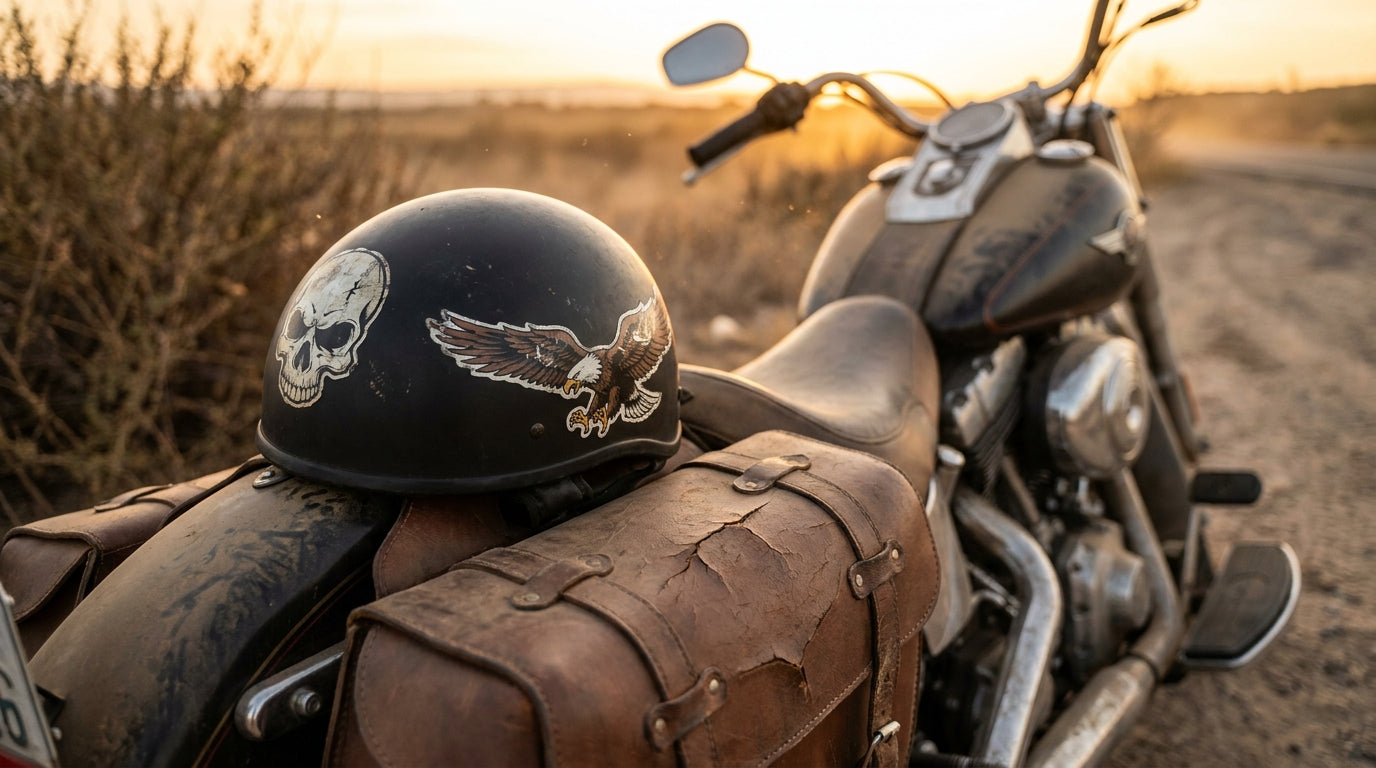
A brand-new helmet comes off the shelf looking like every other one on the road. Same gloss black, same blank shell, same boring profile at every gas stop. That changes the second you stick something on it. The right biker helmet stickers turn a generic lid into something people actually notice from two lanes over.
This guide covers the sticker types that hold up at highway speed, the most popular styles riders search for, how to apply them without wrecking the finish, and the mistakes that send stickers peeling off after one ride. Everything here applies to half helmets, three-quarters and full-face lids.
Why Riders Put Stickers on Their Helmets
A helmet is the most visible piece of gear on a motorcycle. It sits at eye level for every driver, pedestrian and fellow rider around you. Stickers let you claim that space.
The reasons break down into a few categories:
- Personal identity. Your helmet says something about you before you open your visor. A skull decal, an American flag, a club logo. It is the biker equivalent of a bumper sticker, except people actually look at it.
- Group and club rides. Rally stickers, MC chapter patches, charity ride decals. After a few years of riding, a helmet becomes a logbook of where you have been.
- Visibility and safety. Reflective stickers bounce headlights back at night. A 2019 NHTSA conspicuity study found that reflective elements on helmets improved nighttime detection by 33% in controlled tests. That is a real safety gain for a $6 sticker.
- Covering wear. A light scratch on a three-year-old helmet disappears under a well-placed decal. Not a structural fix, but a cosmetic one.
Types of Motorcycle Helmet Stickers That Actually Last
Not every sticker survives 70 mph wind, UV exposure and rain. Here is what works on a helmet and what peels off after one ride.
Vinyl Die-Cut Stickers
The standard. Thin, flexible, conforms to curved surfaces. Quality cast vinyl like 3M's 1080 series is rated for 7+ years of outdoor use. Die-cut stickers have no background, so you see the helmet color around the design. They weigh almost nothing and sit flat against the shell.
3D Chrome and Metal Emblem Stickers
Thick resin-dome or zinc-alloy emblems that sit raised off the surface. These catch light and stand out at a glance. The tradeoff is weight (a metal skull emblem runs 15-25 grams) and lower conformity on tight curves. Best on flat helmet panels like the sides of a half-shell or the back of a full-face.

Reflective Stickers
Look normal in daylight, light up bright in headlights. Made with glass-bead or prismatic retroreflective material. Popular with night riders, commuters and anyone who wants to be seen without mounting lights on their helmet. Reflective vinyl from brands like Oralite or Reflexite holds up well at speed and in rain.

Matte and Satin Finish Stickers
If your helmet has a flat or matte finish, a glossy sticker looks wrong. Matte-finish vinyl matches the surface and blends in cleanly. Some riders use matte black stickers on matte black helmets for a subtle, tone-on-tone look that only shows its detail up close.
Skull and Badass Biker Helmet Stickers
Skull designs are the single most popular category of biker helmet stickers. The range runs from classic crossbones to sugar skulls to full reaper scenes.
What makes a skull sticker work on a helmet is size and placement. A 3-4 inch decal on the side of a half-shell is the sweet spot. Big enough to read at a distance, small enough to look intentional. Oversized stickers that wrap around the chin bar tend to peel at the edges where the curve tightens.
The Punisher skull is one of the most requested single designs. It works in reflective vinyl for night visibility or as a 3D metal emblem for a more aggressive look. A 4x6 inch reflective Punisher decal weighs under 5 grams and costs around $15.

For something heavier, metal skull emblems with a zinc-alloy build add a three-dimensional look that vinyl cannot match. These attach with automotive-grade adhesive tape and hold at highway speed on flat surfaces.

Eagle and Patriotic Helmet Stickers
"Eagle helmet stickers" is the second-most-searched style in this category. The classic American eagle, spread-wing designs, and flag-themed decals are staples on cruiser and touring helmets.
A weatherproof eagle decal built for outdoor use (rated for automotive and marine surfaces) holds up through rain, sun and road grime. The standard size for a helmet eagle is 15-17 cm wide, fitting cleanly on the side or back panel of most lids. Larger eagle decals (20 cm+) work better on saddlebags or tank pads.
Patriotic stickers spike before Memorial Day, the Fourth of July and Sturgis Rally. If you ride to any of these events, an eagle or flag decal is practically a uniform.

Sticker Material Comparison
Choosing the right material matters more than choosing the right design. A great skull sticker in the wrong vinyl peels off in a month. Here is how the main materials stack up for motorcycle helmet stickers:
| Feature | Vinyl Die-Cut | 3D Chrome/Metal | Reflective | Matte Finish |
|---|---|---|---|---|
| Durability | 5-7 years | 3-5 years | 4-6 years | 5-7 years |
| Highway Hold | Excellent | Good (flat areas) | Excellent | Excellent |
| Best For | Any helmet | Cruiser half-shells | Night riders | Flat-black helmets |
| Price Range | $3 - $15 | $10 - $30 | $5 - $15 | $5 - $15 |
| Thickness | 0.1 - 0.2 mm | 1 - 3 mm | 0.1 - 0.3 mm | 0.1 - 0.2 mm |
| Curve Conformity | High | Low | High | High |
Vinyl die-cut wins on versatility. If you are buying your first set of helmet stickers, start with cast vinyl. It works on every helmet shape and finish.
How to Apply Biker Helmet Stickers the Right Way
A sticker is only as good as the application. Here is the process that keeps decals flat and stuck for years, not weeks.
Step 1: Clean the Surface
Wipe the helmet shell with 70% isopropyl alcohol on a lint-free cloth. This removes oils, wax and road film. Do not use acetone, nail polish remover or WD-40. Acetone softens polycarbonate shells (the most common helmet material). A single wipe with the wrong solvent can cloud the clear coat permanently.
Step 2: Dry Completely
Any moisture trapped under a sticker turns into a bubble within a week. Let the cleaned surface air-dry for 2-3 minutes. Do not blow on it or use a heat gun at this stage.
Step 3: Position with a Tape Hinge
Place the sticker where you want it, then tape across the top edge with painter's tape. This creates a hinge. Flip the sticker up, peel the backing halfway, then lay it down while squeegeeing from center outward. Remove the tape, peel the rest, squeegee the other half. Zero bubbles.
Step 4: Press and Cure
For vinyl stickers, firm finger pressure is enough. For 3D metal emblems, press and hold for 30 seconds. 3M recommends a minimum application temperature of 72 degrees F (22 degrees C). A cold garage in winter means weaker adhesive bond. Wait for a warm day or bring the helmet indoors.
Step 5: Wait Before Riding
Give the adhesive 24-48 hours to fully cure before riding. Full bond strength on automotive adhesive tape takes up to 72 hours. Riding immediately risks the sticker catching wind before the bond sets.
Do Biker Helmet Stickers Affect Safety Ratings?
Short answer: no, if you are sticking them on the outer shell surface.
DOT FMVSS 218 tests a helmet's impact absorption and penetration resistance. Those properties come from the shell material and the EPS liner inside, not from what is stuck on the outside. A vinyl decal or metal emblem on the shell surface does not change how the helmet performs in a crash.
The one real risk comes from removal. Some solvents used to peel off old stickers can damage the shell. Polycarbonate helmets (which make up the majority of DOT helmets under $200) are the most solvent-sensitive. Acetone, paint thinner and MEK will soften polycarbonate on contact. Fiberglass composite shells handle most solvents without issue, but there is no reason to risk it.
To remove old stickers safely, use a hair dryer on low heat to soften the adhesive, then peel slowly. Clean leftover residue with isopropyl alcohol or a plastic-safe adhesive remover like Goo Gone.
One important rule: never cover a crack, dent or gouge with a sticker. That hides structural damage you need to see. If your helmet has taken an impact, it needs replacement, not decoration.
5 Mistakes Riders Make with Helmet Stickers
- Using household stickers or bumper stickers. These use a weaker adhesive meant for low-speed or indoor surfaces. At 60+ mph, they catch wind at the edges and peel. Use stickers rated for automotive or outdoor use.
- Applying over cracks or damage. A sticker over a dent looks fine in the parking lot. It also hides a compromised shell that will not protect you in a crash. Inspect first, decorate second.
- Cleaning with acetone before application. This is the most common mistake. Riders think a stronger solvent means a cleaner surface. On polycarbonate, it means a clouded, softened shell. Stick with 70% isopropyl alcohol.
- Covering helmet vents. Intake and exhaust vents are there for airflow. Blocking them causes visor fogging and head overheating on summer rides. Place stickers on solid shell panels, away from vent openings.
- Mismatching finish. A glossy sticker on a matte helmet looks cheap and obvious. Match gloss to gloss, matte to matte, satin to satin. If you are unsure, matte-finish stickers look acceptable on both matte and satin helmets.

Picking the Right Stickers for Your Lid
A helmet is the one piece of gear every rider on the road sees. Whether you go with a skull decal, a reflective eagle, or a set of vinyl flags, the right stickers make a plain lid yours.
Start with the material that matches your helmet finish. Pick a size that fits the flat area of your shell without wrapping over tight curves. Clean with isopropyl, apply at room temperature, and let it cure before you ride.
If you want biker helmet stickers that hold up at highway speed and ship from the U.S., the ALR stickers collection has skull, eagle and reflective designs built for motorcycle use. For full helmet wraps and skins, that is a different approach covered in a separate guide.


No comments yet. Be the first rider to weigh in.