
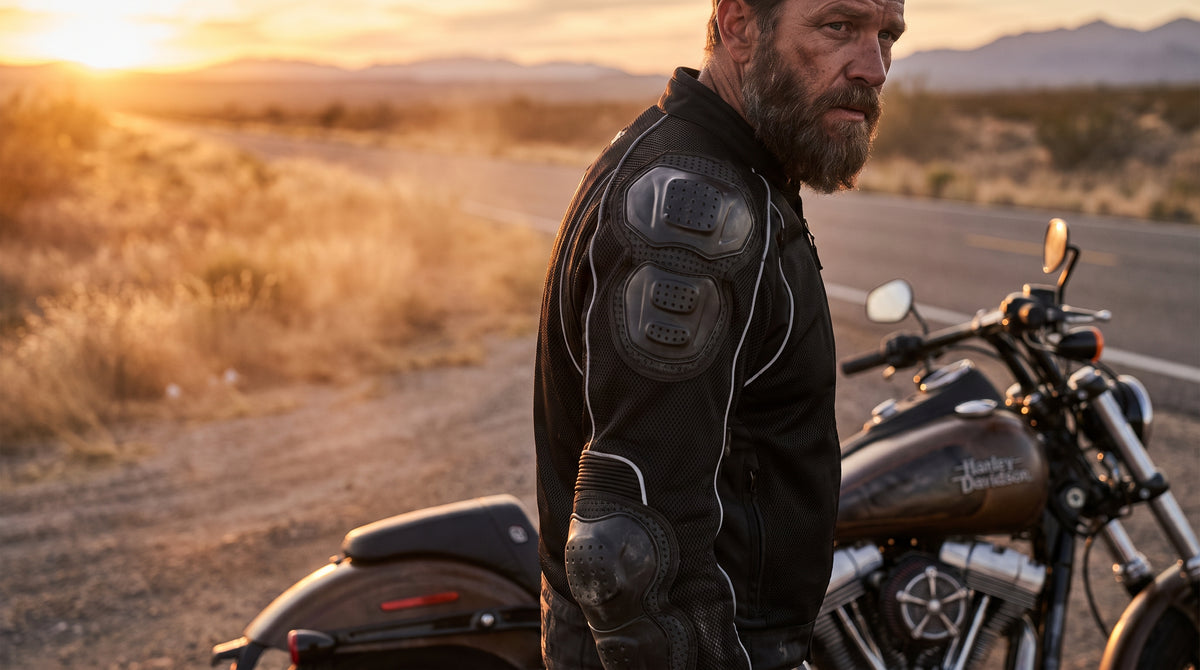
Most riders buy an armored motorcycle jacket and never look inside the shoulder pockets. Pull the pads out of a lot of budget mesh jackets and you find soft foam with no CE stamp anywhere on it. That foam spreads impact across a few inches and little else. A certified CE Level 2 insert keeps the average force reaching your shoulder under 20 kN. Same jacket shape, similar price, completely different outcome when you hit pavement.
This guide covers what separates a real armored motorcycle jacket from a fashion jacket with padding sewn in. You get the CE ratings that actually mean something, how leather, textile and mesh behave in a slide, the fit rules that keep armor sitting over your joints instead of your bicep, and seven jackets worth the money. By the end you will know the one spec to check before anything goes in a cart.
What Makes a Jacket "Armored" (And What Does Not)
Armor in riding gear is governed by two European standards, and both show up on gear sold in the US. EN 1621-1 covers limb protectors: shoulders, elbows, hips and knees. EN 1621-2 covers back protectors only. If a pad is certified, the level and standard are printed on the pad itself, usually on the back face near the edge.
Here is the trap. Plenty of jackets advertise "armor ready" or "removable armor" and ship with uncertified foam in the shoulders and elbows, plus an empty back pocket. The pocket is real. The back protector is sold separately. Check the listing for the words CE, EN 1621 and a level number. No level printed means no test passed.
Padding that is not certified still helps with wind and minor scrapes. It is not impact protection, and pricing it as such is how riders end up surprised.
CE Level 1 vs Level 2: The Numbers That Matter
Both levels pass the test. Level 2 simply lets less force through to your body, because the pad is usually thicker, denser or built from a material that stiffens on impact. The thresholds are fixed by the standard, so they are the same whether the pad costs $15 or $90.
| Standard | Covers | Level 1 limit | Level 2 limit |
|---|---|---|---|
| EN 1621-1 | Shoulders, elbows, hips, knees | 35 kN average, 50 kN single peak | 20 kN average, 30 kN single peak |
| EN 1621-2 | Back protectors | 18 kN | 9 kN |
Read the back protector row again. A Level 2 back protector lets through half the force of a Level 1. That is the single biggest protection upgrade available on most jackets, and it is usually a $40 to $70 insert dropped into a pocket you already own.
Level 1 pads are thinner and bend more easily, which is why they show up in summer mesh jackets and armored shirts. Level 2 is worth the bulk on the back and shoulders if you ride highway speeds. We broke the pad types down further in our guide to CE ratings and armor types.
Leather vs Textile vs Mesh: Pick for the Ride You Actually Take
Armor handles impact. The shell handles the slide, and those are two separate jobs. Cowhide at 1.2mm to 1.4mm thickness is still the benchmark for abrasion resistance, which is why race suits are leather and not nylon. Mesh trades most of that slide protection for airflow you can feel at 25 mph.
| Shell | Slide resistance | Airflow | Best for | Typical price |
|---|---|---|---|---|
| Cowhide leather (1.2 to 1.4mm) | Highest | Low unless perforated | Highway, cool weather, long life | $170 to $240 |
| Textile with liners | Good | Adjustable via vents | Three seasons, commuting, rain | $120 to $170 |
| Mesh with CE armor | Lowest | Highest | Summer heat, city and touring in 90F | $110 to $135 |
The honest answer for most riders is two jackets, not one. A mesh jacket you will actually wear in August beats a leather jacket that stays on the hook because it is 95F out. Gear that gets worn protects you. Gear in the closet does not.
Where mesh gets criticized unfairly: a mesh jacket with genuine CE Level 1 shoulder, elbow and back armor protects your joints just as well as a leather jacket with the same pads. What you give up is abrasion on a long slide, not impact.
7 Armored Motorcycle Jackets Worth Buying
Every jacket below is live in the motorcycle armor collection with its armor spec on the product page. Prices are current. Check the listed armor level on the page before you order, because that is the number that decides how much the jacket is really doing.
1. Best Overall: Motorcycle Armor Jacket with Full Upper Body Protection
This is the full upper body approach: chest, back, shoulders, elbows and spine covered in one piece rather than four pads scattered through a shell. At $134.45 down from $209.95 it costs less than buying a separate back protector and chest insert for a jacket that shipped empty. Riders use it as a standalone armor layer or under a leather jacket that has no armor at all.

2. Best Hot-Weather Mesh: Vance Leather Men's Black Mesh with CE Armor
Straight black mesh with CE armor at $115.95, and the reason it makes the list is that the armor is specified rather than vague. The mesh panels move real air through the torso at speed, which is the difference between a 45 minute summer ride and a two hour one. Plain black also means it does not look like track gear at a gas station.

3. Best Three-Season: Vance Advanced Velocity Mesh and Textile
The three-season build is mesh panels plus textile in the abrasion zones, so you get airflow in July and a shell that holds up in October. $130.95 from $254.95. This is the jacket to buy if you only want one, because the range it covers is roughly 50F to 90F rather than a narrow summer window.

4. Best High-Visibility: Vance Leather Men's Hi-Vis Mesh with CE Armor
Hi-vis is not styling, it is the cheapest safety feature on a jacket. Drivers pulling out of side streets look for movement and contrast, and a fluorescent torso panel gives them both. $115.95, same mesh and CE armor construction as the black version. If most of your miles are commuting in traffic rather than weekend canyon runs, this is the smarter of the two.

5. Best Armored Leather: Vance Commuter Cafe Racer with Armor
A cafe racer cut in leather with armor built in, $182.95 down from $534.99. This is the answer for riders who want the classic silhouette without the usual compromise, because most cafe racer jackets on the market are fashion pieces with zero impact protection. Leather here means real abrasion resistance on the shell plus certified pads at the joints.

6. Best for Cold Rides: Vance Hi-Vis Mesh with Insulated Liner
Same hi-vis mesh shell, plus a zip-out insulated liner, at $125.95. The liner is what turns a summer jacket into a three-season one, and a removable liner beats a permanently insulated jacket because you are not stuck at one temperature. Pull it out in June, zip it back in around November.

7. Best Armor Under Your Own Jacket: ALR Men's Full Body Armor Protection
If you already own a leather jacket you love that has no armor, this is the fix. A full body armor layer at $104.95 that goes under whatever you already wear, covering chest, back, shoulders and elbows. It also solves the vest problem: a leather vest has no armor pockets at all, so this is the only way to get impact protection under one.

How an Armored Jacket Should Fit
Fit is not comfort here, it is whether the armor is over the bone when you need it. A shoulder pad that has slid down your arm protects your bicep. Three checks before you keep a jacket:
- Shoulder pads centered on the bone. Sit in your riding position, arms forward on the bars, and feel for the pad. It should sit on the point of the shoulder, not behind or below it.
- Elbow pads stay put when you bend. Bend your arm to 90 degrees. If the pad slides toward your forearm, the sleeve is too wide or the pocket is oversized.
- Two fingers of slack at the torso, no more. Enough room for a base layer, not enough for the jacket to shift in a tumble. A jacket that flaps at 60 mph is too big.
Sleeve length is measured in the riding position, not standing up. A sleeve that covers your wrist bone while you stand will ride up two inches once your arms reach for the bars, which leaves a gap between glove and cuff exactly where you land.
Summer Riding Without Giving Up the Armor
The most common summer mistake is riding in a t-shirt because the leather jacket is unbearable at 95F. Mesh exists specifically for this, and a mesh jacket with CE Level 1 pads gives you full joint protection at roughly the airflow of a long sleeve shirt.
Perforated leather is the middle option. It keeps most of the abrasion resistance of solid cowhide and adds thousands of small holes for airflow, though it still runs hotter than mesh below 20 mph in stopped traffic. If your summer riding is mostly highway, perforated leather works. If it is city stop and go, mesh wins.
One thing riders underrate: a light colored jacket is measurably cooler in direct sun than a black one. Black looks better in photos and worse in a July parking lot.
Do Not Armor Your Top Half Only
Hips and knees hit the ground in most low speed drops, and jeans are gone in under a second of sliding. Armored riding pants with hip, tailbone and knee pads run $67 here, which is less than the deductible on most policies and far less than a cracked hip.

If full riding pants are a bigger jump than you want, armor shorts worn under regular jeans cover the same three zones. Our breakdown of armor, materials and what riders actually wear on the bottom half goes through the options, and the full protective gear set guide covers how the pieces work together.
5 Mistakes Riders Make Buying an Armored Jacket
- Assuming the back protector is included. An empty back pocket is the single most common gap in gear under $150. Why it fails: your spine is the one area where Level 2 halves the transmitted force, and it is the piece most often missing.
- Buying a size up for comfort. Why it fails: armor pockets are positioned for that size. Go up one and the shoulder pads land on your arms instead of your shoulders.
- Treating fashion biker jackets as riding gear. A thin fashion shell has no abrasion rating and no armor pockets. Why it fails: it tears open in the first few feet of a slide, before the armor question ever comes up.
- Ignoring hot weather reality. Why it fails: the safest jacket you own is worthless on the days you leave it home. Pick for the temperature you actually ride in.
- Never checking the pads again. Armor that has taken an impact is done, and foam compresses with years of heat cycling in a garage. Why it fails: a pad that no longer springs back is not meeting the kN limit it was certified at.
Breaking In and Caring For an Armored Leather Jacket
New cowhide is stiff because the fibers have not flexed yet. The fastest break-in is simply wearing it, including around the house for a few hours, which warms the leather and lets it mold to your shoulders. Expect 300 to 500 miles of riding before it moves easily. Skip the heat gun and the soaking tricks, both dry out the hide and shorten its life.
For cleaning, wipe road grime off with a damp cloth and let it air dry away from direct heat. Leather conditioner two or three times a year is enough for most riders, more if you ride in rain often. Pull the armor out before any cleaning, and never put a leather jacket in a machine or a dryer.
For mesh and textile, most liners are machine washable once the armor is removed, and that matters more than it sounds: sweat salt in mesh breaks down the fabric over a few seasons. The Motorcycle Safety Foundation publishes rider gear guidance worth reading alongside any spec sheet.
Where to Start
If you are buying one armored motorcycle jacket this year, get a three-season mesh and textile jacket with certified CE pads, then add a Level 2 back protector to it. That combination costs less than a premium leather jacket and covers more riding days than either extreme. Add armored leather later, once you know which months you actually ride.
If you already have a jacket you like, the cheapest upgrade in motorcycling is checking what is in the pockets and replacing uncertified foam with real pads. If you are shopping from scratch, the armored jacket and body armor lineup is where I would start, because every piece there lists its protection rather than hinting at it.

No comments yet. Be the first rider to weigh in.