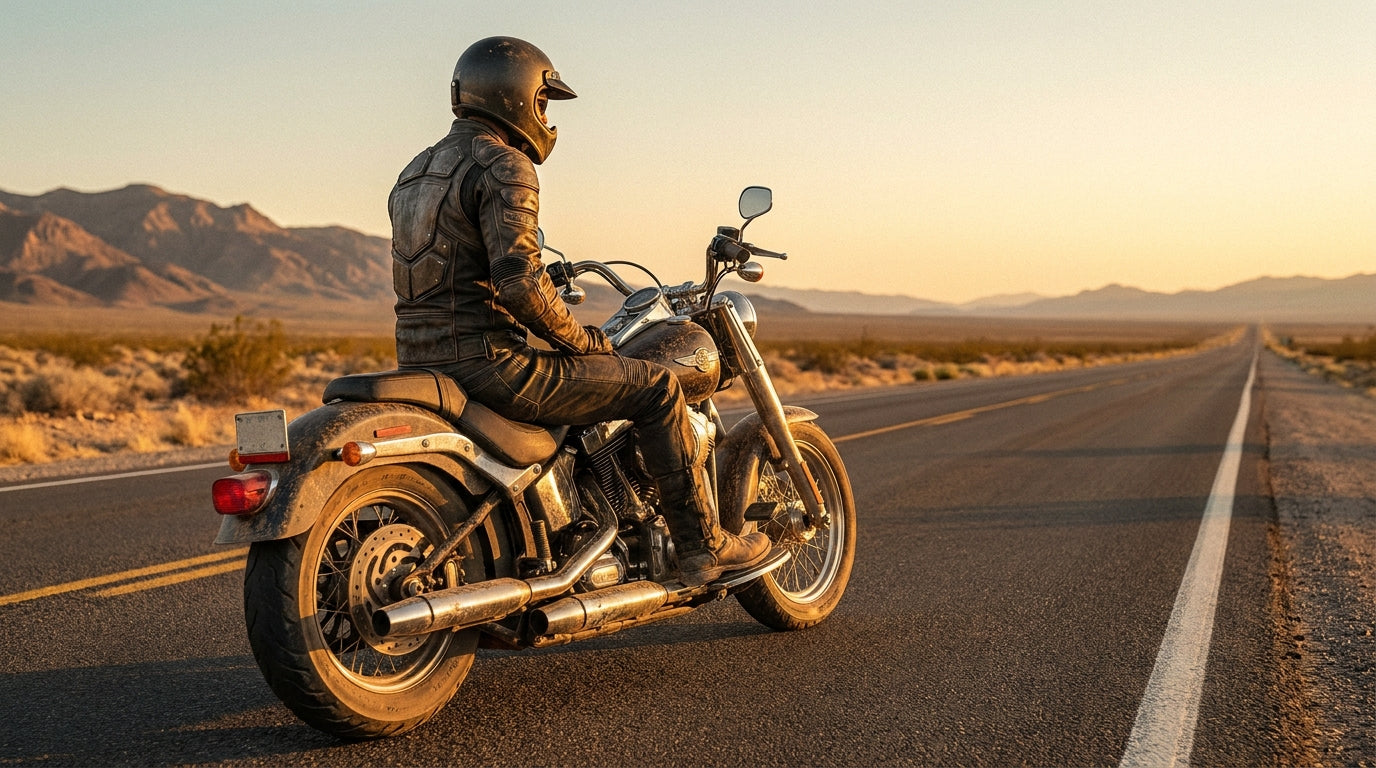
A leather jacket looks the part. It feels solid. But leather by itself does nothing against the blunt force of a 40 mph crash. The difference between walking away from a lowside and spending six weeks in a brace comes down to what sits between you and the pavement: your motorcycle armor.
Most stock jackets ship with thin foam pads that crumble on first impact. Real armor absorbs force, distributes it across the surface area, and keeps your joints and spine intact. This guide covers the best motorcycle armor options on the market today, CE certification levels, materials that actually work under real crash forces, and how to build a full protection kit that fits your riding style and budget.
What Motorcycle Armor Actually Does
Motorcycle armor sits at key impact zones (shoulders, elbows, back, hips, knees) and absorbs crash energy before it reaches your body. Without it, a slide at 30 mph sends roughly 50 kN of force directly into bone and tissue. With CE Level 2 armor at the back, that number drops below 9 kN.
The problem is that many riders assume their jacket "has armor" because it has foam pads in the shoulders. But basic EVA foam compresses on impact and stays flat. It offers one-time, partial protection at best. It holds no CE certification. And it gives riders a false sense of safety that can lead to worse outcomes than wearing nothing with full awareness.
Real motorcycle armor uses materials that stay soft during normal riding and harden on impact. D3O, SAS-TEC, and Forcefield all make inserts that flex with your body, then lock into a rigid shield in milliseconds when force hits. That's the difference between a bruise and a fracture.

CE Ratings Explained: Level 1 vs Level 2
CE certification comes from the European standard EN 1621, which tests armor by dropping a calibrated weight onto it and measuring how much force passes through to the body. Two levels matter for riders.
CE Level 1 (EN 1621-1, limb armor): Transmitted force must stay below 35 kN average, with no single hit above 50 kN. Most entry-level elbow and shoulder protectors meet this standard. Brands like Knox and Icon use Level 1 for limb armor on budget-friendly gear.
CE Level 2 (EN 1621-1, limb armor): Force must stay below 20 kN average, with no hit above 30 kN. This is the standard for serious highway riding. Alpinestars Nucleon Flex Pro and D3O T5 EVO Pro both certify at Level 2.
Back protectors follow a separate standard (EN 1621-2). Level 1 caps at 18 kN average. Level 2 caps at 9 kN. For spine protection, Level 2 is the only rating worth buying.
One thing to watch for: some manufacturers label their jacket as "CE certified" when only the outer shell meets an abrasion standard. That does not mean the armor inside carries its own CE rating. Always check the stamp on the pad itself, not the jacket hang tag. A jacket can be CE-rated for abrasion while shipping with completely uncertified foam inserts inside.
| Rating | Max Avg Force | Max Single Impact | Best For |
|---|---|---|---|
| CE Level 1 (limb) | 35 kN | 50 kN | Casual riding, short commutes |
| CE Level 2 (limb) | 20 kN | 30 kN | Sport, touring, highway |
| CE Level 1 (back) | 18 kN | 24 kN | Light city riding |
| CE Level 2 (back) | 9 kN | 12 kN | All serious riding |
Armor Materials: D3O, Hard Shell and Foam Compared
Three material families dominate the motorcycle armor market. Each handles impact differently, and the price gap between them is smaller than most riders expect.
D3O and viscoelastic compounds: Soft and pliable at rest. Molecules lock together on impact, then return to flexible form. D3O T5 EVO measures 40% thinner than traditional foam while hitting CE Level 2. Used by REV'IT!, Klim, and Forcefield. These feel like wearing nothing until you need them.
Hard shell (PE/polycarbonate): Rigid plastic shells over an inner foam layer. Heavier and bulkier, but cheap and extremely durable. Common in off-road chest protectors and full-body race suits. Leatt and Fox build their MX armor around hard shell designs. Expect these to add weight and reduce airflow.
Basic foam (EVA/polyethylene): Ships stock in most jackets under $150. Rarely carries any CE stamp. Compresses on first impact and does not rebound. If your jacket came with spongy pads that flex easily with your fingers, replace them with certified inserts.
If you're choosing between a leather or textile motorcycle jacket, check whether the armor pockets fit standard CE inserts. Most modern jackets use a universal pocket size, but measure before ordering.

Where Every Piece Goes: The 7 Impact Zones
Motorcycle crashes follow predictable patterns. Studies from the Hurt Report and its European equivalents show the same zones taking damage over and over. Here's where armor matters most, ranked by crash frequency.
1. Shoulders: The first contact point in a lowside slide. CE Level 1 minimum. Shoulder armor should sit directly on the joint, not slide around when you reach for the bars.
2. Elbows/forearms: Drag directly across pavement in almost every slide. Level 1 or Level 2 inserts. The Forcefield Isolator PU elbow pad is 11mm thick at CE Level 2 and fits most jacket pockets.
3. Back and spine: A CE Level 2 back protector is the single most important armor upgrade any rider can make. The Forcefield Pro Sub 4 measures just 14mm thick at Level 2 and weighs 420 grams. Most riders never feel it during a ride.
4. Chest: Increasingly recognized as a critical zone. The SAS-TEC SC-1/CP2 chest insert meets CE Level 2 and fits inside most jacket chest pockets. European standards now push for mandatory chest armor in new gear.
5. Hips: Take heavy impact in lowside and highside crashes. Built into riding pants or worn as separate inserts. D3O makes a hip protector that weighs just 85 grams per side.
6. Knees: Direct impact zone in front-end collisions and low-speed drops. Level 2 recommended for any highway riding. Paired with quality motorcycle boots to cover the shin gap.
7. Hands: Instinct drives every rider to put hands out in a fall. Leather motorcycle gloves with knuckle armor and palm sliders handle this zone. Knox Orsa and Alpinestars SP-8 both carry CE certification for hand protection.

Full Body Motorcycle Armor Jackets: When They Make Sense
A full-body armor jacket bundles shoulder, elbow, chest, and back protection into one mesh or compression-fit layer. It works as a standalone piece under a casual jacket or as a base layer beneath leather.
The Alpinestars Bionic Tech V3 is the benchmark in this category. It covers every upper-body zone with CE Level 2 armor, weighs 1.8 kg, and fits under any jacket without adding bulk. For off-road riders, the Fox Raceframe Impact CE handles chest and back at just 680 grams.
Full-body armor jackets make sense in a few specific situations:
- Riders who prefer non-armored leather or denim vests and want protection underneath
- Track days and sport riding where every impact zone needs coverage
- Adventure and off-road riding where crashes happen more often at lower speeds
- Hot-climate riding where a heavy textile jacket is unbearable but protection still matters
For riders who already own quality leather gear, adding a separate CE Level 2 back protector and upgrading the stock shoulder and elbow inserts is usually more practical than buying a full armor suit.
Budget matters here. A full armor jacket like the Bionic Tech V3 runs $250 to $350. But upgrading individual inserts in an existing jacket costs $120 to $180 total for shoulders, elbows, and a back protector. If you already own a well-fitted riding jacket, the insert upgrade route gives you the same protection for less money and no change to your riding setup.

5 Common Mistakes Riders Make with Motorcycle Armor
1. Trusting stock foam pads. Most jackets under $200 ship with uncertified foam. Flip the pad over and look for a CE stamp pressed into the material. If there's no stamp, it's not rated.
2. Skipping the back protector. The Motorcyclist Association of Great Britain found that only about 30% of riders wear a dedicated back protector. A CE Level 2 back insert costs around $50 to $70 and fits in most jacket back pockets. There is no cheaper upgrade with this much impact on crash outcomes.
3. Wearing armor that shifts. If your shoulder pad slides 3 inches toward your chest when you lean forward, it will not be covering your shoulder joint on impact. Armor must sit directly on the zone it protects. Tighten straps, size down, or switch to a snugger-cut jacket.
4. Ignoring replacement cycles. D3O and similar viscoelastic materials degrade after 5 to 7 years of UV exposure and body heat. Check the manufacturer's recommended replacement interval. If the pad feels noticeably softer than when it was new, swap it out.
5. Pairing good armor with a weak outer layer. A certified CE insert inside a jacket with zero abrasion resistance still leaves skin exposed during a slide. Armor handles impact force. The jacket handles friction. You need both working together. Check out our full motorcycle protective gear guide for the complete breakdown.
How to Pick the Best Motorcycle Armor for Your Riding
Start with your riding style. Commuters and cruiser riders need CE Level 1 limb armor and a CE Level 2 back protector at minimum. Sport riders, tourers, and anyone doing regular highway miles should go Level 2 at every zone.
Check pocket compatibility before ordering inserts. Most jackets use a standard pocket size for shoulder and elbow armor, but sizes vary. Measure the pocket opening and compare against the insert dimensions. D3O and SAS-TEC sell universal-fit inserts for $25 to $40 per piece.
Ventilation matters more than most buyers realize. Hard-shell armor traps heat against the body. Perforated designs like the D3O T5 EVO Pro move air through channels while maintaining CE Level 2 protection. In summer riding, this is the difference between wearing your armor and leaving it at home.
If you're building a protection kit from scratch, a quality motorcycle jacket with CE Level 2 inserts is the most efficient starting point. Add armored riding pants, certified gloves, and solid boots, and every major impact zone is covered.
Weight is worth considering too. A full set of CE Level 2 inserts (two shoulders, two elbows, one back protector) adds roughly 800 grams to 1.2 kg to your jacket. That is less than a water bottle. If you can feel the weight on the bike, the jacket fit is the issue, not the armor.
If you're looking for protective riding gear that's built for real use, the motorcycle protective gear collection is where I'd start.


No comments yet. Be the first rider to weigh in.