
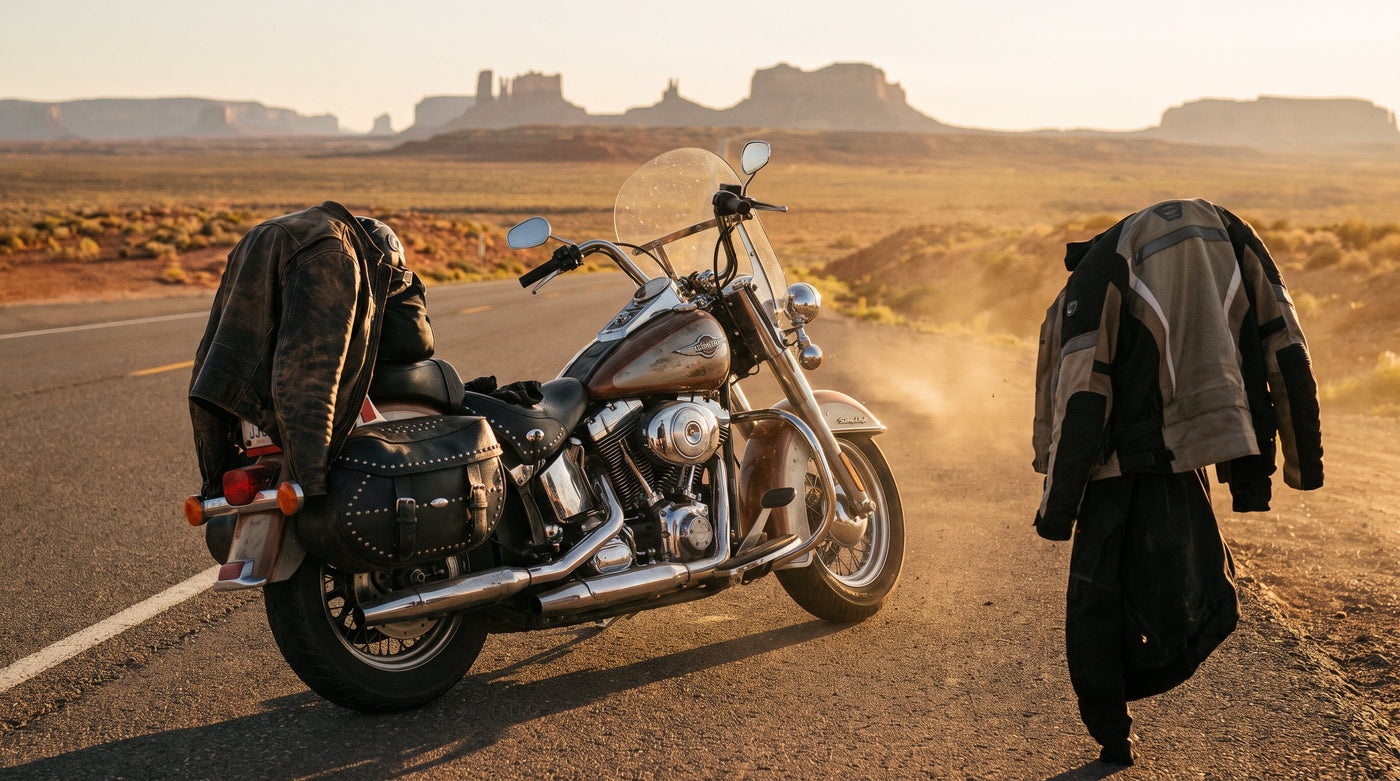
A rider walks into a gear shop planning to grab a simple motorcycle jacket. Twenty minutes later, they're staring at a wall of cowhide, textile, mesh, perforated, and armored options with no idea which one to pull off the rack. The wrong choice means either roasting in August traffic or regretting every penny after the first downpour.
This guide breaks down everything that matters when choosing a motorcycle jacket. You'll learn how leather and textile actually perform in a crash, which jacket works best in summer heat, how armor ratings translate to real protection, and what sizing mistakes to avoid. By the end, you'll know exactly what to look for and what to skip.
Leather vs Textile: What Each Material Actually Does
The "leather vs textile motorcycle jacket" debate is the most-searched comparison in riding gear for a reason. Both materials protect you, but they do it differently.
Full-grain cowhide at 1.2 to 1.3mm thickness is still the gold standard for abrasion resistance. Testing by the Transport and Road Research Laboratory showed that quality leather can withstand over 4 seconds of slide time at 30 mph before wearing through. That translates to roughly 45 meters of asphalt contact. Most textile jackets, even ones rated CE AA, hold up for about 1.5 to 2.5 seconds under identical conditions.
But leather has real tradeoffs. A typical leather cruiser jacket weighs 7 to 9 lbs, holds body heat, and stiffens up if it gets soaked. Textile jackets run 3 to 5 lbs, breathe better through venting panels, and many come with waterproof membranes built right in.
For commuters who ride rain or shine, textile makes daily life easier. For riders who want the best slide protection and don't mind the extra weight, leather wins. Neither is wrong. It comes down to how and where you ride.
How Armor Changes Everything
The jacket shell is only half the protection equation. What's inside matters just as much, sometimes more.
CE Level 1 armor absorbs impacts and transmits no more than 35 kN of force to your body. CE Level 2 cuts that to 20 kN or less. To put it concretely, a Level 2 back protector like the D3O Viper reduces transmitted force by almost half compared to Level 1. That's the difference between a bad bruise and a broken rib.
Most jackets under $200 ship with CE Level 1 pads at the shoulders and elbows and no back protector at all. If your jacket has a foam slab in the back pocket instead of a CE-rated insert, that foam does almost nothing in a real crash. It's a placeholder, not protection.
Upgrade priority in order: back protector first (the spine absorbs the worst impacts in a low-side), then shoulder and elbow. Chest armor is a bonus but far less common. Budget $30 to $50 for a standalone CE Level 2 back insert if your jacket doesn't include one. That single upgrade does more for your safety than spending an extra $100 on a fancier shell.
Best Motorcycle Jacket for Hot Weather
This is where textile and mesh pull ahead of leather by a wide margin. A vented textile jacket with mesh panels can drop your perceived temperature by 10 to 15 degrees compared to a solid leather jacket sitting in 90°F stop-and-go traffic.
The key spec is airflow panel coverage. A jacket like the Joe Rocket Phoenix 14 has mesh panels covering about 60% of the surface area. That's a massive difference compared to jackets that only vent at the chest and upper back. More mesh means more air moving across your core, which is where heat builds fastest.
Perforated leather is a compromise worth considering. It lets some airflow through tiny punched holes but can't match the volume of a dedicated mesh jacket. It works well for spring and fall rides where you want leather protection without a total sweat-out. For true summer riding in the South or Southwest, it won't cut it.
If you ride mostly in summer heat, a mesh-panel textile jacket with CE Level 2 armor is the practical sweet spot. You get real airflow and real protection without the weight penalty. Pair it with a good pair of riding gloves and you're set for hot-weather commuting.
How Long Do Motorcycle Jackets Last?
This depends on the material and how you maintain it.
A quality full-grain leather jacket, conditioned once or twice a year with a leather-specific product like Lexol or Chamberlain's Leather Milk, can last 15 to 20 years of regular riding. The leather actually improves with age. It develops a patina, gets softer, and molds to your body while maintaining its abrasion resistance. That's why vintage riding jackets from the 1990s still hold up on the road.
Textile jackets have a shorter functional life. The waterproof membrane, usually a DWR coating or laminate layer, starts degrading after 3 to 5 years of UV exposure and washing cycles. The abrasion resistance of Cordura or ballistic nylon holds up longer, but once the waterproofing fails, most riders replace the jacket rather than re-treating it.
Mesh jackets wear even faster. Plan on 2 to 4 years of heavy use before the mesh panels start thinning at stress points around the shoulders and underarms.
The math often favors leather on a per-year basis. A $350 leather jacket that lasts 15 years costs about $23 per year. A $200 textile jacket replaced every 4 years runs $50 per year. The upfront cost is higher, but you buy it once and move on. Same logic applies to quality motorcycle boots: buy right the first time and they last for years.
How to Break In a Leather Motorcycle Jacket
New leather is stiff. There's no way around the break-in period, but you can speed it up without damaging the hide.
Start by wearing the jacket around the house for a few hours at a time. Sit, stand, reach forward like you're gripping handlebars. The leather molds to your riding position faster when it's warm from body heat. Do this for a week before your first long ride and you'll skip the worst of the stiffness.
After that first week, apply a thin coat of leather conditioner. Lexol or Bick 4 are reliable choices that won't darken the leather or leave a greasy residue. Work the conditioner into the seams and stress points at the elbows, shoulders, and collar. Let it absorb overnight, then wipe off any excess.
One critical rule: don't soak the jacket or throw it in the dryer. Water-logged leather dries stiff and can crack along the fold lines. If it gets caught in the rain, let it air-dry at room temperature away from direct heat, then condition it once it's fully dry.
Most riders find their leather jacket feels fully broken in after 500 to 800 miles of riding. Thicker hides at 1.3mm and above take longer, but the payoff is a jacket that fits like it was custom-made for your body and riding position.
Leather vs Textile vs Mesh: Side-by-Side Comparison
| Feature | Full-Grain Leather | Textile (Cordura/Ballistic) | Mesh |
|---|---|---|---|
| Abrasion resistance | 4+ seconds at 30 mph | 1.5 to 2.5 seconds | Under 1 second |
| Typical weight | 7 to 9 lbs | 3 to 5 lbs | 2 to 3 lbs |
| Airflow | Poor (unless perforated) | Moderate with vents | Excellent |
| Waterproof | No (unless treated) | Often built-in membrane | No |
| Lifespan | 15 to 20 years | 3 to 5 years | 2 to 4 years |
| Price range | $200 to $600+ | $100 to $400 | $80 to $250 |
| Best for | Cruisers, sport, year-round | Commuting, touring, rain | Summer riding only |
5 Common Mistakes When Buying a Motorcycle Jacket
1. Fitting the jacket over a t-shirt only
You'll ride in layers during cooler months. If the jacket fits snugly over a tee, it will be too tight with a hoodie or fleece base layer underneath. Always try it on with your typical riding layers, and check that you can reach forward without the sleeves pulling up past your wrists.
2. Ignoring the back protector slot
Over 40% of motorcycle jackets in the $100 to $200 range ship without a CE-rated back protector. That foam rectangle is not armor. It's packing material. Budget $30 to $50 for a standalone CE Level 2 back insert. It's the single highest-impact safety upgrade you can make to any jacket.
3. Confusing fashion leather with riding leather
Fashion leather jackets and riding leather jackets look similar on the rack but are built completely differently. Riding jackets have longer sleeves, a dropped back hem to cover your lower back in riding position, and reinforced stitching at impact zones. If the sleeves ride up when you extend your arms forward, it's a fashion piece, not riding gear.
4. Assuming textile means cheap
A Cordura 600D textile jacket with CE Level 2 armor and a waterproof membrane can outperform a bargain leather jacket made from thin bonded leather with no real armor. Material quality and construction matter more than material type. Don't dismiss textile just because it costs less than leather.
5. Skipping the pant zip connection
If your jacket doesn't zip to your riding pants, it can ride up in a slide and expose your lower back and midsection. That 360-degree zip connection keeps the jacket anchored to your body during a crash. It's a safety feature, not an optional accessory.
Picking the Right Motorcycle Jacket for Your Riding Style
The right motorcycle jacket matches your riding conditions, fits over your layers, and has CE-rated armor where it counts. Leather lasts longer and slides better. Textile handles rain and heat without the weight. Neither is universally "better." It depends on where you ride, how often you get rained on, and whether you're willing to maintain leather.
One thing both sides agree on: skip the no-name marketplace options with mystery leather and uncertified padding. You don't need to spend $500, but you do need to know what you're buying. Real leather, double-stitched seams, and actual CE-rated armor are the non-negotiables.
If you're leaning toward leather, the men's leather jacket collection is where I'd start looking. Real cowhide, proper stitching, and gear that holds up season after season.
No comments yet. Be the first rider to weigh in.