
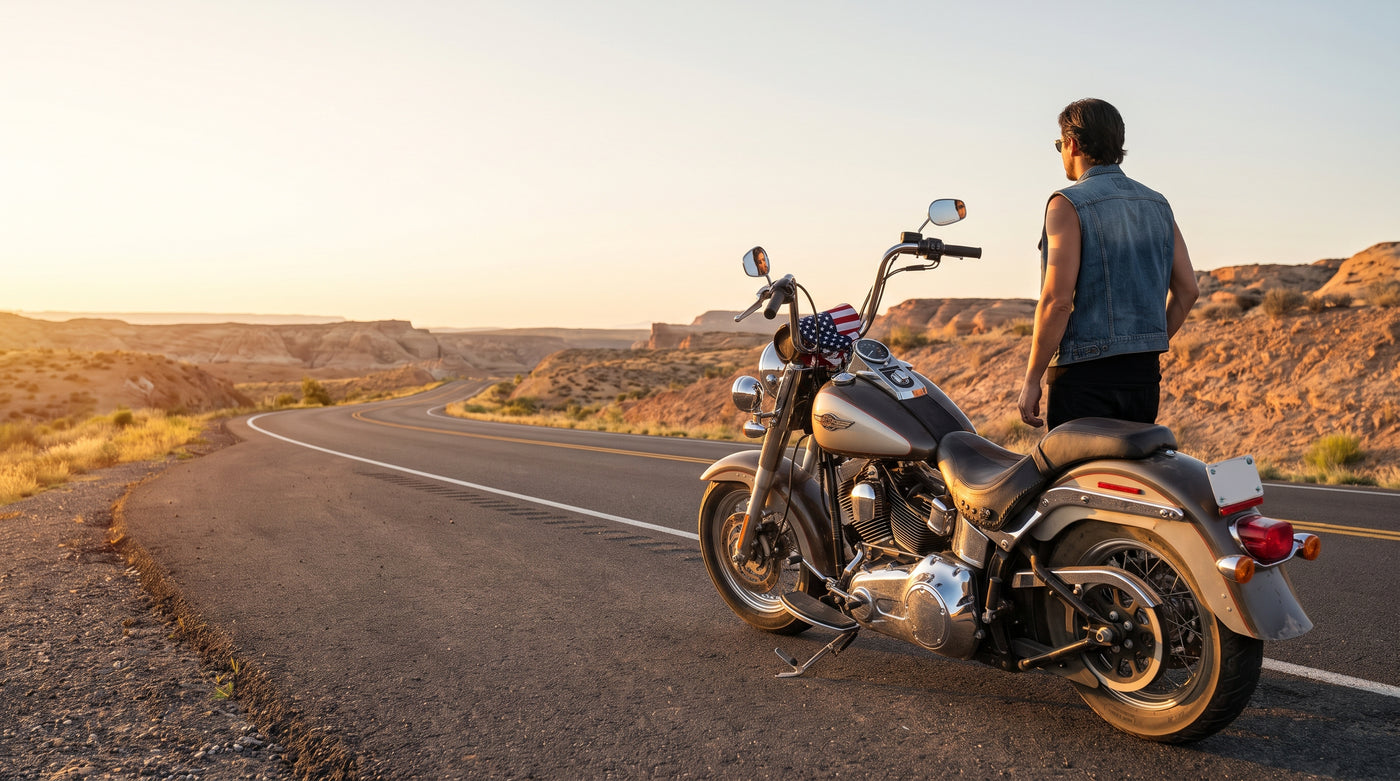
Most men's tank tops start falling apart after two washes. The cheap polyester ones from marketplace sellers stretch at the neck, fade in one season, and pill the first time you layer them under a leather vest. If you ride in summer, you need a tank that handles sweat, sun, engine heat, and vest friction without looking like a rag by August.
This guide covers which fabrics, fits, and styles actually hold up for riders who spend real time in the saddle. You will learn what separates a $6 throwaway men's tank top from one that keeps its shape for years, and which styles pair best with vests, cut-offs, and open-road riding.
What Makes a Biker Tank Top Different from a Gym Shirt
The tank tops in most department stores are built for the gym or the couch. A typical fashion tank uses 3.5 oz polyester-blend fabric, has narrow straps, and a slim body cut. That works fine in an air-conditioned gym. On a motorcycle at 2 PM in July, it fails in three ways.
First, fabric weight. Anything under 5 oz per square yard is going to be see-through when wet and will pill inside a leather vest within weeks. The sweet spot is 5.3 to 6.0 oz ringspun cotton. Second, wider shoulder straps. Narrow straps under 1.5 inches dig into your shoulders when vest leather sits on top. Third, a longer body. Standard tanks run 27 to 28 inches in a medium. Riders leaned forward on a cruiser need 29 to 30 inches so the back does not ride up and expose your lower back to sun and wind.
Gildan's 2200 Ultra Cotton tank weighs 6.0 oz/yd² and has a wider neckline built for layering. That kind of spec is the baseline for what "built for riding" actually means. Compare that to a typical Amazon basics tank at 4.2 oz, and you can feel the difference just by holding both in your hands.
Best Fabrics for Men's Tank Tops on a Motorcycle
100% Ringspun Cotton
The standard for biker wear. Ringspun cotton is softer than open-end cotton because the fibers are twisted tighter before spinning. It absorbs sweat, breathes in heat, and breaks in over time like a favorite pair of jeans. The trade-off: it shrinks 3 to 5% on the first wash if it is not pre-shrunk. A Hanes Beefy-T tank in ringspun cotton, for example, runs 6.1 oz/yd² and holds its shape through 50+ washes without losing its neckline.
Cotton-Poly Blend (60/40 or 50/50)
Lighter, dries faster, and holds its shape through more wash cycles than pure cotton. Good for riders who sweat heavy but do not want to deal with shrinkage surprises. The trade-off is reduced breathability in dead-stop traffic when there is no airflow to wick moisture. Next Level's 6233 CVC tank is a popular 60/40 option at 4.3 oz that dries noticeably faster than pure cotton after a sweaty ride.
Tri-Blend (Cotton/Poly/Rayon)
The softest feel right out of the package. Popular for graphic tees and lifestyle brands. The problem for riders: rayon pills fast under leather friction. If you wear a vest on most rides, a tri-blend tank will look worn and fuzzy within a few months of regular use. It works fine as a standalone casual shirt, but it is not built for layering under gear.
100% Polyester (Skip It for Riding)
This one is counterintuitive. Polyester is marketed as "moisture-wicking," but wicking only works when air moves across the fabric surface. On a motorcycle below 30 mph or sitting in traffic, polyester traps your body heat and holds sweat against your skin. Cotton releases heat. For a 115-mile ride from Phoenix to Tucson in 95-degree weather, cotton keeps you cooler than poly every time.
Biker Tank Top Fabric Comparison
| Fabric | Weight (oz/yd²) | Breathability | Durability Under Leather | Price Range |
|---|---|---|---|---|
| 100% Ringspun Cotton | 5.3 - 6.1 | Excellent | Excellent | $12 - $28 |
| 60/40 Cotton-Poly | 4.3 - 5.5 | Good | Good | $10 - $22 |
| Tri-Blend (Cotton/Poly/Rayon) | 3.8 - 4.5 | Good | Fair (pills under vests) | $14 - $30 |
| 100% Polyester | 3.5 - 4.0 | Poor (traps heat) | Poor | $5 - $12 |
5 Biker Tank Top Styles Every Rider Should Know
1. Classic Ribbed A-Shirt
The old-school undershirt tank with thin-knit ribs and a tight fit. Works under vests and jackets where you want zero bulk. Not ideal as an outer layer since the ribbed knit shows every contour, but at $3 to $5 per shirt, most riders keep a stack of these as disposable base layers for long summer rides.
2. Skull Graphic Tank
The rally staple. A heavyweight cotton tank with a front or back skull print. At Sturgis 2025, skull graphic tanks outsold every other sleeveless design at vendor booths, according to Legendary Buffalo event retailers. If you own one biker tank, this is probably it. The skull and graphic options in the biker tee collection feature screen-printed designs that hold their ink through dozens of wash cycles. Look for water-based ink prints rather than plastisol if you want the graphic to feel soft against your skin instead of sitting on top of the fabric like a sticker.
3. Cut-Off Sleeveless Tee
Take a regular biker tee and cut the sleeves off. The result is thicker fabric than a traditional tank, so it layers better and gives more shoulder coverage. The DIY look fits rally and club culture perfectly. The heavier cotton (usually 5.3 to 6.0 oz) means it drapes with more weight than a standard thin tank. If you go this route, cut about half an inch outside the seam line to keep the armhole from unraveling.
4. Muscle Tee
Wider through the shoulders with a dropped armhole that sits about 2 inches below a standard cut. Best for riders with bigger builds who find traditional tanks too tight across the chest. The wider armhole also vents heat better when you are sitting on a hot seat in traffic. This style works well as an outer layer because the proportions look intentional rather than like a stretched-out undershirt.
5. Racerback Tank
Narrow between the shoulder blades, which channels airflow straight down the spine. Practical for desert and Southwest riding where back sweat is the main comfort problem. Less common in traditional biker culture, but growing at western rallies and long-distance touring events. Pairs well under a leather or denim motorcycle vest because the narrow back panel reduces fabric bunching between the vest and your skin.
How to Get the Right Fit Under a Vest or Jacket
Fit matters more for bikers than for anyone else wearing a tank top, because you are layering gear on top. A tank that looks great in a mirror can bunch, ride up, or dig into your shoulders once you add a vest and lean forward on the bars.
Length: Look for at least 29 inches in a size medium, scaling up proportionally. On a cruiser riding position, your torso stretches forward and a short tank leaves your lower back exposed to sunburn, wind, and road spray. Some biker-specific brands run their tanks at 30 to 31 inches, which is worth the extra inch for riders over 5'10".
Strap Width: Under 1.5 inches, straps dig into your shoulders when vest leather puts pressure on them. Over 2.5 inches, they bunch up and fold under the vest. The 1.75 to 2.0 inch range is the sweet spot for comfort under leather without excess material.
Pre-Shrunk vs. Raw Cotton: If the tag says 100% cotton but does not say pre-shrunk, size up one. Raw cotton shrinks 3 to 5% on the first hot wash and dry cycle. A medium becomes a tight small, which is fine if you planned for it, but frustrating if you did not. When in doubt, wash before your first ride.
Neckline Depth: Standard crew-cut tank necklines sit high. Under a vest, that works. As an outer layer, a slightly deeper scoop (about 3 inches below the collarbone) looks more intentional and less like an undershirt. Most biker-style graphic tanks use this slightly lower neckline by default.
How to Care for Biker Tank Tops So They Last
A $20 tank top that lasts three years beats a $5 tank you replace every two months. But longevity depends on how you wash and dry it, not just the fabric.
Wash cotton tanks in cold water. Hot water accelerates shrinkage and fades screen-printed graphics faster. The American Institute of Laundering found that cold-wash cycles extend garment life by roughly 50% compared to regular hot washes. Turn graphic tanks inside out before washing. This keeps the print face away from the agitator drum and other garments, reducing abrasion on the ink layer.
Skip the dryer when you can. Line drying or flat drying eliminates heat-related shrinkage entirely. If you use a dryer, run it on low heat and pull the tank out while it is still slightly damp. Over-drying is what makes cotton feel stiff and cardboard-like after a few cycles.
Do not use fabric softener on screen-printed tanks. Softener coats the fabric fibers with a silicone layer that breaks down ink adhesion over time. If you want softness, add half a cup of white vinegar to the rinse cycle instead. It softens the cotton without damaging the print.
Common Mistakes When Buying Men's Tank Tops for Riding
1. Choosing Fabric That Is Too Thin
A 3 oz tank under a leather vest becomes see-through when wet and pills within weeks. Leather acts like fine-grit sandpaper against thin fabric with every body movement. If you can see your hand through the fabric when you hold it up to a light, it is too thin for riding use.
2. Ignoring Body Length
Standard-fit tanks are designed for standing upright. On a motorcycle, your torso stretches 2 to 3 inches forward depending on the riding position. A 27-inch tank effectively becomes a crop top on a sportbike lean. This is the number one fit complaint from riders who buy generic tanks online without checking the body measurement.
3. Picking Polyester for Hot Weather
It seems logical since polyester is labeled "moisture-wicking." Wicking needs airflow across the fabric surface to evaporate moisture. On a bike stopped in traffic or cruising below 30 mph, there is not enough airflow to activate the wicking effect. Polyester holds heat against your skin while cotton lets it escape. For rides over 85 degrees, cotton wins every time.
4. Buying Only Black
Black is the default biker color, and it hides road grime well. But black absorbs significantly more solar radiation than lighter colors. On a 95-degree day, a white or charcoal tank under a vest can feel 8 to 12 degrees cooler on your skin compared to black. Keep at least one lighter-colored tank in rotation for peak summer heat. Charcoal is a good middle ground if you want something darker that still reflects more heat than pure black.
What to Look for Before You Buy
A solid men's tank top for riding checks these boxes:
- Fabric weight: 5.0 oz/yd² minimum. 6.0 oz is better for regular vest layering.
- Pre-shrunk label. If the tag does not say pre-shrunk, size up one.
- Double-stitched side seams. Single-stitch tanks split under stress and repeated stretching.
- Shoulder strap width between 1.75 and 2.25 inches.
- Body length of 29 inches or more for a standard medium.
For graphics, screen-printed designs outlast iron-on transfers by years. Iron-ons crack and peel after a handful of washes. Screen-printing sinks pigment into the fabric fibers and holds through dozens of cycles without cracking or fading.
The price difference between a quality riding tank and a marketplace throwaway is usually $8 to $15. But you buy one good tank instead of replacing three cheap ones over the same period. That math works out in your favor every time, and the fit and feel are better from day one.
If you are putting together warm-weather riding gear, the biker tanks and sleeveless collection is where most riders start. Every piece runs 5+ oz cotton with screen-printed graphics built for the road, not the clearance bin.

No comments yet. Be the first rider to weigh in.