
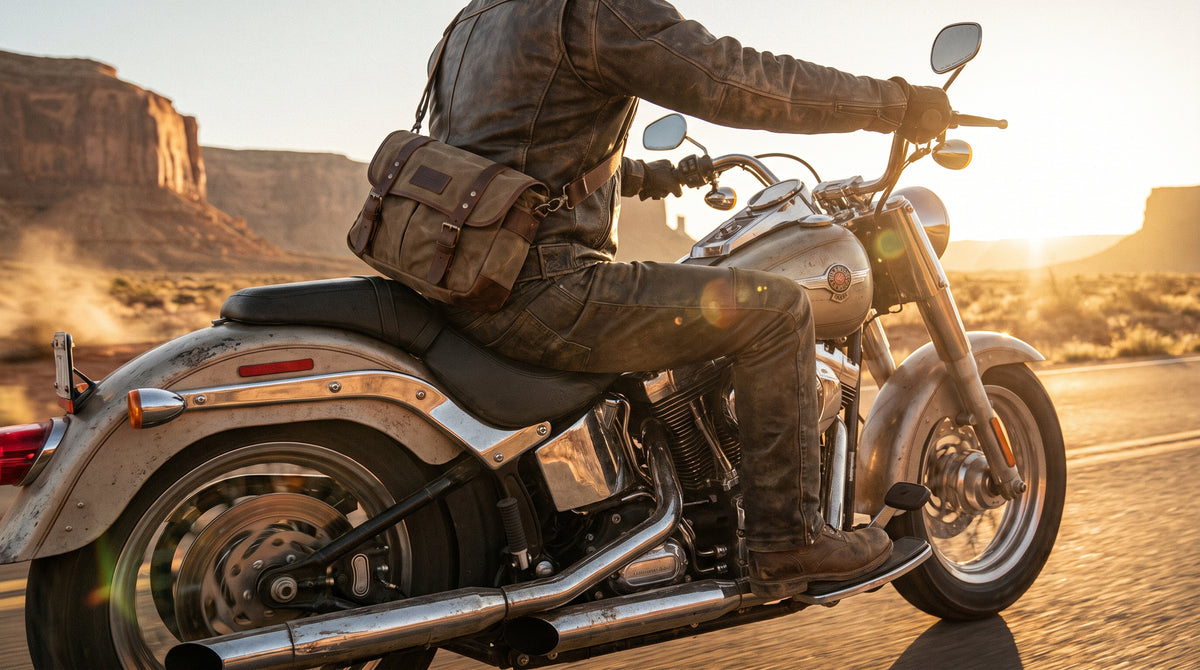
A backpack shifts every time you check your blind spot. A tank bag blocks your forward lean. Saddlebags are locked to the bike, useless when you walk into a gas station or coffee shop. A motorcycle crossbody bag solves all three problems at once. It sits diagonally across your chest, stays flat against your torso at 70 mph, and comes off in one motion when you park. For riders who carry a phone, wallet, keys, and maybe a rain layer, it is the most practical option nobody talks about.
This guide covers the styles, materials, and features that separate a riding crossbody bag from a fashion one. You will know exactly what to look for before spending a dollar.
Why a Motorcycle Crossbody Bag Works Better Than a Backpack
A standard backpack sits behind your shoulders, pulling your center of gravity backward at speed. At 60 mph, wind drag on a loaded 15-liter backpack adds roughly 4 to 6 pounds of rearward pull. On a sport bike that feels like nothing. On a cruiser with an upright seating position, it adds up over a 2-hour ride and fatigues your lower back faster than riding without any bag.
A crossbody bag distributes weight across one shoulder and the opposite hip. The diagonal strap pulls the bag tight against your chest or back, keeping it from shifting during lane changes or hard braking. Most motorcycle crossbody bags add a secondary stabilizer strap that clips around your waist or under your opposite arm, locking the bag in place even at highway speed.
The size constraint is actually a benefit. A crossbody bag holds 3 to 8 liters, just enough for essentials. You are not tempted to overpack, which keeps your riding posture natural and your movements unrestricted. For daily commuters and short-trip riders, that is exactly the right capacity.

Types of Motorcycle Crossbody Bags
Sling Bags
A sling bag is the simplest crossbody design: a single wide strap, one main compartment, and a slim profile. Most weigh under 12 ounces empty. The Chrome Industries Kadet is a popular sling among urban motorcycle commuters because its buckle closure opens one-handed at a stoplight. Sling bags work best for riders carrying a phone, wallet, sunglasses, and a few small tools.
Tactical and Chest Bags
Tactical crossbody bags use MOLLE webbing on the exterior for attaching pouches, and they typically include a padded back panel with mesh for airflow. The chest-rig style sits high on the front of the body, keeping weight off the lower back entirely. These bags run 5 to 10 liters and often include a hidden pocket against the body for cards or cash.
Messenger-Style Bags
A messenger bag is the largest crossbody option, usually 8 to 15 liters. The wide rectangular shape fits a tablet or a compact rain jacket flat. The trade-off: messenger bags sit lower on the hip and can shift on aggressive riding. They work best at city speeds or on cruisers with relaxed ergonomics. Look for models with a padded shoulder strap and a secondary stabilizer clip to keep the bag from sliding forward under braking.

What to Look for in a Riding Crossbody Bag
Material
Cordura 1000D nylon is the standard for motorcycle-specific bags. It resists abrasion, handles rain without soaking through immediately, and does not fade in UV. Leather crossbody bags look better with a cruiser aesthetic but weigh more and need conditioning every few months. Avoid thin polyester and uncoated canvas. Both absorb water fast and tear on the first slide across asphalt.
Closure System
Zippers are the most secure. YKK zippers with a water-resistant coating (not waterproof, just resistant) handle light rain. Magnetic buckles open faster at stops but can pop open under strong vibration on rough roads. Roll-top closures offer adjustable capacity and decent water resistance, but they take two hands to open.
Stabilizer Strap
This is the feature that separates a motorcycle crossbody bag from a regular one. A secondary strap clips around the torso and prevents the bag from swinging forward when you brake or lean. Without it, the bag migrates toward your belly at every stoplight. Any crossbody bag you plan to ride with at speeds above 40 mph should have a stabilizer strap or a waist clip.
Reflective Elements
A 2-inch reflective strip on the strap or body panel makes the bag visible from 300 feet at night. Most car drivers focus on the center of a motorcycle's rear profile. A crossbody bag on your chest or shoulder adds a reflective point higher on your body, outside the typical sight line, which can catch a driver's headlights and improve your visibility at intersections.

Motorcycle Crossbody Bag vs. Other Bag Types
| Bag Type | Capacity | On/Off Bike | Wind Stability | Best For |
|---|---|---|---|---|
| Crossbody / Sling | 3-8 L | Stays with you | High (with stabilizer) | Daily carry, commuting |
| Backpack | 15-30 L | Stays with you | Low (catches wind) | Touring, heavy loads |
| Tank Bag | 5-20 L | Stays on bike | High (sits low) | Maps, phone, quick access |
| Saddlebags | 10-40 L | Stays on bike | High | Long trips, heavy gear |
| Leg Bag | 1-3 L | Stays with you | High | Phone, wallet, keys only |
A crossbody bag fills the gap between a leg bag (too small for anything beyond a phone) and a backpack (too bulky for a 20-minute commute). If you need to carry a water bottle, a compact tool roll, or a thin rain shell on top of your daily essentials, a crossbody is the right size.

5 Mistakes Riders Make with Crossbody Bags
- Wearing the bag on the back instead of the front. A crossbody bag worn across the back catches wind like a small sail. Wear it across the chest or diagonally on the front of the body. The strap sits between your shoulder blades, and the bag rests against your ribs.
- Skipping the stabilizer strap. Without the secondary strap, every hard brake sends the bag swinging forward into your arms. At highway speed, it can shift enough to restrict your movement. Clip the stabilizer every single ride.
- Overpacking a sling bag. A 5-liter sling bag that is stuffed to capacity loses its slim profile and starts bouncing. Pack it to about 75% and keep the load flat. If you regularly need more than 8 liters, switch to a small backpack or add a tank bag to the bike.
- Choosing a bag without water resistance. An unexpected rain shower soaks an uncoated canvas bag in under 3 minutes. Your phone, wallet, and anything paper inside is at risk. Cordura nylon or waxed canvas with a water-resistant zipper handles light rain. For heavy rain, carry a $3 dry bag liner inside.
- Ignoring strap padding on longer rides. A thin, unpadded nylon strap digs into your shoulder after 30 minutes of highway riding. A padded or wide strap (2 inches minimum) distributes the load across a wider area and prevents the hot-spot pressure that makes you shift and fidget while riding.
If you are looking for a motorcycle crossbody bag built for actual riding, the motorcycle bags collection has sling, shoulder, and crossbody styles in leather and Cordura, all sized for riders who need quick on-and-off without the bulk of a full backpack.
No comments yet. Be the first rider to weigh in.