
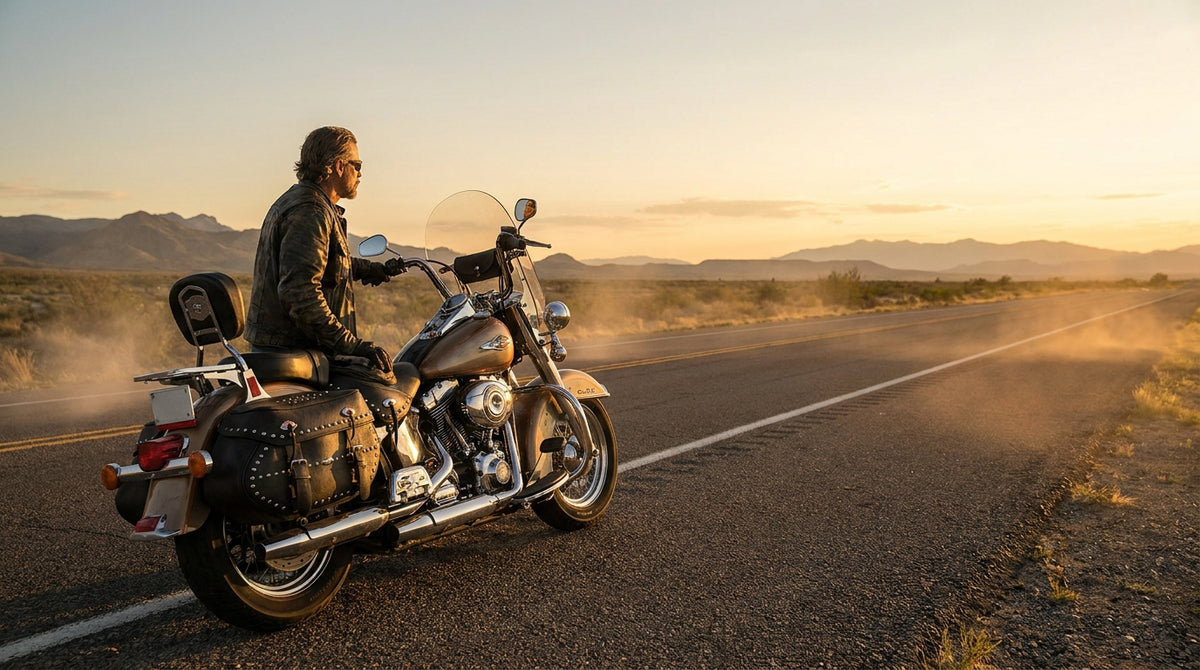
You are doing 70 mph on the highway and a gust of wind slams grit straight into your left eye. Your regular Ray-Bans slide down your nose because they were never built for this. That one second of squinting at speed is how crashes start, and it is completely avoidable.
This guide breaks down the best motorcycle sunglasses for men by protection level, lens type and frame style. You will know exactly what separates riding-grade eyewear from fashion sunglasses, which lens tints work for different conditions and which common mistakes to skip. If you ride without a full-face shield, this matters more than you think.
Why Regular Sunglasses Fail on a Motorcycle
Standard fashion sunglasses use lenses that are 1.5 mm thick on average. The ANSI Z87.1 impact standard, which most motorcycle-rated eyewear meets, requires lenses that survive a 1-inch steel ball dropped from 50 inches. Your drugstore aviators will not pass that test.
Beyond impact, the real problem is wind. At 55 mph, wind hits your face at roughly 80 feet per second. Without a wraparound frame or foam gasket, air funnels around the lens edges and dries out your eyes in minutes. That leads to tearing, blurred vision and constant blinking. None of that belongs on a two-lane road.
Regular frames also sit loose. Motorcycle vibration and head checks at intersections shake standard temples off your ears. Riding-specific frames use rubberized nose pads and curved temples that grip, even when you are sweating inside a half-shell helmet.
There is also the bug factor. At 60 mph, a June beetle hits with roughly the same force as a small BB pellet. A standard CR-39 plastic lens can crack from that impact. Polycarbonate lenses, the standard in motorcycle eyewear, flex and absorb that hit without damage. If you ride rural roads during summer, impact resistance is not optional.
What Makes a Good Pair of Motorcycle Sunglasses for Men
Four things matter, in this order:
- Wind seal. A foam gasket or deep wraparound curve that blocks peripheral airflow. This is the single biggest difference between riding eyewear and everything else.
- Impact-rated lenses. Look for ANSI Z87.1 or ANSI Z87.1+ (high-velocity) markings. Polycarbonate lenses are the standard here. They are lighter than glass and shatter-resistant.
- Anti-fog coating. Foam-padded frames trap heat. Without anti-fog treatment, your lenses cloud up at every red light. Quality riding sunglasses coat the inner lens surface or use vented foam to manage airflow.
- UV protection. UV400 blocks 99.9% of UVA and UVB rays. Anything less is not worth wearing.

Best Lens Colors for Motorcycle Riding
Lens tint is not cosmetic on a bike. The wrong color in the wrong light kills depth perception. Here is what each tint actually does, based on light transmission ratings:
| Lens Color | Light Transmission | Best For | Avoid In |
|---|---|---|---|
| Smoke / Gray | 12-18% | Bright midday sun, highway | Dusk, tunnels, overcast |
| Amber / Yellow | 65-80% | Overcast, dawn, dusk, fog | Direct bright sun |
| Clear | 90%+ | Night riding, rain | Bright sun (no UV help) |
| Brown / Copper | 18-25% | Mixed conditions, partial cloud | Night, heavy overcast |
| Photochromic | 18-80% (auto) | Long rides through changing light | Rapid tunnel-to-sun transitions |
| Mirror / Flash | 10-15% | Extreme glare, desert, snow | Anything below full sun |
Amber lenses are the most versatile single choice for riders who do not want to carry two pairs. They boost contrast enough to pick out road hazards like gravel patches and oil slicks, and they work from morning through late afternoon. Smoke is the go-to for pure sunny highway riding.
Wraparound vs Foam-Padded Frames
These are the two main approaches to wind protection, and they solve the problem differently.
Wraparound (No Foam)
A curved frame that hugs your face and blocks most side wind by geometry alone. The advantage: no foam to wear out, easy to clean, works with most half-shell and three-quarter helmets. Brands like Bobster and Wiley X build their motorcycle lines around this shape. The downside is that small gaps at the top and bottom still let some wind through above 50 mph.
Foam-Padded (Gasket Seal)
A removable or fixed foam strip lines the inner frame edge, creating a seal against your skin. Wind protection at speed is nearly complete. The trade-off: foam traps heat and can cause fogging if the anti-fog coating is weak. Foam also compresses over time and needs replacing every 12 to 18 months on daily-wear pairs. Some riders swap between foam-in for highway days and foam-out for city riding.
For riders who split time between highway cruising and city stops, a convertible pair with removable foam gives the best of both. Slide the foam in for the interstate stretch, pop it out when you are crawling through downtown traffic and your face needs airflow.
Frame material matters here, too. Nylon TR-90 frames weigh around 25 to 30 grams, roughly half the weight of acetate fashion frames. Over a 4-hour ride, that difference adds up. Lighter frames put less pressure on your nose bridge and temples, which means fewer adjustment stops and less fatigue. Most dedicated men's motorcycle sunglasses use TR-90 or grilamid nylon for exactly this reason.
Polarized vs Non-Polarized for Riders
Polarized lenses cut horizontal glare from wet roads, car hoods and flat pavement. On a sunny day after rain, the difference is dramatic. A University of Alabama at Birmingham study on driving visibility found polarized lenses reduced recovery time from glare by up to 50% compared to standard tinted lenses.
But polarized riding is not perfect. Polarization can make LCD screens harder to read. If your bike has a digital dash, GPS or phone mount, you may notice rainbow distortion or dimming at certain angles. Test this before committing. Tilt your head side to side while looking at your phone screen through polarized lenses. If it goes dark at 45 degrees, that is the polarization filter working, and it will do the same to your dash.
If your motorcycle has an analog gauge cluster, polarized is the better choice. If you rely on a digital display, non-polarized with a quality anti-glare coating gives you clarity without the screen interference.
One more thing about polarization and motorcycles: polarized lenses can also affect how you see oil slicks and wet patches on pavement. Polarization cuts reflected light, which is the same light that makes an oil slick visible. In some conditions, a polarized lens can make a wet road look uniformly dry when it is not. Keep this in mind if you ride in areas with frequent rain or industrial runoff.
Vintage and Old-School Biker Sunglasses That Still Perform
The classic aviator shape has been on riders' faces since the 1940s. The original design by Bausch and Lomb for military pilots used a teardrop lens that covered the full field of vision. That same geometry works on a motorcycle, but only if the frame adds modern wind protection.
Modern vintage-style motorcycle sunglasses keep the old-school look but add foam padding, polycarbonate lenses and rubberized temples. You get the Marlon Brando aesthetic with actual ANSI-rated impact protection. The key is picking a pair with enough wraparound curve. Flat-front aviators look sharp at the bar but leave your peripheral vision exposed to wind on the road.
Lens size matters for the vintage look, too. Original military aviators used a 58 mm lens. Most modern motorcycle aviators bump that to 62 mm for better coverage. If you have a narrower face, stick to the 58 mm size to avoid a frame that sits too wide and lets wind in at the temples. Wider faces do better with the 62 mm version and a cable-style temple that hooks behind the ear.

If you want the full retro look, pair vintage-style sunglasses with a set of motorcycle goggles as a backup. Goggles give you complete wind seal on open-face helmets and flip up to your forehead when you stop.
How to Keep Motorcycle Sunglasses from Fogging
Fogging happens when warm, humid air from your face meets the cooler lens surface. On a bike, this is worst at low speeds and stops. Three fixes that actually work:
- Anti-fog spray or wipes. Cat Crap (yes, that is the brand name) and Rain-X anti-fog both leave a hydrophilic film that prevents condensation from beading into vision-blocking droplets. Reapply every 2 to 3 rides.
- Vented foam padding. Some foam-padded frames use channeled or perforated foam that allows just enough airflow to prevent moisture buildup without letting full wind through. Bobster's line of vented-foam riding glasses uses this approach.
- Double-lens construction. A few higher-end motorcycle sunglasses use a dual-pane design similar to ski goggles. The air gap between inner and outer lens acts as thermal insulation. This is the most effective anti-fog solution, but it adds weight and cost.

5 Common Mistakes When Buying Motorcycle Sunglasses
- Buying based on looks alone. A sharp-looking pair with no wind protection is useless above 35 mph. Always check for wraparound coverage or foam padding before anything else.
- Skipping the helmet fit test. Not every frame fits under every helmet. Thick temples can press against your skull inside a snug half-shell and cause pressure headaches after 30 minutes. Try your sunglasses on with your helmet before buying.
- Choosing glass lenses. Glass is optically clearer, but it shatters on impact. A rock kicked up by a truck at highway speed will crack glass. Polycarbonate or Trivex lenses are the safe call for riding.
- Ignoring lens color for conditions. Wearing dark smoke lenses into dusk is a real hazard. If you ride through changing light, carry a second pair with amber or clear lenses, or invest in photochromic lenses that adjust automatically.
- Settling for zero UV protection. Cheap tinted lenses darken your vision without blocking UV rays. Your pupils dilate behind the dark tint, and the unfiltered UV does more damage than riding with no sunglasses at all. Always confirm UV400 rating.
Picking the Right Pair for Your Riding Style
Highway cruiser riders need maximum wind protection. Go foam-padded with smoke or brown polarized lenses. City commuters benefit from lighter tints and removable foam so they can adapt at every stoplight. Touring riders who log 300-plus miles per day should look at photochromic lenses so they never have to swap eyewear mid-ride.
For any style of riding, fit under your specific helmet is the real deciding factor. Take your helmet to the shop or order from a place with free returns. Put the sunglasses on first, then slide the helmet over them. Check for temple pressure points, lens-to-visor clearance and whether the nose bridge shifts when you tighten the chin strap. A pair that feels perfect on your face but pinches under your Shoei is not the right pair.
Whichever style fits your riding, the non-negotiables stay the same: ANSI-rated impact protection, UV400, and a frame that stays put at speed. If you are looking for a solid starting point, the motorcycle sunglasses collection has riding-grade pairs in wraparound, vintage and padded styles. Find something that fits your face and your helmet, and stop squinting through the next ride.


No comments yet. Be the first rider to weigh in.