
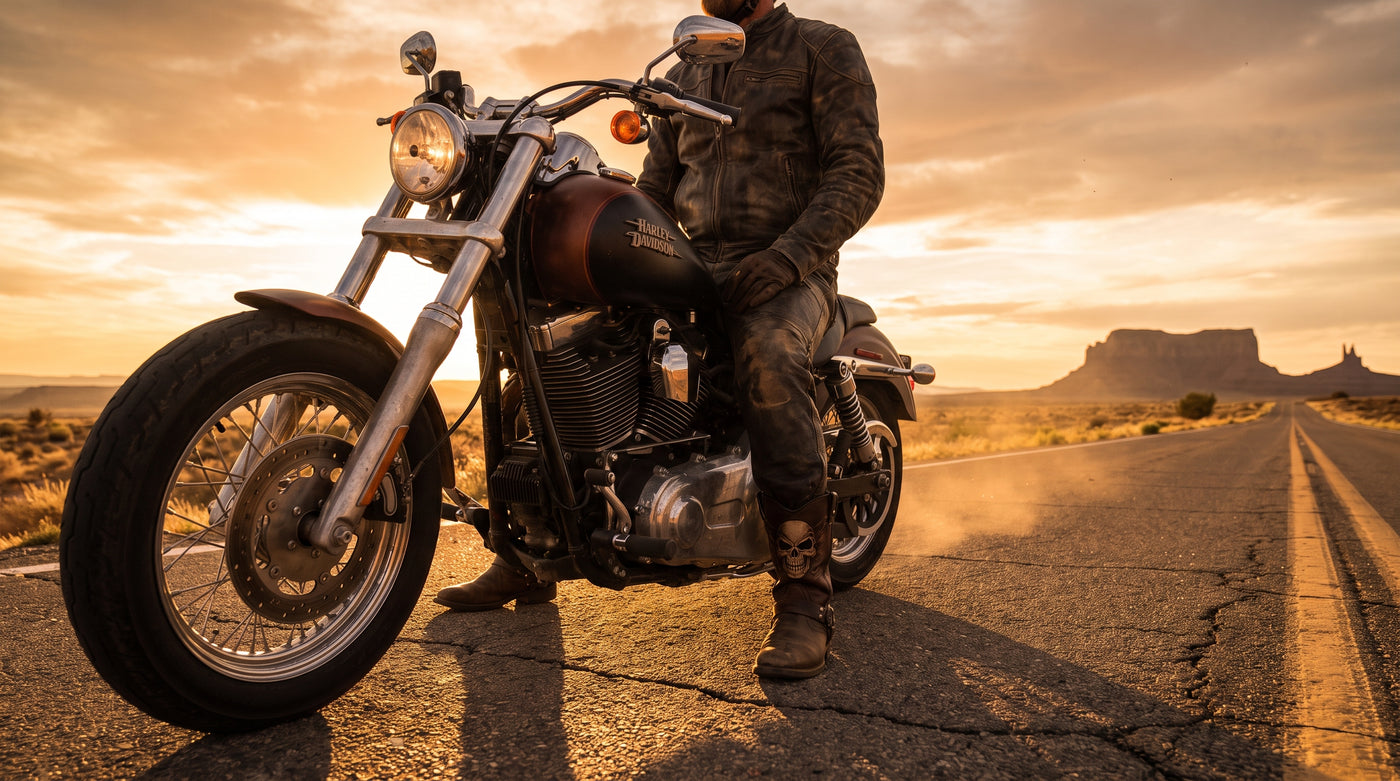
Skull boots look tough in photos. The problem is that half the pairs sold online are cheap vinyl with a skull graphic printed on, and they fall apart after a few hundred miles. The stitching pops at the ankle, the sole peels off the welt, and you are left with a boot-shaped piece of garbage that cannot protect your foot from a puddle, let alone a highway slide. Skull boots for men deserve better than that.
This guide breaks down the real options for riders who want skull-themed boots built with actual leather, proper sole construction, and enough structure to handle daily riding. You will learn which styles work on a motorcycle, how leather skull boots compare to synthetic ones, how to size them, and the specific mistakes that waste money. If you want the skull look and real riding performance, keep reading.
Why Skull Boots Are a Staple in Biker Culture
Skull imagery has been part of motorcycle culture since World War II, when returning veterans formed the first outlaw riding clubs. The skull symbol crossed over from military insignia into biker patches, rings, and eventually boots. Today it signals membership in a riding lifestyle without needing a club affiliation or a 1% patch on your back.
From a practical standpoint, skull boots work because the designs are stamped, engraved, or molded into the leather itself. Unlike printed graphics on synthetic materials, a properly embossed skull on full-grain cowhide wears in rather than wearing off. The Harley-Davidson Faded Glory boot, for example, uses a debossed skull on the shaft that looks sharper after 10,000 miles than it did new. That aging process is part of what draws riders to real leather skull boots over the printed alternatives that peel within a season.
Skull boots also cross over into street fashion. Brands like New Rock and Demonia sell thousands of pairs to non-riders, but those fashion versions rarely have the sole grip, ankle support, or toe reinforcement that actual riding demands. Knowing the difference saves you from buying a boot that looks right but fails on the road. If you have seen the Breaking Bad skull boots that Walter White wore, those were fashion-first designs. They work for a TV set, not for 300 miles of highway in August heat.
Best Skull Boots for Men: 5 Styles That Work on the Bike
Not every skull boot is designed for motorcycling. Here are five styles that combine the skull aesthetic with real riding construction.
1. Lace-Up Skull Ankle Boots
Lace-ups give you the most control over fit. A good pair uses 6 to 8 inch shafts, speed hooks at the top, and a reinforced toe box. The skull detail usually sits on the tongue, the side panel, or the heel counter. For riders, the key advantage is adjustability: you can tighten over thick socks in cold weather and loosen when your feet swell in summer heat. Look for oil-resistant rubber outsoles, since leather soles get slippery on wet foot pegs.

2. Harness Skull Boots
Harness boots add a metal ring and leather strap around the ankle, giving skull hardware a natural home. The ring sits right where the shift lever contacts your foot, adding protection exactly where you need it most. A quality harness skull boot in full-grain leather with a Goodyear welt will run $180 to $300, but the construction lasts years. The skull hardware on better pairs is cast zinc alloy or solid brass, not hollow pot metal that bends the first time you drop the bike.

3. Engineer Skull Boots
The engineer boot is the original pull-on riding boot. Adding skull embossing or buckle details does not change the fundamental design: tall 11 to 13 inch shaft, double buckle straps, no laces to catch on foot pegs. Engineer skull boots work best on cruisers and touring bikes where your feet rest on forward controls. The shaft length covers your shin and protects against engine heat. Chippewa and Carolina both make engineer frames that independent boot makers use as the base for custom skull work.
4. Tactical Skull Boots
Tactical skull boots blend modern construction with biker aesthetics. They typically use a combination of leather and Cordura nylon panels, composite toe caps, and side-zip entry. The skull motif appears as a molded rubber logo on the heel or a stamped design on the leather vamp. These boots sit 8 to 10 inches tall and weigh noticeably less than full-leather alternatives. TCX makes several models in this space with medial ankle armor built in, so you get CE-rated protection without bolting on external guards.
5. Sugar Skull Boots
Sugar skull boots take the Dia de los Muertos art style and apply it to motorcycle footwear. The floral patterns and bright colors work best on embroidered leather rather than printed synthetic, because embroidery holds up against scuffing and UV exposure. These boots cross over well between riding and casual wear. Most sugar skull designs target women riders, but unisex options in genuine leather biker boots are becoming more common from independent makers who stitch the patterns by hand onto full-grain cowhide.
Leather vs. Synthetic Skull Boots: What Actually Lasts
The material question matters more on skull boots than on plain ones because the skull artwork is only as durable as the surface it sits on. Here is how the two main options compare for riders.
Full-grain cowhide at 1.2 to 1.4 mm thickness is the standard for serious riding boots. Skull details embossed or engraved into this leather become part of the hide itself. They cannot peel, chip, or wash off. The leather molds to your foot over 40 to 60 hours of break-in, breathes enough to prevent overheating, and resists abrasion in a slide far better than any synthetic.
PU (polyurethane) and vinyl boots cost $30 to $70. Skull designs on synthetic materials are screen-printed or heat-transferred onto the surface. Within 2,000 to 3,000 miles, flex point cracking appears around the ankle and toe box, and the printed skull starts flaking off. You cannot re-sole a bonded synthetic boot, so when the outsole separates, the whole boot is trash.
The math works out clearly. A $190 pair of real leather skull boots lasts 5 to 8 years with proper care and one resole. Three rounds of $50 synthetics over the same period costs $150 and delivers worse protection every single ride. Leather is cheaper per mile and safer per hour.
How to Size Skull Boots for All-Day Comfort
Skull boots follow the same sizing rules as any motorcycle boot: most run a half-size to a full size large compared to sneakers. If you wear a 10 in athletic shoes, start at 9.5 in leather skull boots for men.
Width matters as much as length. Skull boots with heavy hardware around the ankle can feel tighter through the instep than plain boots in the same size. If you have wider feet, look for "EE" or "wide" options. Cramped toes reduce your feel on the brake and shift levers, which is a real safety issue at highway speed.
Try boots on in the afternoon when your feet are largest, and wear the same riding socks you use on the bike. Leather stretches about half a size during break-in, so a slightly snug fit on day one is expected. If your toes are crushed or your heel lifts more than a quarter inch, that size is wrong no matter how much break-in you give it.
For online orders, measure your foot length in centimeters and compare against the brand's specific size chart rather than trusting a US/EU conversion table. Size charts vary between manufacturers by up to a full size, so Chippewa's 10 and TCX's 10 may not be the same boot. Trace your foot on paper, measure heel to toe in cm, and match that number to the brand chart. It takes 30 seconds and saves you a return shipment.
Skull Boots Compared: Style, Protection and Price
Here is how the five main skull boot styles stack up on the details that matter for daily riding.
| Style | Height | Entry | Skull Detail | Best For | Price Range |
|---|---|---|---|---|---|
| Lace-Up | 6 to 8 inches | Laces + zip | Tongue, heel | Street, commuting | $120 to $200 |
| Harness | 10 to 12 inches | Pull-on | Ring, buckle | Cruisers, rallies | $180 to $300 |
| Engineer | 11 to 13 inches | Pull-on | Shaft emboss | Cruisers, touring | $200 to $350 |
| Tactical | 8 to 10 inches | Side zip | Molded logo | Daily commute | $150 to $280 |
| Sugar Skull | 7 to 10 inches | Varies | Embroidery | Cruisers, casual | $140 to $260 |
All five styles protect your feet adequately when built with real leather and proper sole construction. The choice comes down to your riding position, your bike type, and how much ankle coverage you need. Cruiser riders on forward controls benefit from the taller shaft of an engineer or harness boot. Commuters who walk between rides do better with a lace-up or tactical style that is easier to move in off the bike.
4 Mistakes Riders Make When Buying Skull Boots
1. Choosing looks over construction. A skull boot with a sick design but a glued-on sole and no toe reinforcement will not survive real mileage. Always check the sole attachment method. Goodyear welt or Blake stitch means the boot can be resoled. Cement (glue) only means the boot is disposable. The skull art means nothing if the boot falls apart by mile 5,000.
2. Buying printed skulls on synthetic material. Heat-transferred skull graphics peel and crack at the flex points within months. Embossed, engraved, or embroidered designs on real leather are the only option that lasts. If you can feel the design sitting on top of the surface rather than pressed into it, walk away.
3. Ignoring the sole for wet conditions. Many mens skull boots ship with smooth leather soles that look vintage but become ice rinks in rain. Oil-resistant rubber outsoles with a shallow lug pattern, like Vibram's 430 Mini Lug, give you grip on wet pavement and gas station concrete without catching on foot pegs.
4. Sizing too tight around skull hardware. Skull buckles, rings, and metal accents add bulk around the ankle and instep. If you are between sizes, go up. A half-size too large with a thicker insole is far more comfortable than a half-size too small with metal pressing into your ankle bone for 200 miles.
Finding Skull Boots Built for Real Riding
The best skull boots combine the artwork you want with the protection you need. Full-grain leather, a stitched sole, oil-resistant rubber, and skull details that are pressed into the material rather than printed on top. That combination holds up for years of actual highway miles.
If you are shopping for a pair, the leather motorcycle boots collection is where to start. Handmade construction, real leather, and designs built for riders who put serious miles on their boots.

No comments yet. Be the first rider to weigh in.