
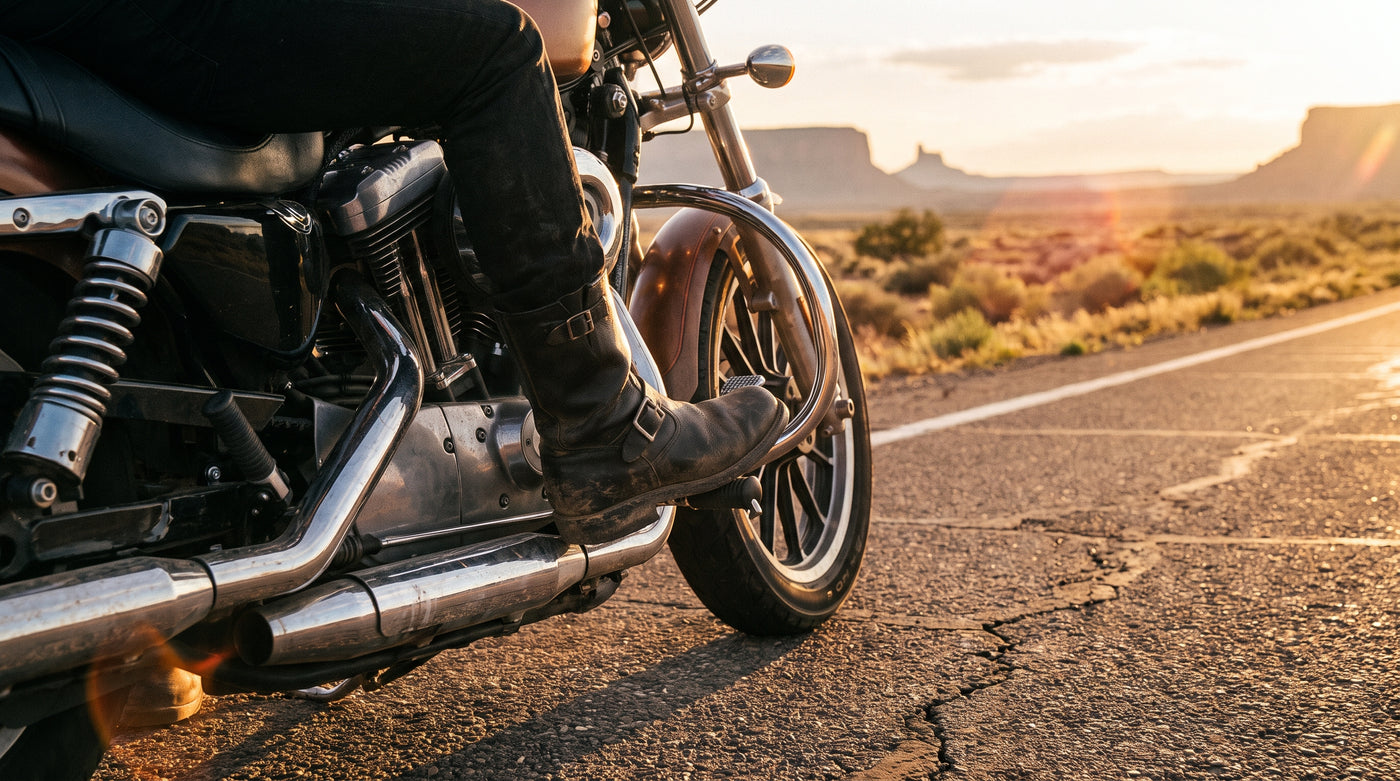
A buddy showed up to a group ride last spring wearing $40 "motorcycle boots" from a no-name marketplace seller. By mile 80, the sole was separating, his socks were soaked from zero waterproofing, and he finished the last 50 miles in gas-station sandals. Black biker boots look simple enough to buy. Getting the wrong pair, though, turns a solid ride into a painful one you will not forget any time soon.
This guide covers the real differences between black biker boots that hold up on the road and the ones that fall apart before you finish breaking them in. You will learn how leather types compare, which boot styles suit which kind of riding, how to nail your sizing, and the specific mistakes that cost riders money. If you ride, your boots matter more than almost any other piece of gear you own.
Why Riders Pick Black Biker Boots Over Every Other Color
Walk through any bike rally parking lot and count boot colors. Black outnumbers everything else by a wide margin, and it is not just about looks. Black leather hides road grime, chain grease, and scuff marks that would ruin lighter colors in a single ride. A pair of tan or brown boots shows every oil spot the moment you park at a gas station. Black ones just keep looking like they belong on a motorcycle.
There is a durability reason, too. Full-grain black cowhide, the kind used in boots like the Red Wing Engineer 2268, develops a deeper patina over time instead of fading. That aged look is part of what makes authentic leather biker boots worth the investment over synthetic alternatives that crack and peel after one season.
Black also matches everything in your riding wardrobe. Leather vest, denim, riding jacket, chaps. You never have to think about whether your boots clash with the rest of your gear. That sounds minor until you are packing for a week-long rally and realize one pair of black biker boots covers every situation you will run into.
Full-Grain Leather vs. Synthetic: What Holds Up on the Road
The single biggest factor in whether black biker boots last one season or ten years comes down to the leather. Full-grain cowhide, typically cut at 1.2 to 1.4 mm thickness for motorcycle boots, is the top layer of the hide with the original grain pattern left intact. It resists abrasion far better than processed leather, molds to your foot shape over time, and breathes enough to keep your feet from overheating on summer rides.
Corrected-grain leather (often labeled "genuine leather" on budget boots) has been sanded down and stamped with an artificial grain pattern. It costs less and looks decent out of the box. But it wears through faster, especially around the toe box and heel counter where your foot flexes against the shift lever hundreds of times per ride.
Synthetic boots made from PU (polyurethane) or vinyl bonded to fabric typically cost $30 to $60. They feel stiff from day one, and they do not break in. They break down. After 3,000 to 5,000 miles, most synthetic boots show visible cracking along the flex points. A quality pair of full-grain real leather biker boots for men will outlast three or four rounds of throwaway synthetics, making them cheaper per mile over the long haul.
5 Black Biker Boot Styles Every Rider Should Know
Not every biker boot does the same job. Here are the five main styles worth knowing, along with what each does well and where it falls short.
1. Engineer Boots
The engineer boot is the original old school biker boot. Pull-on design, no laces, with a buckle strap across the instep and another at the top of the shaft. Chippewa's 11-inch Steel Toe Engineer (style 27899) is a reference point in this category: Vibram sole, full Goodyear welt construction, and a 12-inch shaft for serious ankle and shin coverage. Engineers offer a clean silhouette and strong protection. The trade-off is they take longer to pull on and off, and the lack of laces means you cannot fine-tune the fit over the instep.

2. Harness Boots
Harness boots share the pull-on design of engineers but add a metal ring and leather strap around the ankle. The Frye Harness 12R, in continuous production since 1977, basically defined this category. For bikers, the metal ring sits right where the shift lever contacts your foot, adding a layer of protection exactly where you need it most. These are the badass biker boots you see at Sturgis and Daytona. They look aggressive without trying too hard, and the ring hardware doubles as functional armor on the shift side.

3. Lace-Up Combat Style
Lace-up biker boots give you the most control over fit. You can tighten them over thick wool socks in cold weather and loosen them when your feet swell in 95-degree heat. Most lace-ups in the motorcycle space sit 8 to 10 inches tall and feature speed hooks at the top for quick lacing. The main drawback: laces can catch on foot pegs or shift levers if you do not tuck them properly. A side zip solves that problem on most modern designs.

4. Tactical Riding Boots
These blend traditional motorcycle boot construction with modern materials like Cordura nylon panels, composite toe caps, and oil-resistant rubber outsoles. Brands like TCX and ICON build boots specifically for daily street riding, with reinforced heel cups and medial ankle armor. Most come with side-zip entry for fast on-and-off. If you commute on your bike five days a week, tactical boots deserve a serious look for their mix of protection and convenience.
5. Ankle Boots
Ankle biker boots stop below the calf, usually at 6 to 7 inches tall. They are easier to walk in once you get off the bike, and they work well for cruiser-style riding where your feet sit flat on forward controls. The trade-off is less shin protection and reduced ankle support during a slide. For riders who split their time between the saddle and the sidewalk, ankle boots hit a practical middle ground that taller styles cannot match.

How to Size Black Biker Boots for All-Day Comfort
Motorcycle boots do not size the same as sneakers. Most biker boots for men run a half-size to a full size large, especially pull-on styles like engineers and harness boots. If you wear a 10 in athletic shoes, start by trying a 9.5 in leather motorcycle boots.
Leather stretches during break-in. A pair of full-grain boots will give about 0.5 to 1 full size as the leather conforms to your foot shape. That means a slightly snug fit out of the box is normal and desirable. If boots feel comfortable from the very first minute, they will probably be too loose after a month of riding, and you will end up adding insoles to compensate.
Width matters as much as length. Riders with wider feet should look for boots marked "EE" or "wide." Cramped toes reduce your control over brake and shift levers because you lose feeling through a numb toe box. Try boots on in the afternoon when your feet are at their largest, and wear the same socks you actually ride in. Measure both feet, since most people have one foot slightly larger, and order for the bigger one.
Breaking In Black Leather Biker Boots Without the Pain
New leather boots are stiff. That is a feature, not a defect. It means the leather is thick enough to protect your feet and ankles. The break-in period for quality full-grain boots runs about 40 to 60 hours of wear, or roughly 2 to 3 weeks of daily use.
Skip the online shortcuts. Do not soak your boots in water. Do not blast them with a hair dryer. Both methods damage the leather fibers and weaken the boot structure faster than years of normal riding would. Instead, wear them around the house for an hour or two each day during the first week. Your body heat and natural foot moisture will soften the leather at the right pace without forcing it.
A neutral leather conditioner like Bickmore Bick 4 helps speed the process along safely. Apply a thin coat after the first week of wear. This keeps the leather supple without over-softening it. Avoid mink oil on black boots, as it can over-saturate the grain and make the leather too soft for proper ankle support.
If you feel a hot spot on your heel or instep during the break-in period, apply moleskin over it before your next wear session. Blisters slow the whole process down because you start avoiding the boots entirely, which defeats the purpose.
Black Biker Boots Compared: Engineer vs. Harness vs. Lace-Up
Here is how the three most popular black biker boot styles stack up on the details that actually matter for riding.
| Feature | Engineer | Harness | Lace-Up |
|---|---|---|---|
| Entry style | Pull-on | Pull-on | Lace + side zip |
| Typical height | 11 to 13 inches | 10 to 12 inches | 8 to 10 inches |
| Fit adjustability | Low (buckle only) | Low | High |
| Shift lever protection | Moderate | Good (ring guards it) | Excellent |
| On/off speed | Slow | Moderate | Fast (with zip) |
| Typical break-in | 50 to 60 hours | 40 to 50 hours | 30 to 40 hours |
| Best for | Cruisers, touring | Cruisers, rallies | Street, commuting |
| Style | Old school | Classic biker | Tactical / modern |
All three styles hold up well when they are built with quality leather and proper sole construction. The choice comes down to your riding style and foot shape. Engineers favor riders who want maximum shin coverage without laces to manage. Harness boots deliver that iconic biker look with extra protection at the shift lever contact point. Lace-ups offer the best custom fit and the fastest on-off cycle for riders who commute daily.
5 Mistakes Riders Make When Buying Black Biker Boots
1. Buying on price alone. A $35 pair of "biker boots" from a random marketplace seller uses bonded leather or straight PU. The sole glue fails after 2,000 to 3,000 miles, the material cracks at every flex point, and you end up buying replacements. Spending $130 to $250 once on real leather costs less per mile over the life of the boot.
2. Ignoring the sole material. A leather sole looks classic but gets dangerously slippery on wet pavement and wears down fast on metal foot pegs. Oil-resistant rubber outsoles with a shallow lug pattern, like Vibram's 430 Mini Lug, give you grip without snagging on pegs. Always check the sole before anything else.
3. Skipping the toe box check. Your left boot takes the most punishment from the shift lever. Boots without reinforcement at the top of the toe box develop a visible wear mark within months. Look for a reinforced or double-layered toe, especially on the shifting foot side.
4. Buying too tight and expecting magic. Leather stretches, but not uniformly. The toe box barely moves. The instep and heel expand the most. If your toes are crunched on day one, that problem is not going to fix itself no matter how many hours you log in the saddle.
5. Ignoring shaft height for your bike. Riders on cruisers with forward controls benefit from taller shafts at 11 inches or more that protect the shin from engine heat. Sport and standard riders in an aggressive lean need shorter boots around 8 inches for ankle flexibility. Match the boot height to your riding position, not to what looks good in photos.
Finding Mens Biker Boots That Go the Distance
The best pair of black biker boots is the one you can ride 30,000 miles in and still re-sole when the rubber wears thin. Full-grain leather, a Goodyear welt or stitchdown construction, and an oil-resistant outsole. That formula has worked for 60 years because nothing beats it for the combination of protection, comfort, and durability on the road.
If you are ready to find your next pair, the leather motorcycle boots collection is a solid place to start. Real leather, handmade construction, built for actual riding.

No comments yet. Be the first rider to weigh in.