
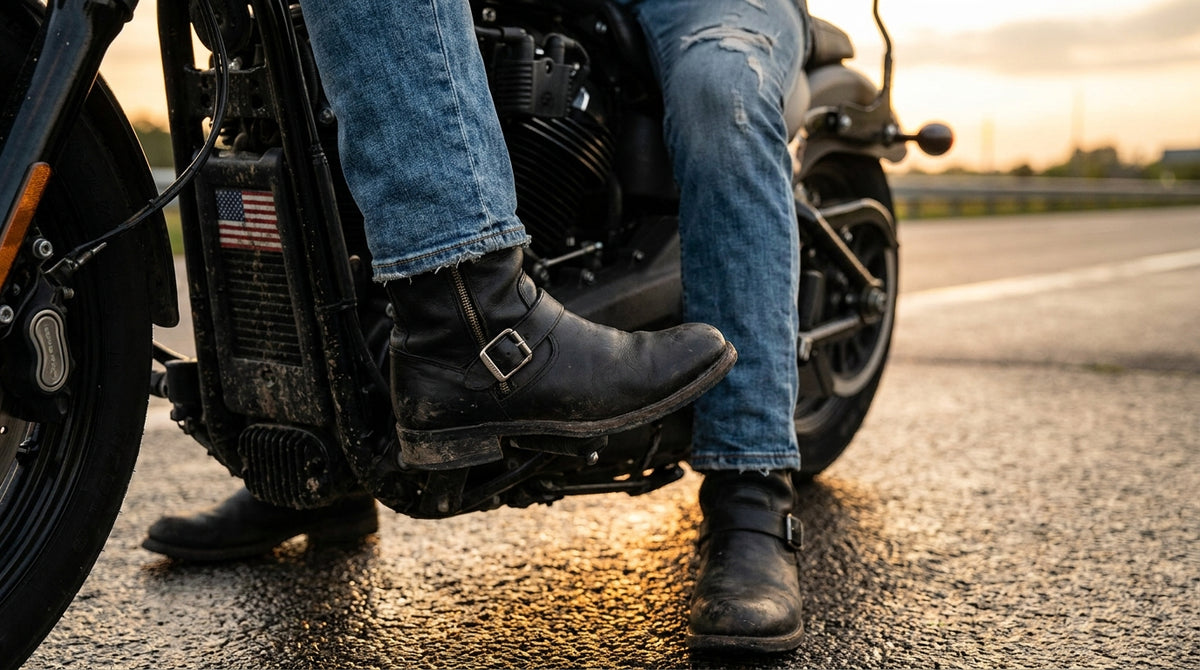
Most riders shopping for black ankle biker boots pick the pair by silhouette, then find out on the first cold morning that the shaft stops below the ankle bone. A 5 inch boot sits right at the joint. A 6 inch boot clears it. That single inch is the difference between a boot that looks the part and a boot that does the job when your foot goes down on gravel.
Height is the spec almost nobody checks, and it is the one that matters most. This guide covers what shaft heights actually mean in inches, why the Motorcycle Safety Foundation draws its line above the ankle, which leathers survive a shifter, and which closure style holds up over a few thousand miles. By the end you will be able to read a boot listing and know in ten seconds whether it belongs on a bike.
What Counts as a Black Ankle Biker Boot
Boot makers measure the shaft from the top of the sole to the top of the upper. Most biker boots are listed in whole inches, and the number tells you exactly where it lands on your leg. Hot Leathers, one of the larger American biker footwear makers, sells the same harness pattern in 8 inch and 11 inch versions, so you can see the jump clearly.
Here is how the common heights compare on an average adult leg:
| Shaft height | Where it sits | Best for |
|---|---|---|
| 5 inch | At the ankle bone | Street style, short rides, fashion-first |
| 6 inch | Just over the ankle | Daily riding with a low-profile look |
| 7 to 8 inch | Mid shin | Highway miles, cold and wind protection |
| 10 to 11 inch | Upper calf | Long touring, classic engineer look |
| 14 inch | Knee high | Full coverage, mostly women's styles |
So when people search for ankle boots, they usually mean the 5 to 6 inch range. That is a real category and there is nothing wrong with it. You just want to land on the upper end of it.
The Over-the-Ankle Rule Most Shoppers Miss
Rider training in the United States is consistent on this point: footwear should cover the ankle. The Motorcycle Safety Foundation teaches over-the-ankle boots as the baseline, and the reason is mechanical rather than stylistic. In a low-speed tip-over the bike leans onto the foot and ankle first, and the ankle joint has very little natural padding on the outside.
It shows up in the licensing material too. One of the standard motorcycle footwear questions on state knowledge tests asks what the most important feature of riding footwear is, and the correct answer is that it helps protect the ankles and feet in a tip-over. Not grip, not support for the knees. Ankles.
This is why a 5 inch boot is a compromise. It looks like a biker boot and it is far better than a sneaker, but it leaves the joint exposed. If the short silhouette is what you want, a 6 inch shaft gives you nearly the same look with the coverage the training actually calls for.
Why 6 Inches Is the Sweet Spot
A 6 inch black boot clears the ankle bone by roughly an inch on most legs while still sitting under a straight-leg jean. You get coverage without the tall shaft bunching your denim or catching on the seat when you swing a leg over.
It also stays comfortable off the bike. An 11 inch harness boot is excellent at 70 mph and clumsy in a grocery store. A 6 inch boot walks normally, which matters if the bike is how you actually get places. Riders who want one pair for commuting and weekends tend to land here.
The Swat-style 6 inch lace-up is a good example of the shape. Plain black, round toe, no hardware to snag, and a shaft that clears the joint.
If you would rather not deal with laces every morning, the same 6 inch height comes with zippers on both sides. You pull it on like a slip-on and the fit stays where you set it.
Black Leather That Survives a Shifter
The left toe of a riding boot takes a beating nothing else in your wardrobe does. Every upshift drags the top of that toe box across the shifter lever. On thin or coated material the finish wears through in a season and you get a grey scuff that never polishes out.
Full-grain leather is the answer because the grain runs all the way through. When it scuffs it burnishes darker instead of flaking. Vegan and synthetic uppers are lighter and cheaper, and they work fine for occasional riding, but the coating is a surface layer and once it splits there is no fixing it.
Where American Legend Rider comes down: genuine leather built to be resoled is worth paying once for, budget synthetic is acceptable if you ride a few times a month, and no-name marketplace boots with unlisted materials are the ones to avoid. Not because they look bad, but because an unlisted upper is almost always a thin coated split that will not survive the shifter.
Handmade leather ankle boots sit at the top of that range. Heavier, stiffer out of the box, and still going after the synthetic pairs have been replaced twice.

For a vegan-friendly option with the same short profile, the gothic skull pattern covers the style side without the leather price.
Side Zipper, Laces or Harness
Closure is not just convenience, it changes how the boot behaves at speed. Three options dominate black biker boots:
- Side zipper. Fastest on and off, and the shaft keeps a clean line. Look for a full-length zipper with a leather backing strip so the teeth do not press into your ankle. The weak point is the zipper itself, so a metal pull beats plastic.
- Laces. The only closure that lets you tune the fit around your instep, which matters for high or low arches. Downside is the laces themselves. Long loose ends near a chain or sprocket are a genuine hazard, so tuck them.
- Harness and buckle. The classic look, with a strap running around the ankle. Mostly styling on short boots, though the strap does keep the shaft from gapping. Many harness boots also use a side zipper underneath so you are not undoing buckles daily.
A practical middle ground is the lace-up with a buckle over the top. You get instep adjustment plus the strap holding everything closed.
And if you decide you want a little more shin coverage than a true ankle boot without going tall, the 8 inch short harness is the next step up. It reads as a short boot but adds two inches over the joint.
Sizing, Width and Break-In
Biker boots run differently from sneakers. Two rules save most of the returns:
Order your measured size, not your sneaker size. Athletic shoes are usually built half a size long. A leather boot that is half a size big will let your heel lift, and heel lift is what causes blisters during break-in.
Account for width separately. Shaft height tells you nothing about the toe box. If you normally need a wide fitting, a round-toe engineer or logger last gives noticeably more room than a cap-toe or a pointed western last. We go deeper on this in the guide to motorcycle boots for wide feet.
Break-in on full-grain leather takes roughly two to three weeks of regular wear. Wear them around the house with thick socks first. Do not soak them, and do not try to speed it up with heat, which dries the leather and cracks it at the flex point across the toe.
Side-zip boots need one extra check. Zip them fully and flex your ankle forward as if you were on the pegs. If the top of the zipper digs in, the shaft is too stiff for that height on your leg and you want a softer upper or a shorter shaft.
Soles, Weather and the Winter Problem
Short boots have one real weakness and it is not impact, it is water. A 6 inch shaft puts the opening a few inches below your knee, so rain running down your jeans lands directly in the boot. Riders who commute year round usually solve it with the shaft, not the boot, by tucking denim over the top rather than into it.
The sole matters more than most listings suggest. Look for three things. A defined heel, which stops your foot sliding forward off the peg. An oil-resistant rubber compound, because gas station aprons are the slickest surface you will put a foot on. And a stitched or screwed welt instead of pure glue, since a welted sole can be replaced for a fraction of what new boots cost. Goodyear welted boots can be resoled three or four times.
Cold is the other trade-off. A 6 inch boot leaves a gap of bare shin that a 10 inch boot covers, and at 60 mph in 45 degree air that gap gets noticed within twenty minutes. Thick wool socks close most of it.

Five Mistakes That Ruin a Good Pair
- Buying on silhouette and ignoring the inch count. Two boots that look identical in photos can be 5 inch and 7 inch. The listing number is the only reliable spec, so find it before you check out.
- Picking a smooth flat sole. A flat leather sole slides on a wet peg and on wet pavement at a stop. You want a lugged or at least siped rubber outsole with a defined heel that catches the peg.
- Treating a fashion ankle boot as riding gear. A thin zip-up dress boot has no toe box, no ankle padding and a glued sole. It will come apart in a slide, and there is nothing to rebuild.
- Letting laces hang. Loose lace ends near a drive chain is one of the few gear mistakes that can hurt you at low speed. Double knot and tuck them into the shaft.
- Never conditioning the leather. Rain strips the oils out of full-grain leather. Two or three applications of conditioner a year keeps the flex point from cracking and easily doubles how long the pair lasts.
How to Choose Yours
Work it in this order. Pick 6 inch as your default height, since it clears the ankle and still looks short. Choose full-grain leather if this is your main riding pair, or a vegan upper if you ride occasionally and want the look. Then pick the closure that fits your routine, with side zips for daily riding and laces if you need to dial in the instep. Check the sole has real tread and a heel. Order your measured size.
Get those five right and the boots will outlast the bike's tires several times over. If you are shopping now, the leather motorcycle boots collection is where I would start, and it is worth reading the broader breakdown of black biker boots if you are still deciding between short and tall.

No comments yet. Be the first rider to weigh in.