

A plain black full face helmet disappears in traffic. A black plush dragon head with round eyes and stubby wings does not. That is the whole reason the Toothless helmet cover keeps selling out at rallies and school-run drop-offs, and why riders who swore they would never put a cartoon on their lid end up wearing one.
This guide covers what a Toothless helmet cover is, which helmets it actually fits, how it behaves once you pass 60 mph, how to wash it without wrecking the plush, and where it sits next to the other 33 styles in our helmet cover lineup. No fluff, just the stuff you need before you buy one.
What a Toothless helmet cover actually is
It is a stretch plush skin that slips over the outside of a helmet you already own. Nothing bolts on. Nothing gets glued. The Toothless Dragon Motorcycle Helmet Cover is a one-size stretch shell shaped like the Night Fury from How to Train Your Dragon, complete with the ear flaps, the wings and the grin. Slip-on install takes about 30 seconds and the visor stays fully usable.
The important part: the cover does not replace your helmet. Your helmet is still doing every bit of the protecting. The cover is a fabric layer sitting on top of the shell, the same way a phone case sits on a phone.

Will a Toothless helmet cover fit your helmet?
This is the number one question we get on every dragon motorcycle helmet cover, and the answer is straightforward. The cover is one size with stretch fabric, built around full face helmet geometry. That means:
- Full face helmets: the intended fit. Chin bar, crown and visor opening all line up.
- Modular helmets: yes, with a note. Flip the chin bar up before you pull the cover on, then settle it down. Check that the cover is not pinched in the flip mechanism.
- Street and sport helmets: fine. The stretch handles the taller spoiler shapes on most sport lids.
- Half helmets and skull caps: no. There is no chin bar for the cover to grip, so it will roll up and off.
- Open face three-quarter helmets: poor fit. Same problem, nothing on the bottom edge to anchor to.
If you ride a half helmet and still want the look, you are better off shopping skull-graphic helmets than trying to force a cover onto a lid it was never cut for.
The visor opening is the thing to double check when you first pull it on. Seat the cover so the opening frames your visor evenly. If it sits 10 mm low on one side, lift and reseat instead of stretching it sideways, which is what tears the seam over time.
How it behaves at highway speed
A plush cover is fabric, and fabric on a helmet at speed raises three fair concerns: does it stay on, does it make noise, and does it grab wind.
Staying on. The grip comes from the stretch fabric clamping around the chin bar and the bottom edge of the shell. Seated properly, it holds at highway speed. The failure case is almost never speed itself. It is a cover pulled on over a helmet with a big rear spoiler and left half-seated, so airflow gets under the trailing edge and peels it. Thirty seconds of seating it correctly is what keeps it on.
Noise. Plush fabric over a hard shell reduces the high-frequency whistle that comes off a bare shell and vents. It is not a silencer and it will not replace earplugs. Wind noise inside a helmet at 65 mph routinely runs past 95 dB, and no fabric cover meaningfully changes that. Wear plugs either way.
Wind grab. The wings and ears on the Toothless cover are soft and small. They flatten in the airstream rather than acting like sails. You feel the cover the most in strong crosswinds and when you turn your head fast at speed, roughly the way a helmet-mounted camera feels.
One real trade-off worth naming: vents. A plush cover sits over your helmet's intake and exhaust vents. On a 95-degree day in stop-and-go traffic, that matters. For summer commuting, most riders keep the cover for the fun rides and run the bare lid when the heat is up.

Toothless or Light Fury: which dragon should you get?
Both are Night Fury shapes and both slip on the same way. The difference is entirely visual, and it changes how the cover reads on the road.
| Cover | Look | Best for | Price |
|---|---|---|---|
| Toothless Dragon | Matte black plush, green eyes, wide grin | Black and dark helmets, the instantly recognizable pick | $47.95 |
| Light Fury Dragon | White and pale blue plush, blue eyes | White, silver and light helmets, better daytime visibility | $37.95 |
If visibility to drivers is a real factor for you, the Light Fury helmet cover is the stronger choice. A white dragon head against a dark car windshield line reads from further back than a black one. If you want the character everyone names on sight, Toothless wins that contest every time.
Plenty of two-bike households buy both, one per rider. The pair photographs well, which is a large part of why these things spread at rallies in the first place.
Does a helmet cover affect helmet safety?
Straight answer: a slip-on plush cover does not change what your helmet's shell and EPS liner do in an impact. DOT FMVSS 218 certification applies to the helmet itself, and a fabric layer on the outside is not part of that structure. Your certified helmet stays certified, and it stays your actual protection.
What a cover can change is everything around the impact:
- Vision. If the cover is seated too low, it eats the top of your visor opening. Reseat it before you ride, every time.
- Ventilation. Covered vents mean a hotter head in summer traffic.
- Hearing. Slightly muffled, which is fine for road noise and less fine for a siren behind you.
- Conspicuity. This one goes the other way. A dragon head is far easier for a driver to register than a black dome, and being seen earlier is the cheapest safety upgrade in motorcycling.
A cover is also genuinely good at protecting the helmet's finish. Helmet shells pick up scuffs from bar-end drops, tank-bag straps and garage shelves. Plush takes those hits instead of your clear coat. If you want the full breakdown on what to look for, our guide to helmet cover styles, fit and what to avoid goes deeper on materials.
Where a Toothless cover actually earns its keep
Novelty gear gets bought once and abandoned when it has no job. This one has three.
Being seen in traffic
Drivers at intersections scan for cars, not motorcycles. Anything that breaks the expected silhouette gets processed faster. A grinning black dragon head at mirror level is not a shape a driver filters out.
Riding with kids around
Parents who ride get a lot of mileage out of this one. School pickups, birthday parties, toy runs and charity rides all land differently when the bike shows up with a dragon on the helmet. Toy runs in particular are where these covers do the most work, because the whole point of the ride is being visible and approachable.
Gifts that do not miss
A Toothless motorcycle helmet cover is one of the few biker gifts that works when the buyer does not ride. No sizing, no fitment lookup, no jacket measurements. One size, slips over the helmet they already own, ships in a box you can wrap. That is why these move hardest between October and December alongside the rest of the helmet cover lineup.

Washing and care without ruining the plush
Plush picks up road grime, bug spatter and whatever your garage floor has going on. Here is how to keep it looking like a dragon instead of a wet cat.
- Hand wash cold. Fill a sink with cold water and a small amount of mild detergent. Ten minutes of soaking does most of the work.
- Squeeze, never wring. Wringing twists the seams and permanently kinks the pile. Press water out between two towels instead.
- Air dry flat, away from sun. Direct sunlight fades black plush faster than anything else. A shaded spot and 24 hours is the move.
- No dryer, no iron. Heat mats the pile into clumps that do not brush back out.
- Brush it back up. Once dry, a soft brush restores the fluff and makes an old cover look new.
Store it loosely in a cloth bag rather than crushed under the seat. Compression flattens the ears and wings, and they do not spring back as well as the main shell.
The rest of the lineup, at a glance
The dragon is the flagship, but the collection runs 33 live styles and different riders want very different energy. Quick orientation:
| Style | Vibe | Who it suits |
|---|---|---|
| Toothless / Light Fury | Character, instantly recognized | Animation fans, parents who ride |
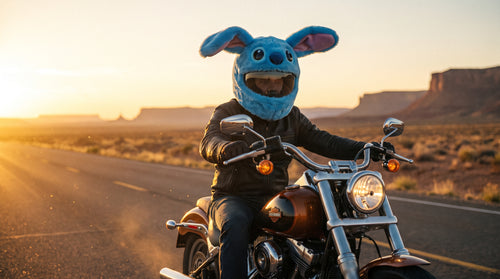
| Stitch | Chaotic blue, big personality | Riders who want laughs at every light |
| Pikachu | Bright yellow, maximum visibility | Commuters in heavy traffic |
| Bunny ears (black, white, gray, pink) | Simple, cute, low commitment | First-time cover buyers |
| Devil emoji, Alien, Shark | Edgier, less cartoon | Riders who want it odd, not cute |
| Santa, Turkey, Pumpkin | Seasonal | Holiday rides and toy runs |
If you want the comedy end of the catalog rather than the character end, the roundup of the funniest motorcycle helmet covers you can actually buy is a better starting point than this page.

Five mistakes riders make with plush helmet covers
- Buying one for a half helmet. No chin bar means no anchor. The cover rides up within a mile. Full face and modular only.
- Riding off without reseating the visor opening. A cover that shifted 10 mm in the garage steals the top of your sight line at exactly the wrong moment. Check it every single time.
- Machine washing it. The agitator mats the pile and stretches the seams. One cycle is usually enough to end a cover.
- Leaving it on all summer. Blocked vents in July traffic is a real comfort and fatigue problem. Take it off when it is hot and slow.
- Treating it as safety gear. It is a cover, not protection. Your DOT-rated helmet does the job. Replace that helmet after any impact, cover or no cover.
Worth naming the quality gap too, since these covers are everywhere on marketplace listings. The cheap versions use thin single-layer fleece with unfinished seams, which stretches out after a handful of rides and stops gripping the shell. Denser plush with finished seams keeps its shape, keeps its grip and still looks right a season later. It is a one-time buy at the right build and a repeat purchase at the wrong one.

Bottom line
A Toothless helmet cover is cheap personality with a real side benefit. It makes you easier to see, it keeps your shell from picking up scratches, and it costs less than a tank of premium. It fits full face and modular helmets, goes on in about 30 seconds, and needs nothing more than cold water and patience to stay looking sharp.
Skip it if you ride a half helmet or commute through summer heat in stop-and-go traffic. Get it if you want the one piece of gear that makes strangers at gas stations talk to you.
If you are shopping for one, the motorcycle helmet covers collection is where I would start. The dragon is the one people recognize from across a parking lot.
No comments yet. Be the first rider to weigh in.