
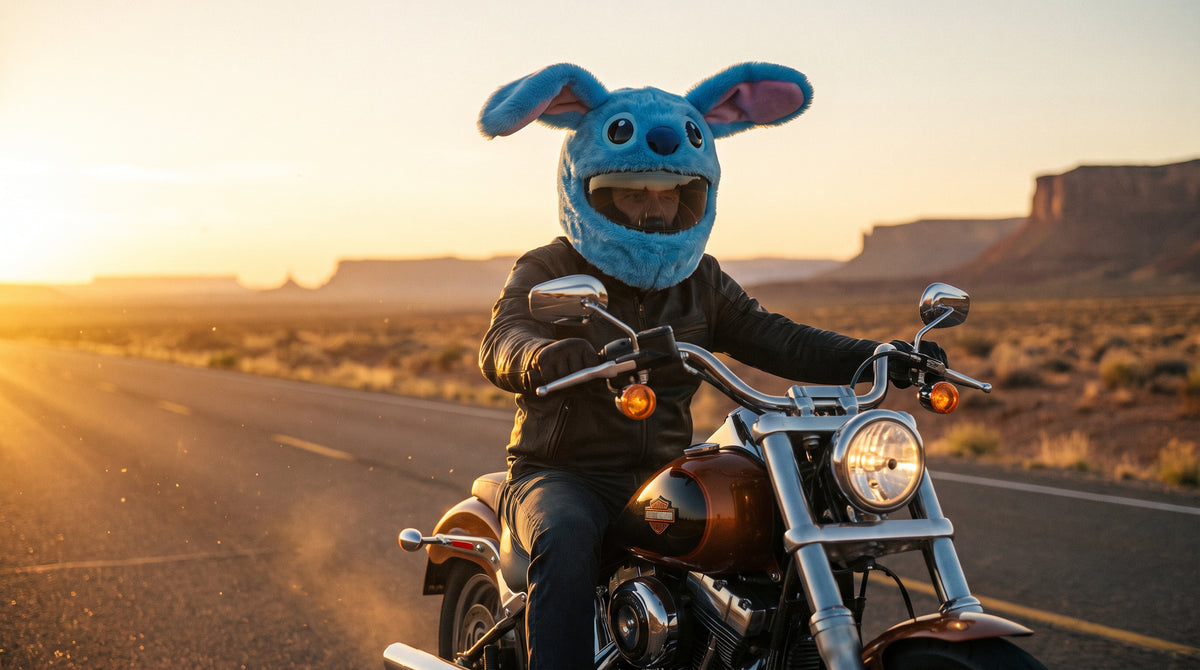
Pull up to a red light in a plain black full face helmet and nobody looks twice. Pull up wearing a bright blue plush alien head with floppy ears and the kid in the minivan next to you loses it. That is the entire appeal of the Stitch helmet cover, and it is why riders search for it more than almost any other character cover we track. It slips over the helmet you already own, costs $37.95, and takes about ten seconds to put on.
This guide covers what a Stitch motorcycle helmet cover actually is, whether it fits your lid, what happens to it at highway speed, how to wash it without wrecking the pile, and how it stacks up against the other plush covers riders buy. No fluff, just the answers people actually search for.
What a Stitch helmet cover actually is
It is a soft plush skin that pulls over the outside of a full face helmet, the same way a sock goes over a foot. The face opening lines up with your eye port so the visor still works. The ears, eyes and nose are stitched or sewn onto the shell of the cover, not glued, so they survive wind better than cheap printed versions.
The important part: it is a cover, not a helmet. There is no shell, no EPS liner, no impact rating. Your protection comes entirely from the helmet underneath, which should carry a DOT sticker meeting FMVSS 218, the US federal helmet standard. The cover adds a few ounces of fleece on top of a helmet that already weighs roughly 3 to 4 pounds, so you will not notice the weight.

Will a Stitch helmet cover fit your helmet?
Almost certainly, if you ride in a full face. These covers are cut for full face and modular helmets, which are the round, closed shapes the plush was designed to stretch across. A standard adult full face runs somewhere between 22 and 24 inches in circumference, and the fabric has enough give to cover that whole range on one size.
Where it goes wrong is the shapes it was never built for. A half shell leaves the back of your head bare, so the cover has nothing to grip and flaps loose. An open face with a long drop visor tends to bunch at the chin bar that is not there. Adventure helmets with a big peak are the worst fit of all, because the peak tents the fabric and turns it into a sail.
Quick fit check before you order
- Full face or modular: yes, this is the shape it was made for.
- Open face: usually works, expect a looser fit around the jaw.
- Half shell or beanie: skip it, there is nothing for the cover to hold onto.
- Peaked adventure lid: skip it, the peak catches air.
If you are not sure which family your helmet falls into, our breakdown of how helmet covers fit and what to avoid walks through each shape with photos.
Is a Stitch motorcycle helmet cover safe at speed?
Honest answer: it is safe for the kind of riding most people bought it for, and it is not a track accessory. The cover does not touch the impact protection at all. The shell and liner underneath do their job exactly the same whether there is fleece on top or not.
What does change is airflow. Plush is not aerodynamic. Above about 60 to 70 mph the pile catches more wind than bare shell, and riders consistently report two things: more helmet buffeting and more noise. The ears are the main culprit, because they stick out into clean air and flutter. Nothing dangerous happens, but a long interstate slog in one gets tiring in a way a bare helmet does not.
The real safety rule is simpler and it has nothing to do with speed. Never let the cover creep over your eye port, and never let it block a vent. A cover that slides down half an inch while you are riding is a cover that is now in your peripheral vision. Seat it properly, tug it back off the visor edge, and check it at every stop for the first few rides until you learn how it settles.
Where these covers genuinely shine
- City and surface streets: under 50 mph the wind issue basically disappears.
- Charity rides and toy runs: this is the natural habitat of a plush cover.
- Bike nights and meetups: it is the cheapest conversation starter in the lot.
- Cold mornings: the fleece layer cuts a surprising amount of wind chill.
Are motorcycle helmet covers legal?
There is no federal law in the US that bans a helmet cover. What the law cares about is the helmet underneath, and in helmet-law states that means a DOT-compliant lid. Put a cover over a DOT helmet and you are still wearing a DOT helmet.
Two practical snags are worth knowing. First, the DOT certification sticker lives on the back of the shell, and a cover hides it. If an officer wants to see that label, you will be taking the cover off at the roadside. Second, every state has some version of an obstructed-vision rule, and a cover that sags onto the eye port is the kind of thing that invites a conversation. Neither is a reason to avoid a cover. Both are a reason to fit it properly and know your own state's helmet law before you ride.
Stitch vs the other plush helmet covers
The Stitch cover is the most searched of the bunch, but it is one of a dozen or so plush designs riders actually buy. Here is how the popular ones compare on price and the kind of attention they pull.
| Cover | Price | Best for | Ear profile |
|---|---|---|---|
| Stitch | $37.95 | All-round crowd pleaser | Large floppy |
| Toothless Dragon | $47.95 | Biggest visual impact | Swept-back fins |
| Light Fury Dragon | $37.95 | Same shape, lighter color | Swept-back fins |
| Pikachu | $37.95 | Kids notice it fastest | Tall pointed |
| Cinnamoroll | $47.95 | Softest, most detailed | Long bunny ears |
| Gray Shark | $37.95 | Lowest wind profile | Fin, no ears |
Toothless Dragon
The loudest of the group visually. The fins sweep back instead of sticking up, so it handles air better than the tall-eared designs, and at $47.95 it is the priciest here. We covered it in detail in the Toothless cover breakdown.

Light Fury Dragon
Identical shape to the Toothless, in a pale finish, and $37.95 instead of $47.95. If you want the dragon silhouette without the black, this is the one. The light color shows road grime faster, so plan on washing it more often.

Pikachu
The tall pointed ears are the trade-off. They get the most reaction from kids of anything in this list, and they also flutter the most above 55 mph. Great for parade laps and short town rides, less great for a two-hour highway run.

Cinnamoroll
The plushest fabric of the group and the most detailed stitching, which is where the $47.95 goes. The long bunny ears hang rather than stand, so they flap less than Pikachu's points despite being longer.

Gray Shark
The quiet pick. A single dorsal fin and no ears at all means the cleanest airflow in this lineup, which makes it the one to choose if you actually commute in your cover rather than just posing in it.

What separates a good plush cover from a cheap one
Every one of these designs has a $12 lookalike on a marketplace listing somewhere. The photos look identical. The difference shows up in three places, and all three are structural rather than cosmetic.
How the features are attached. On a cover built properly, the ears, eyes and nose are sewn into the seams. On the cheap versions they are glued or heat-pressed onto the surface. Glue fails at the exact moment it matters, which is a 60 mph headwind pulling on an ear, and once an ear tears off the cover it does not go back on.
How the eye port is finished. A hemmed, reinforced opening keeps its shape. A raw cut edge stretches a little every time you pull the cover on, and a stretched opening is what starts creeping down over your visor after a few weeks. That is the single most common complaint riders have about covers, and it is almost always a construction problem rather than a sizing one.
What the pile is made of. Decent fleece recovers after a wash and keeps its loft through a season. Thin synthetic pile mats down after the first cleaning and never comes back, which is why a bargain cover tends to look worn out by month two.
The position here is straightforward: a cover you wear over a DOT helmet in traffic is not the place to save twenty dollars. Buy one with sewn features and a hemmed eye port and it stays out of your sightline, which is the only thing about a novelty cover that is not purely cosmetic.
How to wash and store a plush helmet cover
Bugs, road film and helmet sweat all end up in the pile. Wash it and it lasts seasons. Throw it in a hot machine cycle and you will pull out a matted, shrunken version of what you bought.
- Hand wash in cold water with a small amount of mild detergent. No bleach, no fabric softener, since softener coats the fibers and kills the loft.
- Squeeze, do not wring. Twisting distorts the seams around the eye port, and a stretched eye port is what starts the sagging problem.
- Air dry only, flat or over a helmet stand, and give it a full 24 hours. A dryer will melt synthetic pile.
- Brush the pile back up with a soft brush once it is dry to restore the fluff.
- Store it loose, not crushed at the bottom of a saddlebag. Compression flattens the ears permanently.
Five mistakes riders make with helmet covers
- Buying one for a half helmet. It will not stay put. There is no chin bar and no lower shell to anchor to, so the cover rides up the first time you hit 40 mph.
- Treating the cover as the safety gear. A plush skin has no rating and no impact structure. If the helmet under it is a novelty lid with no DOT sticker, the cover changes nothing about how that ends.
- Letting it drift onto the eye port. The most common real complaint. Reseat it at fuel stops and check it before you pull out.
- Machine washing it hot. One cycle is all it takes to mat the pile and shrink the opening so it no longer seats correctly.
- Riding long highway miles in the tall-eared designs. Pick the shark or a swept-fin dragon if most of your miles are at 70 mph. Save the ears for town.
Which one should you actually buy?
If this is your first cover, the Stitch is the safe pick and the reason is not the character. The floppy ears sit against the shell instead of standing up into the airstream, so you get a big visual payoff without the flutter the pointed designs bring, and at $37.95 it is at the low end of the price range. The dragons cost more and pull more stares. The shark is the one to buy if you commute.
Whichever you land on, buy a cover built for a full face and keep a real DOT helmet under it. The cover is the fun part. The helmet is the part that matters. If you are browsing, the full helmet cover lineup is where I would start, and the roundup of the funniest covers riders are buying is worth a look if you want something nobody at your bike night has seen yet.

No comments yet. Be the first rider to weigh in.