
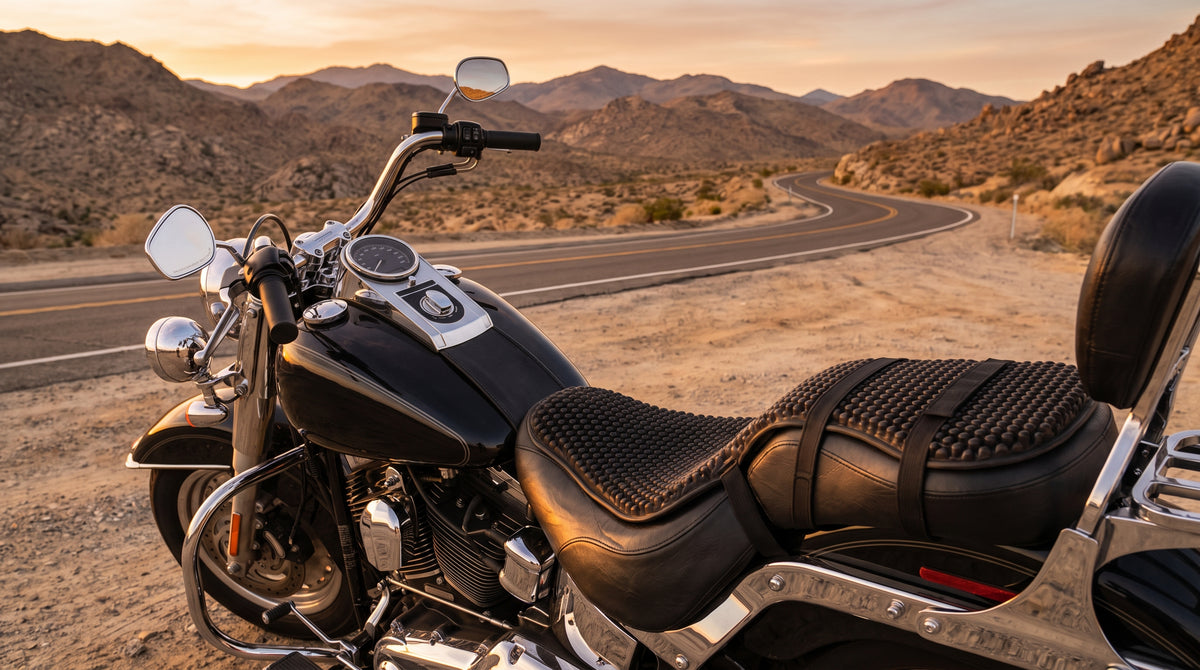
Hour one is fine. Hour two you start shifting your weight every few miles. By the time the gas light comes on you are standing on the pegs at every light, and the ride you planned for the day quietly turns into a ride home. The seat did not break. Stock cruiser seats carry about 1 to 2 inches of foam over a hard plastic pan, and that foam compresses under the two bones you actually sit on.
A gel seat cover for motorcycle use is the cheapest fix for that, and it is also the one riders get wrong most often. This guide covers what gel does that foam cannot, how gel compares to air and memory foam, how to size a pad so it does not creep sideways at 70 mph, and which style fits your kind of riding. Prices below are live American Legend Rider prices, from $27.99 for a commuter pad to $144.95 for a comfort bundle.
What a gel seat cover actually does
Your body weight does not land evenly on a seat. Almost all of it funnels into two points, the sit bones, roughly four inches apart. Foam under that kind of point load packs down and stays packed for the rest of the ride. Gel behaves differently. It flows sideways under pressure, so the load spreads across a much wider contact patch instead of drilling into the same two spots.
That is the whole trick, and it is worth being honest about the limit: a gel pad spreads pressure, it does not add suspension travel. If your bike hammers you over expansion joints, that is a shock and preload problem, not a seat problem. What gel fixes is the slow ache that builds over distance. The ALR 3D Honeycomb pad at $61.99 adds an open cell structure on top of the gel so air moves under you, which matters more than riders expect in August.

Gel vs air motorcycle seat cushion: the honest comparison
This is the question riders search more than any other, and the answer is not the same for everyone. Gel and air solve the same problem from opposite directions. Gel spreads load with a fixed material. Air spreads load by letting a sealed bladder move fluid pressure around as you shift.
| Type | How it works | Best for | Watch out for | ALR price |
|---|---|---|---|---|
| Gel | Semi solid gel flows sideways and widens the contact patch | Riders doing 1 to 4 hour days who want zero fiddling | Adds 1 to 2 inches of seat height, and gel firms up below about 40F | $27.99 to $76.99 |
| Air | Sealed cells move air as you shift, so pressure never parks in one spot | All day touring and tailbone pain | Needs the right inflation, and overfilling makes it worse than stock | $34.95 |
| Memory foam | Molds to your shape, then holds it | Short commutes and passengers | Compresses flat on long days and soaks up water unless sealed | Varies |
| Sheepskin | Wicks sweat and cuts friction, very little pressure relief | Hot climates and chafing, not sit bone pain | Does nothing for numbness on its own | Varies |
Short version: if your rides end around the two hour mark, gel is the better buy and the simpler one. If you ride all day, or your pain sits right on the tailbone, air wins because the pressure point keeps moving. Riders splitting the difference often run a gel cover on the rider seat and keep an air pad for long trips.

How to size a gel seat cover so it does not slide
Most returns come down to size, not quality. Measure the flat part of your seat, the area you actually sit on, not the whole saddle. A solo rider pad in the 11 by 14 inch range covers a typical cruiser seat. Sportbike and bobber seats often need something closer to 10 by 11.
- Measure width at the widest point of the sitting area, then subtract half an inch. A pad that hangs over the edge starts walking sideways within 20 miles.
- Do not cover the front dish. The scooped nose of the seat is where you brace under braking. Pad over it and you slide forward into the tank.
- Account for height. Gel adds roughly 1 to 2 inches. If you are already flat footing at a stop by a hair, go thinner or go air.
- Check your seat shape. Heavily stepped touring seats need a contoured pad, and a flat rectangular gel pad will bridge the step and rock.
For a straight commuter setup, the CENJITION 3D gel cover at $27.99 is the size that fits the widest range of seats, and it is breathable EVA rather than a sealed vinyl that traps heat.

Best gel seat cover picks by how you actually ride
There is no single best pad. There is a best pad for your mileage. Here is how the range in the motorcycle seats and comfort collection breaks down by rider.
The daily commuter, 20 to 60 minutes each way
You need thin, breathable and cheap. Anything thick changes your reach to the bars for a ride that was never long enough to hurt. The $27.99 CENJITION pad is the right call here, and it dries fast when you get caught out in weather.
The all day rider, 200 mile Saturdays
This is where a thicker shock absorbing gel pad earns its money. The $76.99 shock absorbing comfort pad runs a denser gel core, so it keeps spreading load in hour four instead of bottoming out the way a cheap pad does. If you ride two up regularly, this one also holds its shape better under a second rider.

The rider with tailbone pain
Tailbone pain is a different problem from sit bone ache. The pressure is further back and lower, and a firmer gel pad can actually push harder on it. The $34.95 air pad is the better tool, because the cells shift as you move and never load the coccyx for more than a few seconds at a time.
The passenger who has stopped coming along
Pillion seats get the worst foam on the bike, usually under an inch, and passengers have no bars to brace on. A backrest cushion at $73.99 fixes the support problem, while the $38.99 rear pad handles the seat itself. Fixing the back seat is the cheapest way to get a riding partner back.


The rider who wants it handled in one order
The $144.95 comfort and security bundle pairs a seat cushion with a 1080p dual lens dash cam. It is the practical pick if you are already shopping for a camera, since buying the two separately lands close to the same number.

Numbness is a circulation problem, not a padding problem
Worth separating these two, because a pad will not solve both. Ache means pressure, and a pad fixes pressure. Numbness and pins and needles mean blood flow is getting pinched, usually by a seat edge catching the back of the thigh, and more padding can make that worse by pushing you higher into the same edge.
If you go numb, stand on the pegs for 10 seconds every 30 to 45 minutes and drop your seat height rather than raising it. A thinner gel cover often beats a thick one here. The same logic applies to your hands, which is why the grips and gloves you run matter more than most riders think. Our guide to fingerless gloves for riders covers the vibration side of that.
Installing a gel seat cover so it holds at highway speed
A loose pad at 70 mph is a genuine hazard, not an annoyance. Every pad worth buying ships with either four corner straps or a full elastic skirt.
- Clean the seat first. Road film and leather conditioner both act like a lubricant under a pad.
- Run the straps under the seat pan, not around the frame. Straps around the frame pull the pad down at an angle and crease it.
- Sit on it before you tighten the last strap. Tension it with your weight on the seat so it does not bunch when you mount up.
- Recheck after the first 10 miles. Gel settles once, then holds. That first check is the one riders skip.
- Pull it off when you park outside for days. Trapped water between pad and seat is how vinyl seats start to lift at the seams.
Five mistakes that waste the money
- Buying the thickest pad available. Thickness changes your triangle to the bars and pegs. Two inches of gel on an already tall seat creates a new back problem while solving a seat one.
- Using a car or office gel cushion. They are not UV stable, not waterproof, and have no strap system. One rain ride and it is a sponge.
- Treating a pad as a fix for worn foam. If your stock foam is 15 years old and packed flat, a pad is a patch. Reupholstering or a replacement seat is the real answer.
- Grabbing an unbranded marketplace pad for $12. The gel in the cheapest listings is usually a thin gel sheet over regular foam, so it packs down in a season and the stitching lets go at the strap anchors. A $27.99 pad built for motorcycle use outlasts three of them.
- Ignoring the passenger seat. Riders spend $200 on their own comfort and leave a passenger on bare foam, which is the actual reason the second seat stays empty.
Where American Legend Rider sits on this
The seat pad aisle is full of disposable goods. A gel sheet glued into a vinyl bag will read the same on a product page as a proper gel core in a breathable EVA shell, and the two are not the same purchase. Our position is simple: buy the pad that is built for a bike, with real straps, a weather rated shell and a gel core thick enough to still be working in hour four. That is a $28 to $77 decision you make once, instead of a $12 decision you make every spring.
The same thinking runs through the rest of the gear worth owning, which we broke down in what every rider actually needs.
If you are shopping for a gel seat cover for motorcycle riding, start by measuring the flat of your seat, then decide between gel and air based on how long your rides really are. Gel for the two hour days, air for the all day runs and tailbone pain. The seat cushion collection is where I would start looking.

No comments yet. Be the first rider to weigh in.