
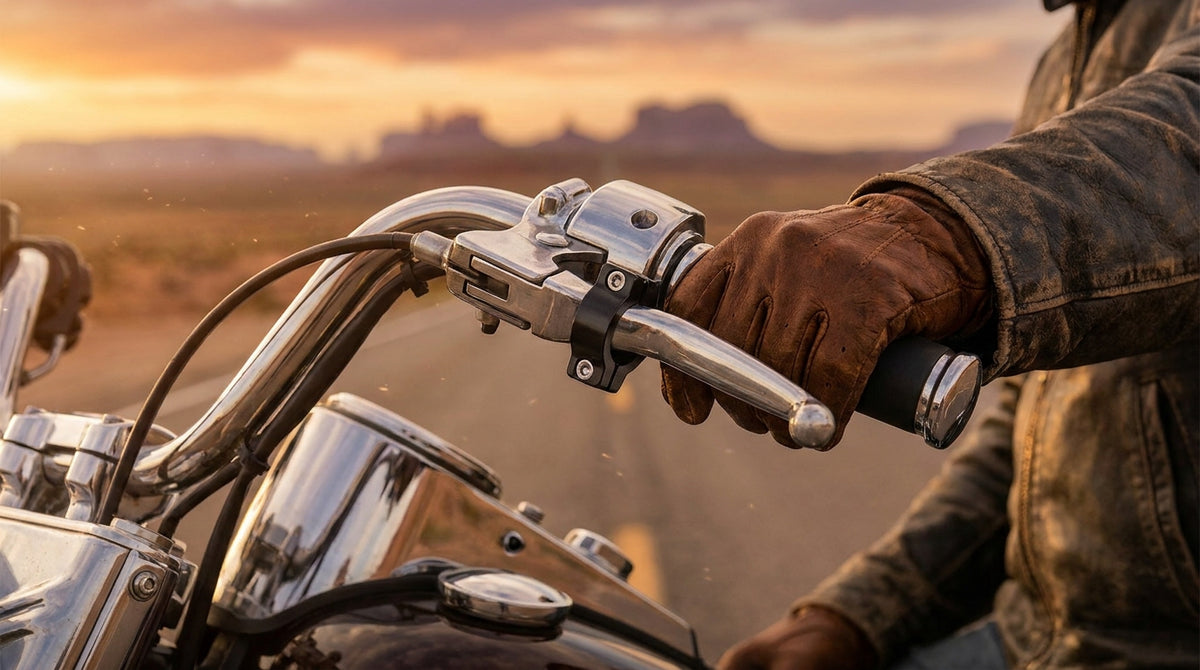
At mile 90 on a straight stretch of interstate, the thing that quits first is not the bike. It is your right hand. Holding a 1 inch grip at a steady 70 mph for two hours puts your wrist in one fixed angle, and the forearm cramp that follows is why riders start searching for motorcycle cruise control at 2am.
Here is the part most buying guides skip: there are three completely different products sold under that name, and two of them never hold a set speed. This guide covers what each one does, what it costs, what fits your bike, and which one is right for the way you actually ride. By the end you will know whether you need a $19 clamp or a $900 wiring job.
Do motorcycles have cruise control from the factory?
Some do. Electronic cruise control is standard across most Harley-Davidson Touring models, so a Street Glide or Road Glide holds speed with a thumb switch the same way a car does. Honda's Gold Wing has had it for decades. BMW's RT and GS tourers include it, and most new ride-by-wire sport tourers list it as standard or a cheap option.
What they have in common is price and throttle type. Factory cruise shows up on big touring bikes with electronic throttles, usually north of $18,000. Below roughly $10,000, almost nothing ships with it. Sportsters, Rebels, Bobbers, older Dynas, most mid-size cruisers and nearly every cable-throttle bike built before the mid-2010s have no cruise control at all.
That gap is exactly where the aftermarket lives. If your bike has a cable throttle and no thumb switch on the right bar, you are choosing between a mechanical lock, a palm rest, or a full electronic kit.
The three kinds of motorcycle cruise control
These get mixed together in search results, which is how riders end up buying a $15 part expecting a $900 feature. Here is the honest comparison.
| Type | Typical price | Holds speed on hills? | Install time | Best for |
|---|---|---|---|---|
| Friction throttle lock (clamp) | $15 to $50 | No, holds throttle position only | 5 to 10 minutes, no wiring | Highway cruising, rest for the wrist |
| Throttle assist palm rest | $12 to $25 | No, nothing is held at all | Under 1 minute | Reducing grip pressure on long days |
| Electronic cruise control kit | $500 to $1,100 plus labor | Yes, true closed loop speed hold | 4 to 8 hours of wiring | Touring riders doing 400 mile days |
| Factory cruise control | Included on the bike | Yes | None | Baggers and touring bikes |
Notice the middle column. A friction lock pins the twist grip where you left it, so your speed climbs on a downgrade and bleeds off on a climb. That is not a flaw in the product, it is the physics of a mechanical clamp. Riders who understand that are happy with them. Riders expecting a car-style system are not.
Throttle locks: how a friction clamp actually works
A throttle lock is a small collar that mounts beside the grip and squeezes against the switch housing or the bar end. Roll on to the speed you want, flick the lever with your thumb, and friction keeps the grip from springing back. Flick it off, or simply roll the throttle against it, and you are back in full control.
The good ones give you adjustable tension, so you can set it loose enough that a firm roll-off breaks it free without touching the lever. That is the setting experienced riders use. It takes about 30 seconds of parking lot practice to find.
Our universal throttle lock is the $18.95 version of this: a machined clamp with a thumb lever that fits both 1 inch Harley bars and 7/8 inch metric bars, no tools beyond a small hex key.

Two things a friction lock will not do. It will not hold speed up a grade, and it will not disengage when you squeeze the brake. Both are reasons it belongs on open highway, not in traffic.
Throttle assist palm rests: cheap, useful, and widely misunderstood
Search "motorcycle throttle assist" and you mostly get palm rests. These are a rubber or plastic paddle that clips over the grip and sticks out about an inch and a half. Nothing locks. You rest the heel of your palm on the paddle and let your arm weight hold the throttle instead of your fingers.
For around $15 they fix a specific problem well. If your hand goes numb or your fingers ache after an hour, the cause is usually a tight pinch grip plus vibration. A palm rest lets you open your hand and ride with a relaxed fist, which also cuts how much vibration reaches your wrist. If tingling in the hands is your main complaint, our breakdown of why hands and feet tingle on long rides covers the other causes worth ruling out.
What a palm rest does not do is give you hands-free time. You cannot shake out your arm or adjust your helmet. For that you need a lock or an electronic kit.
Electronic cruise control kits: what $900 actually buys
A real aftermarket cruise control system is a servo, a control module, a handlebar switch, and a speed signal tap. The servo pulls the throttle cable, the module reads wheel speed, and the two work together to hold a set mph within about 1 to 2 mph on grades. Brake and clutch switches cut it out instantly, the way a car does.
Expect $500 to $1,100 for the kit depending on your model, plus 4 to 8 hours of shop labor if you are not comfortable splicing into the wiring and routing a cable. Dedicated-fitment kits exist for Harley Touring, Gold Wing, V-Strom, Africa Twin and similar long-distance machines.
Who should spend it: riders doing 400 mile days, riders with wrist or shoulder injuries, and anyone with a bike they plan to keep for ten years. Who should not: weekend riders doing 150 mile loops on back roads, because you will never leave it on long enough to notice.
One fitment note that saves real money. If your bike is ride-by-wire, check for a factory cruise retrofit or a dealer-enabled option before buying a servo kit. On several models the hardware is already there and it is a switch and a flash, not a $900 install.
Is a motorcycle throttle lock safe?
Used correctly, yes. Misused, it is the only piece of $19 gear on your bike that can get you hurt, so the rules matter.
- Set the tension light. A hard roll-off should break the lock free without you reaching for the lever. Test it standing still, then at 25 mph in a parking lot.
- Highway only. Open road, light traffic, no curves that need throttle modulation. Never in town, never on a twisty mountain road.
- Keep your hand on the grip. The point is to unload your wrist, not to let go of the bar. Stretch one hand at a time.
- Remember the brakes do nothing to it. You roll off first, then brake. Build that order into muscle memory before you ever need it.
- Re-check the clamp monthly. Vibration walks fasteners loose. A lock that slips halfway through its travel is worse than none.
Riders who get burned are almost always the ones who set tension too high and then meet a slow car. Light tension solves it.
How to fit a universal throttle lock in 10 minutes
Almost every universal clamp installs the same way. You need one hex key and a tape measure.
- Measure your bar diameter. Harley and most American cruisers run 1 inch bars, which is 25.4mm. Most metric bikes run 7/8 inch, which is 22mm. Universal locks ship with a shim for the smaller size.
- Pick your side. The clamp goes on the right grip, inboard of the bar end and outboard of the switch housing, wherever the lever clears your thumb.
- Dry fit before tightening. Twist the throttle through its full range with the clamp loose. Nothing should bind against the brake lever or the switch block.
- Snug it, do not crush it. Hand tight plus a quarter turn. Overtightening a clamp on a thin-wall bar deforms the tube.
- Set the friction. Engage it at idle, then roll off hard. If your hand has to fight, back the tension off until a normal roll-off wins.
- Test ride on an empty road. 20 minutes at highway speed tells you whether the lever position works with your glove thickness.
Thick winter gauntlets change everything about lever placement. If you ride year round, fit the lock wearing your coldest-weather gloves.
Best motorcycle cruise control by how you ride
There is no single best motorcycle cruise control, there is the right one for your mileage.
Daily commuter, 30 to 60 miles
Skip the lock. You will never get a long enough clear stretch to use it. A palm rest or better gloves does more for your hands than anything that clamps to the bar.
Weekend highway rider, 100 to 250 miles
This is the friction lock sweet spot. $19, ten minutes, and you can shake out your throttle hand every twenty miles. It is the highest value upgrade per dollar on a cable-throttle cruiser.

Iron butt and long-haul touring, 400 miles and up
Buy the electronic kit, or buy a bike that already has one. At that distance the difference between holding position and holding speed is the difference between arriving tired and arriving wrecked. Pair it with a seat fix, since hand fatigue and tailbone pain usually show up on the same ride. Our comparison of gel versus air seat covers is the companion piece to this one.
Two-up riding
Electronic only. With a passenger aboard, your bike loses more speed on climbs and gains more on descents, so a friction lock needs constant correction and you lose the benefit.
Where the cheap stuff goes wrong
Throttle locks are simple enough that price mostly buys materials, and materials are where the no-name marketplace versions fail. The failure mode is specific: a soft plastic clamp body flexes under vibration, friction tension drifts, and the lock starts letting go on its own. A rider who has learned to trust it is the worst person to hand that to.
A machined metal clamp with a proper adjuster screw and a replaceable friction pad costs a few dollars more and holds its setting for seasons. That is the whole American Legend Rider position on this part of the catalog: real materials, parts that stay where you put them, bought once. Budget synthetic versions work for occasional riders, but they wear out faster. Unbranded clones with no stated material and no support are the ones to leave alone, because a throttle part that fails mid-corner is not a warranty conversation, it is a crash.
The full motorcycle cruise control collection is where ours lives if you want to see fitment and pricing.
5 mistakes riders make with throttle locks
- Setting tension by feel in the garage only. Static friction is higher than rolling friction. A lock that feels right at a standstill can be too stiff at 70 mph. Always verify moving.
- Using one on a twisty road. Every corner needs throttle modulation. A locked grip on a 35 mph sweeper is how riders run wide.
- Expecting it to hold speed. On a 6 percent grade you will shed 8 to 10 mph before you notice. Watch the speedo, not the tach.
- Mounting it where the lever hides under the brake lever. You have to be able to flick it off without looking. Dry fit first, every time.
- Buying a palm rest and calling it cruise control. Useful product, wrong job. It stops nothing, it only changes how you hold the grip.
Bottom line
If your bike has no factory cruise and you ride highway miles, start with a friction throttle lock. It is $19, it fits in ten minutes, and it solves 80 percent of what riders are actually chasing, which is getting the load off one wrist. If you log 400 mile days or ride two-up for hours, go straight to an electronic kit and have it installed properly. And if your hand pain is the real problem rather than the speed holding, fix the grip pressure first with a palm rest and a better pair of gloves.

If you are shopping for one, the universal lock in our cruise control collection is where I would start. It fits both 1 inch and 7/8 inch bars, it is the cheapest real fix for throttle hand fatigue, and it comes off in two minutes if you decide it is not for you.


No comments yet. Be the first rider to weigh in.