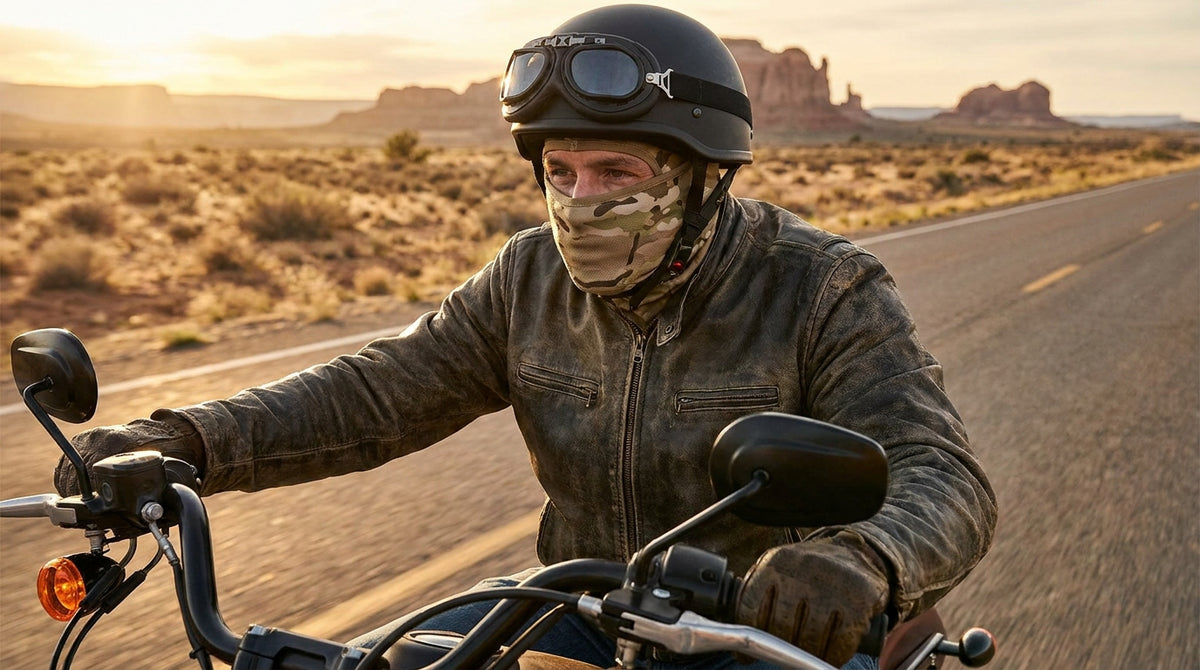
Most riders buy a black balaclava, lose it in a black bag, then pull it out in July and cook. The camo versions solve a smaller problem than people think, and a bigger one than they expect: you can see where you dropped it, and the printed polyester hides dust and bug splatter that turns a plain black mask grey after a month of riding.
This is the practical version of the MultiCam balaclava question. What the pattern actually is, how the nine live colorways differ, what fits under a half helmet without bunching at the jaw, and which one is worth the extra eight dollars. Prices here run $14.95 to $22.95, and every pick below is a mask you can put in a cart today.
What a MultiCam balaclava actually is
MultiCam is a specific camouflage pattern, not a generic word for camo. It was designed by Crye Precision and the US Army adopted a version of it as the Operational Camouflage Pattern in 2015. It blends seven colors so the print reads as the right shade in more than one environment instead of only matching one type of ground.
A MultiCam balaclava takes that print and wraps it around a one piece head cover with an eye opening. The riding versions are thin stretch polyester, roughly 0.5 mm of fabric, which is why they slide under a helmet liner instead of fighting it. The military pattern is the reason these sell to hunters and airsoft players too, and the reason the "scorpion" and "python" naming shows up in the colorways.
If you want the plain black and skull end of the shelf instead, the balaclavas collection carries those. This guide stays on the camo prints.
Why riders pick camo over plain black
Three reasons come up again and again, and only one of them is about looks.
- Dirt hiding. A black mask shows road dust and dried bug spatter after a couple of long rides. A seven color print hides it until wash day.
- Heat. Black absorbs more sunlight than a tan or grey print. On a 90 degree afternoon, a desert colorway under a vented half helmet is the cooler choice.
- It does double duty. The same $14.95 mask works for a hunting sit or a cold morning on the tractor. Riders who already own three black masks tend to buy camo next.
What camo does not do is make you safer. A mask is wind and debris protection, not impact protection. That job belongs to a DOT rated helmet, and nothing you pull over your head changes it.
The 9 MultiCam balaclavas worth wearing
Nine colorways, grouped by the print family they belong to. Each one is live stock with the current price, so you are comparing real options and not a wish list.
1. Scorpion Black: the one most riders end up buying
This is the black based scorpion print, and at $22.95 it is the priciest of the nine. It earns it by being the only colorway that still looks right with an all black kit. Searches for a multicam black balaclava land here more than on any other pattern, which tells you what people actually want: camo texture without giving up the blacked out look.

2. Scorpion Desert: best for sun and dust
Tan base, $19.95. If you ride in Arizona, Texas or anywhere the shoulder is more sand than grass, this is the one that stays looking clean. The lighter base also runs cooler in direct sun than the black version.

3. Scorpion Jungle: the $14.95 starting point
Green based, and the cheapest way into the pattern at $14.95. Buy two. One lives in the saddlebag and one lives in the wash, which is the only system that works once you start wearing a mask daily.

4. Scorpion Snow: winter and white dust roads
The pale colorway, also $14.95. It is the right call for late season riding and for anyone whose summer road turns into caliche dust. Keep in mind a light print shows oil marks faster than a dark one, so it is the least forgiving of the nine if you work on your own bike.

5. Python Black: the subtle one
$14.95, and the print reads almost solid from more than ten feet away. If you want something that does not announce itself at a gas stop, this is the quietest pattern on the list while still being camo up close.

6. Python Desert: tan with more contrast
$19.95. Same snake scale print on a sand base. Of the two desert options it has the sharper pattern, which hides dust a little better than the softer scorpion blend.

7. Striped Desert: the loudest pick
$22.95 and the most aggressive print of the nine. This is the one to buy if the mask is part of the look rather than an afterthought. Pair it with goggles rather than sunglasses, because a busy print plus bare eyes reads unfinished.

8. British Desert: the odd one that works
$19.95. A British pattern inspired print with larger blotches and fewer colors than true MultiCam. Bigger shapes mean it stays readable as camo at a distance instead of blurring to grey, which is a real difference once you see two masks side by side.

9. Bionic Hill: sold as a camo ski mask for a reason
$14.95, and this one is listed as a camo balaclava ski mask for riding and hunting. Same polyester build as the rest of the family, with a print that leans more toward brush and leaf than military blocks. It is the pick for riders who also hunt and want one mask for both.

MultiCam balaclava comparison: price, base color, best use
Nine patterns, one table. Base color is what decides heat and how well it hides dirt, so sort by that before you sort by looks.
| Pattern | Price | Base | Best for |
|---|---|---|---|
| Scorpion Black | $22.95 | Black | All black kits, night riding |
| Scorpion Desert | $19.95 | Tan | Hot sun, dusty shoulders |
| Scorpion Jungle | $14.95 | Green | First camo mask, spares |
| Scorpion Snow | $14.95 | Pale grey | Late season, light dust |
| Python Black | $14.95 | Black | Subtle print, daily wear |
| Python Desert | $19.95 | Tan | Dust hiding, high contrast |
| Striped Desert | $22.95 | Tan | Statement look with goggles |
| British Desert | $19.95 | Sand | Camo that reads at distance |
| Bionic Hill | $14.95 | Brown green | Riding and hunting in one |
Four of the nine sit at $14.95. The jump to $22.95 buys a different print, not a different fabric, so start cheap unless a specific colorway is the reason you are here.
How a balaclava should fit under a helmet
A mask that fits wrong is worse than no mask. Three checks, in order.
- Put the mask on before the helmet, every time. Pulling a helmet over a mask that is already seated is what drags the eye opening down over your sightline.
- Find the nape seam. It should sit flat on the back of your neck. If it rolls into a ridge, the mask is a size small for your head and the ridge becomes a pressure point by mile 30.
- Check the jaw, not the eyes. With a half helmet the fabric wants to pull down when you turn your head. If the chin edge lifts off your jaw at speed, wind gets in and the whole mask balloons.
Under a full face helmet, thin polyester like this also stops cheek pad wear, which is the quiet reason a lot of riders keep wearing one in mild weather. For the fuller picture on styles and coverage, the motorcycle face masks guide covers half masks, neck tubes and the rest.
Fabric and season: when polyester is not enough
Every MultiCam pick above is thin stretch polyester. That is the right fabric from roughly 55 degrees up, where you want wind and bug protection without heat. Below that it stops being enough, and no amount of layering a thin mask fixes it.
For cold mornings the answer is fleece. A camo fleece balaclava runs about $24.45 and is a genuinely different product: thicker, warmer, and too warm to wear in May. Riders in a real winter climate end up owning both and swapping in October.
One honest limitation on the thin prints: they do almost nothing for rain. Wet polyester against your face at 60 mph is colder than bare skin. If your riding is wet more than it is cold, spend the money on a windproof neoprene style instead and keep the camo for dry days.
5 mistakes riders make buying a camo balaclava
- Buying one and washing it never. These are $14.95. Buy two and rotate, or the one you own gets worn dirty, which is how face breakouts start.
- Assuming camo means tactical grade. The print is MultiCam. The fabric is standard stretch polyester. Nobody is selling you body armor for fifteen dollars.
- Picking the loudest print for a daily mask. Striped Desert at $22.95 is great on a rally weekend and too much at a Tuesday morning gas pump. The Python Black is the daily version of the same idea.
- Ignoring base color in hot weather. A black mask in Phoenix in August is a self inflicted wound. Go tan.
- Treating a mask as safety gear. It is wind, dust and sun protection. The helmet does the protecting, and a cheap no name helmet is not fixed by a nice mask.
Which MultiCam balaclava I would actually buy
If you own nothing yet, start with Scorpion Jungle at $14.95 and find out how often you really wear a mask. If you already wear one daily and want the version that goes with everything, pay the $22.95 for Scorpion Black. If you ride hot and dusty, Scorpion Desert at $19.95 is the one you will still like in August.
The reason to buy these from a shop that sells to riders rather than from a random marketplace listing is boring and it matters: you get a product page with the real pattern name, a price that does not change at checkout, and gear chosen for riding rather than whatever print was cheapest that month. Marketplace knockoffs of this exact mask exist, they use thinner fabric that pills after three washes, and there is no one to ask when the eye opening sits wrong.
If you are shopping, the full face masks collection is where the rest of the coverage options live, and the skull mask range is the other direction to go if camo is not your thing.
No comments yet. Be the first rider to weigh in.