
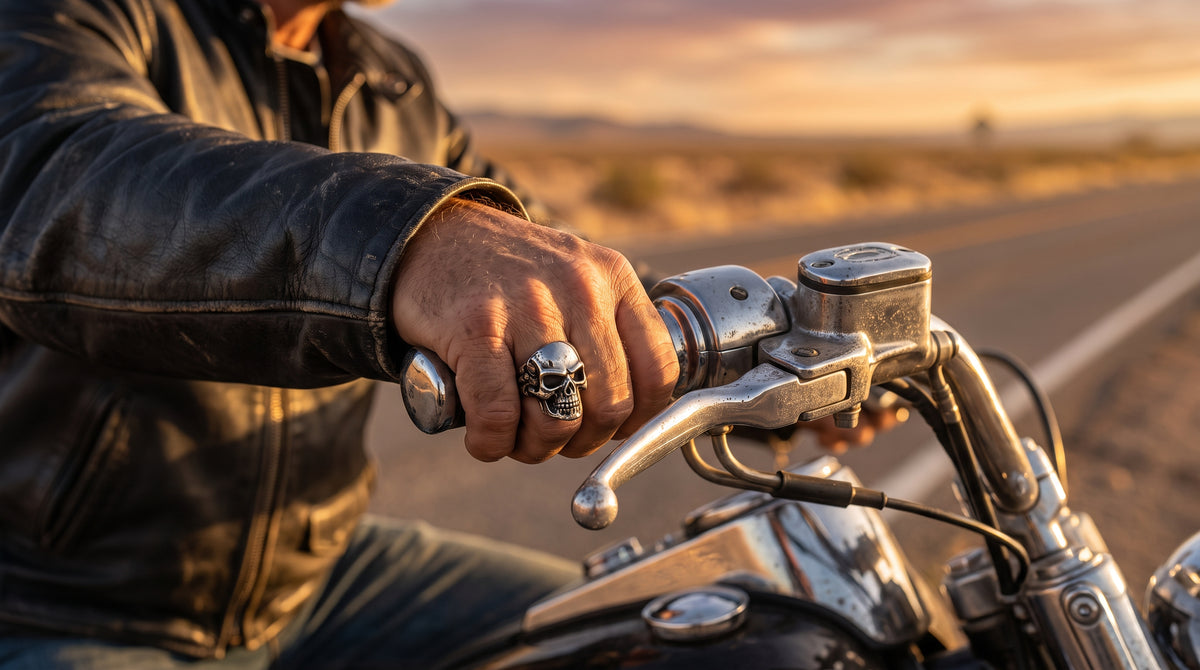
On July 4, 1947, about 4,000 riders rolled into Hollister, California for a race weekend. A staged photo of a drunk rider on a Harley ran in Life magazine two weeks later, the country decided motorcycling had a problem, and a single number stuck to the sport for the next eighty years. That number is the whole reason a 1%er ring exists.
A 1%er ring is not just another skull band with attitude. It carries a specific meaning, a set of unwritten rules, and a history most sellers never bother to explain. This guide covers where the 1% diamond came from, who can wear one and where it gets complicated, which metals actually survive daily riding, and how to size a wide band so it stops fighting your glove.
Where the 1% Actually Comes From
The origin story every rider repeats goes like this: after Hollister, the American Motorcyclist Association said 99% of motorcyclists are law-abiding citizens, and the remaining 1% claimed the insult as a badge. It is a clean story. It is also only half true.
The AMA has stated publicly that it has no record of ever issuing that quote. No press release, no transcript, nothing in the archives. The phrase most likely grew out of newspaper coverage and the 1953 Marlon Brando film The Wild One, which was loosely built on the Hollister weekend. The quote is probably apocryphal. The identity it created is very real.
By the 1960s, clubs that operated outside AMA sanctioning were wearing a diamond-shaped patch with "1%" inside it. The diamond shape matters as much as the number. It is the container that signals the wearer is not a weekend hobbyist, and it is the shape you see repeated on rings, belt buckles and pendants today.
1%er Patch Rules vs 1%er Ring Rules
This is the part that gets glossed over, and it is the part worth reading twice. A 1% diamond patch and a 1%er ring are not the same object, and they do not carry the same weight.
A patch sewn onto a vest is club property. It is issued, it is earned, and in most clubs it is returned when a member leaves. Wearing a three-piece patch set or a 1% diamond you were never given is the single fastest way to start a conversation you do not want at a rally. If you are unclear on how any of that works, read our breakdown of how club patches actually work and which ones to avoid before you put anything on a vest.
A ring sits in a different category. It is jewelry, it is sold openly, and millions of riders with no club affiliation wear the 1% motif as a nod to outlaw style. Nobody is checking credentials at a gas pump. The practical rule most riders follow is simple:
- Ring on its own: fine. It reads as style, the same way a skull ring does.
- Ring plus club colors you did not earn: not fine. The combination is what signals a claim, and the claim is what causes trouble.
- Riding in an area with an active club presence: read the room. Style choices that are invisible in one state get read differently in another.
Why Bikers Wear Rings in the First Place
Strip away the symbolism and there is a practical answer. A ring is the one piece of gear that stays on when the helmet, jacket, gloves and boots all come off. It is the identity you carry into the diner.
There is also a weight difference that surprises first-time buyers. A plain wedding band runs roughly 4 to 6 grams. A cast stainless skull ring commonly lands between 15 and 30 grams. That heft is the point. It sits on the hand like hardware, not decoration, and it is why a well-made biker ring feels completely different from a fashion ring at the same price.
The trade-off is that mass and profile both matter once you put a glove on. More on that below.
Metals That Survive Daily Riding
Most rings that fail do not break. They discolor, they green a finger, or the plating wears off the high points within a season. Here is how the common options actually hold up.
| Material | What it is | Holds up? | Resizable |
|---|---|---|---|
| 316L stainless | 16-18% chromium, 2-3% molybdenum | Best all-round. No tarnish, shrugs off sweat and rain | Very difficult |
| "Titanium steel" | A trade name, usually 316L or 304 stainless | Same as stainless. Contains little or no titanium | Very difficult |
| Sterling silver | 92.5% silver, 7.5% copper | Tarnishes, but the patina sinks into skull detail and looks better for it | Yes, by a jeweler |
| Gold-tone plating / PVD | Thin coating over a steel core | Good on recessed detail, wears first on knuckle edges | No |
| Unmarked brass alloy | No stated composition | Avoid. This is the one that turns a finger green | No |
If a listing will not name the alloy, treat that as the answer. Stainless-steel sellers say "316L" because it is a selling point. Nobody hides good material.
7 1%er and Outlaw-Style Rings Worth Wearing
These are the styles riders actually reach for, from the literal 1% diamond to the outlaw-adjacent designs that carry the same attitude without the symbol. Every one of them is stainless or steel-cored, so none of them will stain a hand in a wet week.
1. The straight 1%ER Man Ring
The unambiguous version. The 1% sits inside the diamond exactly as it appears on a patch, with no extra ornament competing for attention. This is the one to pick if the symbol is the point and you want it legible from across a table. Stainless build, so it takes rain and chain grease without a mark.

2. Titanium steel 1% Er skull ring with gold-tone accents
Same symbol, louder execution. The skull and the gold-tone detailing make it read as jewelry first and statement second, which is useful if you want the motif without the flat declaration. The gold tone is a surface treatment over the steel core, so expect the knuckle edges to brighten with wear.

3. Stainless steel skeleton ring
A full skeletal wrap rather than a single skull face. The detail runs around the entire band, so it holds up visually from every angle instead of only head-on. It is also one of the heavier pieces here, which puts it at the top of that 15 to 30 gram range.

4. American flag skull ring
The best option for riders who want outlaw weight without the 1% claim. The flag motif reads as patriotism rather than affiliation, which means it travels anywhere and to any rally without a second thought. Stainless steel, so the raised flag detail stays crisp.

5. Wolf head ring in 316L stainless
The sculptural alternative. A wolf head has more surface variation than a skull, which means shadows do more of the work and the ring looks good in flat daylight. The 316L spec is stated outright on this one, so you know exactly what is on your hand.

6. Black stainless skull ring with blue eyes
Blackened finishes hide the scuffs that a polished ring shows within a month, which makes this the most forgiving pick for someone who works with their hands. The blue stone eyes give it a focal point that plain black steel usually lacks.

7. Vintage punk skull ring
The heaviest and most detailed piece on this list, and priced accordingly. The vintage finish is oxidized into the recesses rather than sitting on top, so it ages instead of wearing off. If you want one ring that becomes your ring, this is the category.

For the full lineup including bands that skip the skull entirely, the biker ring collection is the place to browse. We also broke down skull, outlaw and MC ring styles in more depth if you are still deciding on a direction.
1%er Jewelry Beyond the Ring
The ring is by far the most common form the symbol takes, and there is a reason for that. A hand is visible, a ring is easy to remove before a border crossing or a job interview, and it never touches the one piece of clothing that carries actual club meaning. That makes it the low-friction way to wear outlaw style.
The other pieces riders ask about:
- Pendants and chains. A 1% pendant on a heavy curb chain sits under a shirt most of the day, so it reads as personal rather than declarative. Look for a stainless chain rated to at least 4mm link width. Thinner chains snag on jacket zippers and fail at the clasp.
- Belt buckles. More visible than a ring and harder to read as casual style, so this is the one to think twice about if you ride through areas with an active club presence.
- Tattoos. Worth saying plainly: a 1% tattoo is the one version you cannot take off. In club culture it is treated as a claim of membership, not a style choice, and riders who get one without affiliation regularly regret it.
If you want the chain without the symbol, our biker necklace lineup covers the skull and cross designs that carry the same weight with none of the questions attached.
How to Size a Wide Biker Ring
More returns come from sizing than from any quality problem, and the cause is almost always band width. A US size 10 has an inner diameter of about 19.8mm, but that measurement assumes a narrow band. Widen the band and the same diameter grips much harder because there is more surface pressing against your finger.
- Band wider than 8mm: order a half size up from your normal size.
- Measure at the end of the day. Fingers swell through the day and swell more in heat, which is exactly when you are riding.
- Check it with a glove on. A high-profile skull ring creates a pressure point inside a tight riding glove, and pressure points turn into hot spots by hour two.
- Buy stainless in the right size the first time. Stainless is hard enough that most jewelers will not resize it, and the ones who will often refuse anything with detail work.
A common fix is to wear the heaviest ring on the right hand if you ride with your throttle hand ungloved at stops, and keep the clutch hand simpler.
Five Mistakes That Ruin a Good Ring
- Pairing a bought 1% ring with club colors. The ring alone reads as style. Add a three-piece patch set you were not given and it reads as a claim. That combination is the problem, not the ring.
- Buying plated metal over an unnamed base. Plating over steel is fine. Plating over an alloy nobody will name is how you end up with a green finger and a ring you stop wearing.
- Sizing by number instead of by width. Your wedding-band size is not your 10mm skull-band size, and ordering it that way is the single most common return reason.
- Wearing a tall ring under a race-fit glove. Anything with a raised skull or a high crown will bite once your hand swells. Save the tall pieces for off the bike.
- Polishing a vintage-finish ring. That dark recessed patina is the design. Take a polishing cloth to it and you erase the depth it was made for.
Picking the One You Will Actually Wear
The honest summary: a 1%er ring is a style choice with a real history behind it, and knowing that history is what separates wearing it well from wearing it wrong. The symbol is fine on your hand. It is the vest that has rules.
If it is your first heavy ring, start with stainless in a mid-profile design and size up a half size. That combination survives weather, survives gloves, and still looks like something the day you sell the bike. If you are shopping for one, the biker rings collection is where we would start, and the flag and wolf designs are the safest picks if you want the weight without the symbol.
No comments yet. Be the first rider to weigh in.