
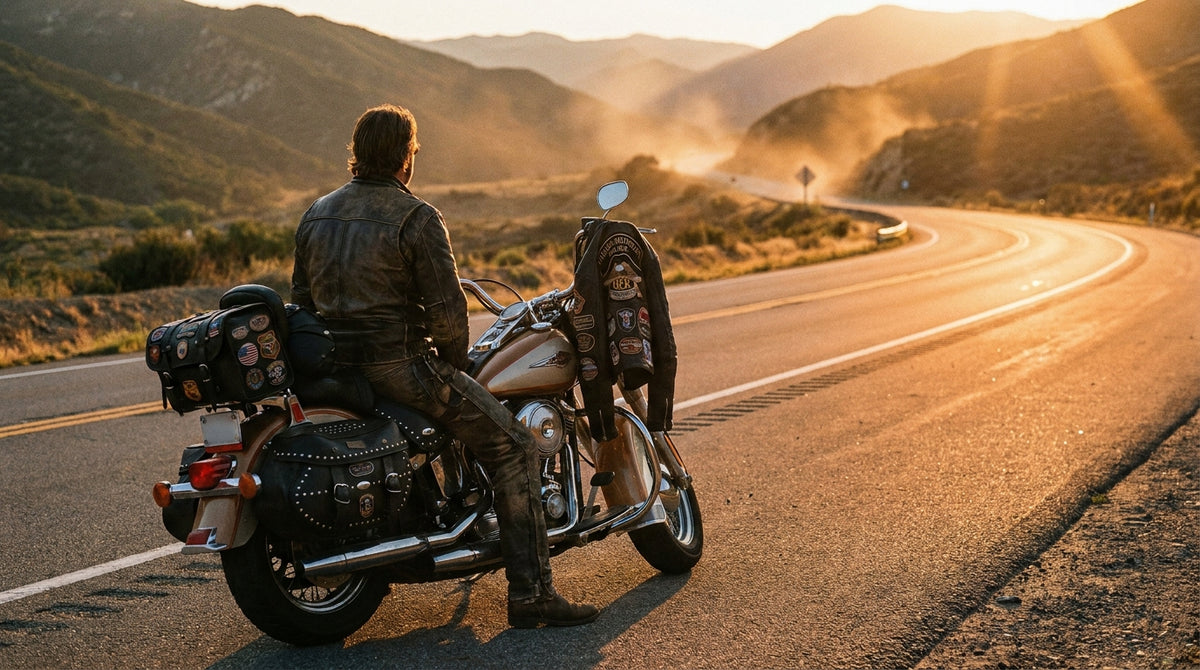
A new rider buys a three-piece back patch set from Amazon, sews it onto a brand-new leather vest, and wears it to his first bike night at a local bar. Within 20 minutes, a club member walks up and tells him to take the vest off. The patch layout he chose, a top rocker with a territory name plus a center patch and bottom rocker, is a combination reserved for full-patch motorcycle club members. The rider had no idea. He thought they looked cool. That kind of mistake can turn a casual evening into a serious confrontation.
Motorcycle patches carry real meaning in riding culture. Some are purely decorative. Others signal club membership, rank, or territory. This guide covers the different types of motorcycle patches, what they actually mean, which ones to avoid, and how to pick patches that fit your riding style without crossing lines you did not know existed.
What Motorcycle Patches Mean in Riding Culture
Patches are not just decoration on a vest. In the motorcycle world, they function as a visual language. A rider's patch layout tells other riders whether he belongs to a club, what rank he holds, what territory the club claims, and whether the club operates as a one-percenter organization or a family riding club.
The American Motorcyclist Association (AMA), founded in 1924, originally classified organized motorcycle clubs into two groups: AMA-sanctioned clubs that followed rules and paid dues, and everyone else. The "1%" patch comes from the widely repeated claim that 99% of motorcyclists are law-abiding citizens. Whether or not the AMA actually said those exact words, the 1% diamond patch became a symbol for clubs that operate outside mainstream motorcycle culture. Wearing a 1% patch without membership is one of the fastest ways to create a problem at any bike gathering.
Even outside the outlaw world, patches carry weight. A HOG (Harley Owners Group) chapter patch identifies a rider as part of a specific dealer-sponsored group. A veteran MC patch signals military service. A riding club (RC) patch indicates a casual group that rides together but does not claim territory. Each type follows different rules about who can wear what and where.

Types of Motorcycle Patches and What They Represent
Not every patch on a vest means the same thing. Here is a breakdown of the main categories riders encounter.
Three-Piece Patches (MC Clubs)
A three-piece patch set has a top rocker (club name), a center patch (club logo), and a bottom rocker (territory). This layout is exclusively used by motorcycle clubs (MCs). The Hells Angels, Bandidos, Outlaws, and Pagans all use three-piece sets. Wearing a three-piece set without being a patched member of that club is treated as a direct challenge. Full stop.
Two-Piece Patches (Riding Clubs)
A two-piece set uses a top rocker and a center patch, but no bottom rocker. This layout signals a riding club (RC) rather than a motorcycle club (MC). Riding clubs are social groups that organize rides and events without claiming territory. Most riding clubs register with their local Confederation of Clubs (COC) to avoid conflicts with established MCs in their area.
One-Piece Patches
A single patch with no rocker is the safest option for independent riders. One-piece patches include name patches, event patches, memorial patches, humor patches, and flag patches. These carry no club affiliation and are generally accepted anywhere. The Sturgis Motorcycle Rally, which drew over 500,000 riders to South Dakota in 2023, sells thousands of one-piece event patches every year.
Side Patches and Tabs
Small rectangular patches worn on the front of the vest or on the sides. Common examples: "Ride Free," veteran service patches, blood type patches, and "In Memory Of" tabs. These are personal statements and do not carry club-level significance. Most riders accumulate 5 to 15 side patches over a few years of attending rallies and events.
| Patch Type | Layout | Who Wears It | Risk Level |
|---|---|---|---|
| Three-piece (MC) | Top rocker + center + bottom rocker | Patched MC members only | High if worn by non-members |
| Two-piece (RC) | Top rocker + center patch | Riding club members | Low to moderate |
| One-piece | Single standalone patch | Anyone | None |
| Side patches/tabs | Small rectangles or shapes | Anyone | None |
Motorcycle Patches to Avoid If You Are Not in a Club
Certain patches send signals that can create real problems for riders who wear them without understanding the context. Here are the ones to steer clear of.
1% diamond patch. This small diamond-shaped patch means the wearer belongs to an outlaw MC. Wearing it as a fashion statement is not treated as a joke by the clubs that earned it. The Bureau of Alcohol, Tobacco, Firearms and Explosives (ATF) has used 1% patches as evidence in federal investigations, so this is not just a social issue.
Three-piece back patch set. As mentioned above, the top rocker, center, and bottom rocker layout is reserved for MC members. Wearing any version of this layout, even with a made-up club name, can be interpreted as claiming territory. A group of friends who want matching back patches should use a one-piece design with no rockers.
Territory bottom rockers. A bottom rocker with a state or city name claims that territory for the club. Dominant MCs in most regions consider unauthorized territory claims a direct challenge. Even riding clubs that register with their local COC sometimes face pushback when choosing bottom rockers with geographic names.
Property patches. "Property of [Club Name]" patches are worn by associates and partners of MC members. Wearing one without the club's permission is disrespectful to both the club and the tradition.
Specific club logos. Wearing a Hells Angels death head, a Bandidos fat Mexican, or any other MC's trademarked insignia without membership is both socially dangerous and legally risky. The Hells Angels have filed trademark lawsuits against unauthorized use of their logo in the U.S., Canada, and Europe.

How to Pick the Right Motorcycle Patches for Your Vest
If you ride independently or belong to a casual group, one-piece patches and side tabs are the way to go. They let you personalize your vest without stepping into club politics. Here is how to put together a patch layout that looks good and stays out of trouble.
Start with a center back patch. Pick a single large patch for the center of the back. Popular choices include American flag patches, eagle designs, skull graphics, and "Lone Wolf" or "Independent Rider" patches. A quality embroidered back patch in the 10 x 12 inch range costs $15 to $35 from a domestic embroidery shop. That one patch anchors the whole vest.
Add front chest patches. The left chest typically gets a name patch or a riding motto. The right chest is common for a flag patch or a club affiliation (for RC members). Standard chest patches run 3 x 4 inches and cost $5 to $12 each.
Fill the sides with rally and memorial patches. Event patches from Sturgis, Daytona Bike Week, Laconia, and local rallies build a personal riding history on your vest. Memorial patches honoring fallen riders are placed on the lower back or sides. These patches are the ones that make a vest uniquely yours over time.
Custom Motorcycle Patches: Embroidered vs Iron-On vs PVC
Custom patches let a riding group create a shared identity without the baggage of an MC-style layout. Three main production methods dominate the market.
| Type | Durability | Detail Level | Cost (4 in patch) | Best For |
|---|---|---|---|---|
| Embroidered | 10+ years | High (thread texture) | $3 to $8 each (50+ qty) | Leather and denim vests |
| Iron-on | 1 to 3 years | Medium | $2 to $5 each (50+ qty) | Textile jackets, casual wear |
| PVC / rubber | 5+ years | Low to medium | $2 to $6 each (50+ qty) | Tactical vests, rain gear |
| Woven | 5 to 8 years | Very high (fine detail) | $3 to $7 each (50+ qty) | Complex designs, small text |
Embroidered patches are the gold standard for motorcycle vests. The raised thread gives them a texture that iron-on prints cannot match, and they hold up for a decade or more of highway riding, weather exposure, and washing. A company like Stadium Custom Awards in New York produces embroidered patches with up to 12 thread colors and merrow-stitched borders. Minimum orders start at 25 to 50 pieces for most shops, with per-unit cost dropping at 100+ quantity.
Iron-on patches work well for textile jackets and casual applications. The adhesive backing holds for 1 to 3 years before peeling at the edges. For a permanent install on a leather vest, skip the iron-on and sew the patch directly. Adding a few hand stitches around the border of an iron-on patch doubles its lifespan and prevents curling.
PVC patches are waterproof and clean easily, which makes them popular for rain gear and tactical-style vests. They lack the classic look of embroidery, but they survive conditions that would destroy a thread patch in a season. For riders who commute in all weather, PVC patches on a textile denim motorcycle vest is a practical combination.

5 Mistakes Riders Make with Motorcycle Patches
1. Wearing a three-piece set without being a patched member. This is the most common and most dangerous mistake. A three-piece back patch with rockers is not a style choice. It is a statement of club membership and territory. Riding clubs and independents should stick to one-piece or two-piece layouts.
2. Ironing patches onto leather. Leather does not bond well with iron-on adhesive. The heat required to activate the glue (around 350 degrees Fahrenheit) can scorch, discolor, or permanently damage leather. Sew patches onto leather vests by hand or take them to a leather shop. Most cobblers and alteration shops charge $3 to $8 per patch for hand sewing.
3. Placing patches in the wrong position. The center back is for the main club or personal patch. Top and bottom positions are reserved for rockers. Front left chest is typically a name patch, front right is a flag or rank. Mixing these up signals that the wearer does not understand patch culture. Our vest patches placement guide covers the full layout.
4. Buying cheap printed patches that fade in a season. Sublimation-printed patches look sharp out of the package but fade noticeably after 2 to 3 months of sun and rain exposure. Embroidered patches cost slightly more upfront and last 10 times longer. For a vest that sees regular highway use, embroidery pays for itself within the first year.
5. Not checking with the local COC before starting a riding club with patches. The Confederation of Clubs exists in most U.S. states as a communication channel between MCs and RCs. Registering a new club name and patch design with the COC helps avoid accidental conflicts with existing clubs. Skipping this step has led to confrontations that could have been prevented with a single meeting.
Where to Find Quality Motorcycle Patches
Rally vendor tents remain the most popular source for one-piece patches. Sturgis, Daytona, and Laconia all have dozens of patch vendors selling everything from flag patches to custom embroidered designs. Prices range from $3 for a small side tab to $30 or more for a large embroidered back patch.
Online, dedicated patch suppliers offer wider selection and bulk pricing. For custom orders, look for shops that provide a digital proof before production, use polyester thread (not rayon, which fades faster), and offer merrow-border finishing. Minimum order quantities for custom work typically start at 25 to 50 pieces.
For riders who want ready-made motorcycle patches with solid stitching and designs built for the biker lifestyle, the ALR patches collection has options that ship fast and hold up on the road. Pair them with a solid biker clothing setup and the vest starts telling your story from day one.


No comments yet. Be the first rider to weigh in.