
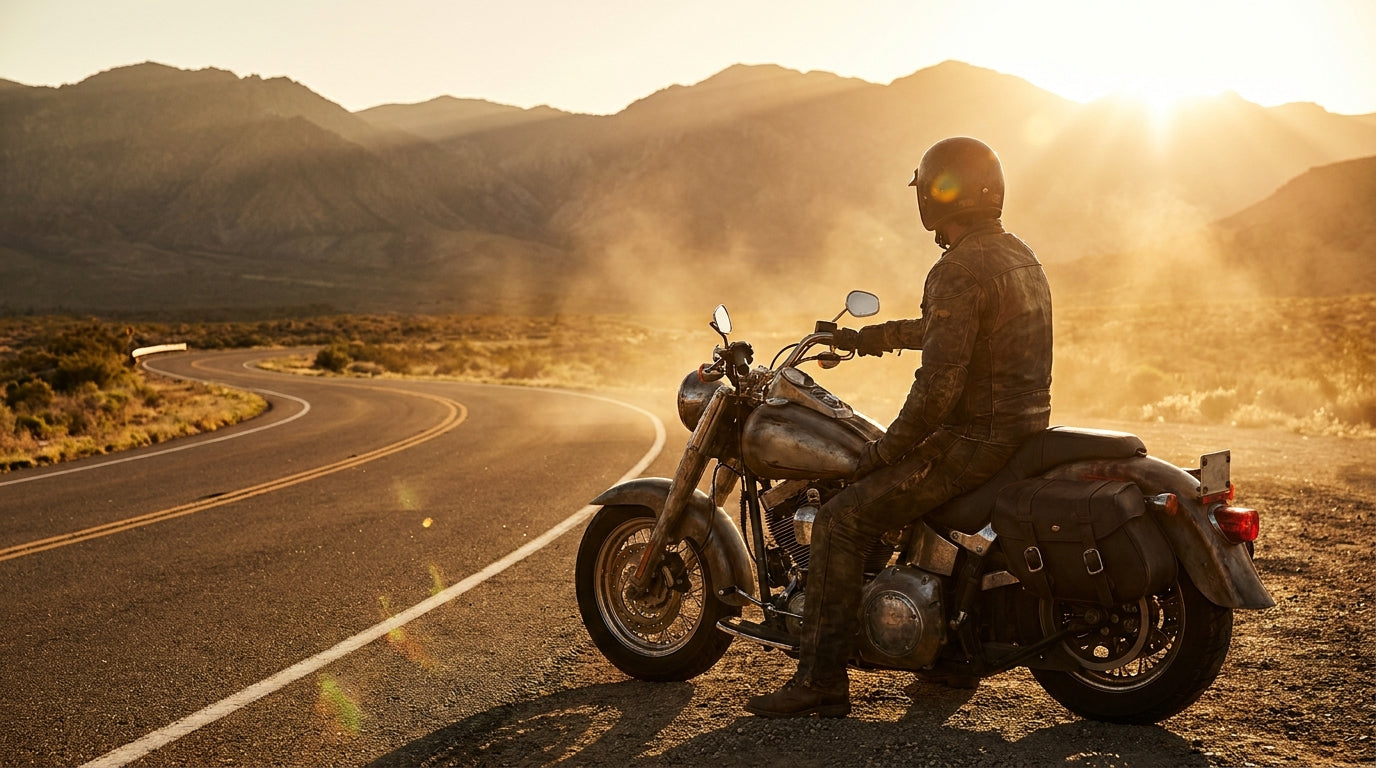
Most riders build their biker wardrobe backwards. They grab the jacket that looks sharpest on the rack, then find out the fit clashes with their vest. The boots do not match the pants. The shirt underneath rides up past the belt at 70 mph. Building biker clothing that works means starting with function, layering for weather and protection, and letting the style follow from there.
This guide covers every core category of biker clothing for men: leather jackets, vests, boots, shirts, and riding pants. You will learn which materials actually survive road conditions, what to spend on each piece, and how to build a riding setup that looks as good at a bar stop as it does on the highway.
Leather Jackets: The Core of Every Biker Clothing Setup
A leather motorcycle jacket is the single most important piece of biker clothing you can own. It protects against road rash, blocks wind at speed, and sets the visual tone for everything else you wear on the bike. The minimum leather thickness for real abrasion protection is 1.0 to 1.2mm cowhide. Anything thinner is a fashion jacket, not riding gear.
A standard men's leather riding jacket in 1.1mm cowhide weighs between 3.5 and 5 pounds depending on hardware and liner. That weight matters because lighter jackets ride up in wind. A jacket that fits snug at the waist and hits just below the belt line stays put at highway speed. Jackets that stop above the waist gap open when you lean forward, exposing your lower back to wind and road debris.
For cruiser riders, a classic asymmetric-zip jacket (Perfecto-style) runs $200 to $450 for genuine leather. The Schott 613 is the original design, in production since 1928, and still the benchmark every biker jacket gets compared against. Textile jackets cost less but wear differently. Cordura nylon resists abrasion well but does not develop the patina that makes leather look better year after year. For riders who want the real thing, a men's leather jacket built from full-grain cowhide will outlast three or four textile jackets at the same price point over time.

Biker Vests for Club Rides and Solo Riding
A motorcycle vest serves two jobs. First, it adds a layer of wind protection over a T-shirt on warm days when a full jacket is too hot. Second, it carries club patches, pins, and personal insignia that define a rider's identity on the road. A standard denim biker vest in 14 oz cotton denim weighs about 1.2 pounds and fits over a shirt without adding bulk that restricts arm movement.
Leather vests are heavier, usually 2 to 3 pounds, but they block more wind and last longer. A well-made leather vest develops a broken-in look within one season that denim takes years to match. The key detail to check on any vest is the back panel. Club riders need a flat back panel at least 14 inches wide and 12 inches tall to fit a center patch. Vests with seams running across the back panel make patch mounting difficult and cause the patch to buckle.
For riders who want both options, a leather or denim motorcycle vest with a clean back panel and inside chest pockets is the most versatile pick. Snap closures beat zippers on vests because they open faster when the temperature shifts mid-ride, they sit flatter against the body while riding, and they do not scratch the paint on your tank when you lean forward.

Biker T-Shirts and Riding Shirts
Under a jacket or vest, the shirt takes the most direct contact with your skin and sweat. A standard biker tee in 6.1 oz cotton (the Gildan Ultra Cotton benchmark) holds its shape after 50 or more washes and does not thin out like lighter 4.3 oz shirts do. For riding, heavier cotton is better. It absorbs sweat without feeling clammy and does not stick to a leather jacket liner the way polyester does.
Biker T-shirts lean heavily on skull graphics, club-style typography, and American eagle and flag imagery. The designs are part of the culture, but the shirt itself needs to work on the bike first. Look for pre-shrunk cotton, reinforced shoulder seams, and a length that tucks securely into jeans. A shirt that rides up exposes your lower back to the jacket zipper, which digs in after an hour of riding and leaves a raw mark.
Long-sleeve shirts and flannels work as a middle layer between a tee and a jacket in spring and fall. A heavyweight flannel in 8 to 9 oz fabric weight blocks enough wind on its own for rides under 50 mph. If you want biker t-shirts that hold up wash after wash, screen printing on heavyweight cotton outlasts direct-to-garment printing by a wide margin. DTG prints start cracking after about 20 washes, while screen prints on 6 oz cotton hold color and shape for a full riding season.

Boots That Complete the Look
Biker boots do more work than any other piece of clothing to protect you on a motorcycle. Your feet sit inches from hot exhaust pipes, asphalt, and the shift lever. A proper riding boot covers the ankle, has an oil-resistant sole, and uses a Goodyear welt or cement construction that keeps the sole from separating under vibration and heat.
The classic harness boot with a square toe and O-ring straps is the most recognized biker boot style. The original design dates back to WWII-era military boots modified by returning servicemen who started riding Harleys and Indians in the late 1940s. Today, a standard leather harness boot runs $120 to $250 for genuine leather with a stacked heel of 1.5 to 2 inches. That heel height gives solid footing on the shift and brake pegs without making it hard to walk off the bike.
For riders who need a boot that crosses over to daily wear, a low-profile engineer boot or lace-up combat boot works well. The critical feature on any riding boot is a shank, a rigid internal support between the insole and outsole that prevents the sole from flexing around the foot peg. Boots without a shank fatigue your arches after about 45 minutes of riding. The biker boots guide covers fit, construction, and styles in more detail.

Riding Pants and Lower-Body Gear
Jeans are the default lower-body choice for most cruiser riders. Standard denim does offer some abrasion resistance, but not much. A pair of Levi's 501s in 12.5 oz denim wears through in about 0.6 seconds of slide on asphalt, based on MotoCAP testing data. Kevlar-lined riding jeans extend that to roughly 3 to 4 seconds, which prevents road rash in most low-speed slides under 30 mph.
Leather riding pants offer the best abrasion protection. Full-grain cowhide at 1.0mm thickness resists a slide for over 6 seconds. The tradeoff is comfort: leather pants run hot in summer, feel stiff until broken in, and cost more than jeans. Most riders pick leather chaps that strap over regular jeans as a compromise. Chaps add the leather layer where it matters most (thighs, knees, and shins) without the full-body heat of leather pants. A solid pair of riding chaps runs $80 to $150 and adds meaningful protection without replacing your entire lower wardrobe.
Belt choice matters more than most riders think. A heavy leather belt, 1.25 to 1.5 inches wide, keeps your jeans anchored when wind catches your jacket. Thin dress belts flex and allow the waistband to shift, which pulls your shirt out and exposes skin. A double-prong or roller buckle grips better than a single prong and does not loosen on long rides. Match the belt leather to your boots and the whole lower half of the outfit holds together visually.
Biker Clothing Compared: What to Spend and What Lasts
| Category | Entry Price | Quality Range | Expected Life | Key Material |
|---|---|---|---|---|
| Leather Jacket | $150 | $250-$450 | 10+ years | 1.0-1.2mm cowhide |
| Leather Vest | $80 | $120-$250 | 8+ years | 0.8-1.0mm cowhide |
| Denim Vest | $40 | $50-$90 | 3-5 years | 12-14 oz cotton |
| Biker T-Shirt | $15 | $20-$35 | 1-2 years | 6.0+ oz cotton |
| Riding Boots | $100 | $150-$300 | 5-8 years | Full-grain leather |
| Riding Jeans (Kevlar) | $60 | $100-$200 | 2-4 years | Kevlar-lined denim |
| Leather Chaps | $80 | $100-$180 | 6-10 years | 0.9-1.1mm cowhide |
The pattern is clear. Leather pieces cost more upfront but last three to five times longer than denim or cotton alternatives. A $350 leather jacket that lasts 10 years costs $35 per year. A $120 textile jacket replaced every 2 years costs $60 per year. Quality biker clothing is cheaper over time when you factor in replacement costs and the fact that good leather looks better with age, not worse.
5 Mistakes When Buying Biker Clothing
- Buying fashion leather instead of riding leather. Fashion leather jackets use 0.5 to 0.7mm lambskin that tears on contact with asphalt. Riding leather is 1.0mm or thicker cowhide or buffalo hide built for abrasion resistance. If the jacket feels paper-thin and buttery soft in the store, it is not riding gear. It is a costume piece that will not protect you in a slide.
- Ignoring fit on the bike. Biker clothing needs to fit in riding position, not standing in front of a mirror. A jacket that sits perfectly while standing can bind across the shoulders and ride up at the waist when you lean forward on the bars. Try gear on while sitting on the bike, or at minimum in a forward-leaning position before buying.
- Skipping the boots. Sneakers and work boots are the first things new riders wear on a motorcycle. Neither has ankle protection, oil-resistant soles, or a shank for foot peg support. A slide at 25 mph in sneakers can grind through the shoe and into skin within one second. Proper riding boots are not optional.
- Buying logo-heavy gear from non-motorcycle brands. General fashion brands that add "biker" to their product labels sell a look, not riding gear. They use thinner materials, skip reinforced stitching at stress points, and price based on brand name rather than construction quality. Buy from brands that make gear for actual riders.
- Not layering for temperature. Biker clothing should work as a system: base layer (T-shirt), mid layer (vest or flannel), and outer layer (jacket). Riders who buy one heavy jacket for all seasons overheat in July and freeze in November. Three lighter layers give more temperature range than one thick piece, and you can strip down to a vest and tee at a lunch stop without carrying extra gear.
Building a biker clothing setup does not mean buying everything in one trip. Start with the jacket and boots, the two pieces that protect you most on the road and define the look. Add a vest and riding shirts as your wardrobe grows. If you want gear built for actual riding and not costume shops, American Legend Rider carries leather, denim, and accessories made for the road.
No comments yet. Be the first rider to weigh in.