
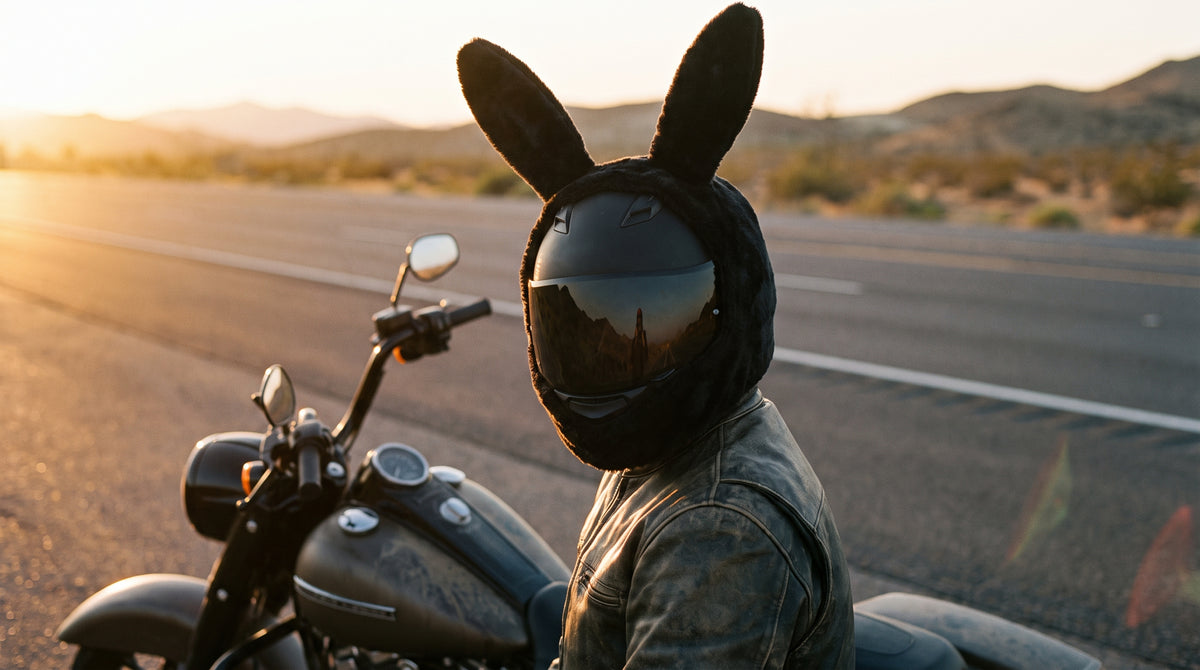
At a gas stop outside Barstow a guy on a Road King laughed so hard he nearly dropped his card reader. The reason was a pair of fuzzy black ears standing straight up off a full-face helmet in the next bay. Four riders asked the owner where he got it before he finished fueling. That is the whole appeal of a bunny ears motorcycle helmet, and it costs less than a tank of premium.
This guide covers the nine real ways to get bunny ears on your head, from $37.95 plush covers that slip over the helmet you already own to a $219.45 helmet with the ears built in. You will also learn which ear styles survive highway speed, how the sizing actually works, and the three mistakes that end with an ear in the ditch somewhere behind you.
Bunny Ear Helmet Cover vs a Built-In Bunny Helmet
There are two products hiding behind the same search. A bunny helmet cover is a plush fleece skin that stretches over your existing lid, usually $37.95 to $47.95. A bunny ear helmet has the ears molded or mounted onto the shell itself and runs closer to $219.45.
The cover wins on price and on safety logic. It does not touch the shell, the liner, or the DOT certification of the helmet underneath, because you keep riding your own certified helmet. The built-in version wins on durability and on a cleaner silhouette, since nothing can shift or peel off at speed.
| Option | Typical price | Fits your current helmet | Best for |
|---|---|---|---|
| Plush bunny helmet cover | $37.95 to $47.95 | Yes, universal stretch fit | Riders who want the look on and off in seconds |
| Cat or bunny ear helmet | Around $219.45 | No, it replaces the helmet | Riders who want ears permanently, no fabric |
| Stick-on novelty ears | Under $15 | Sometimes | Nothing. Adhesive fails in the wind |
If you are deciding between the two, start with a cover. Thirty-eight dollars is a cheap way to find out whether you actually enjoy the attention before you commit to a whole new helmet.
The 9 Best Bunny Ears Motorcycle Helmet Picks
Every option below is a real plush cover or helmet, priced as listed. They are ranked by how well the ears hold their shape once you are moving.
1. Black Bunny Ears Motorcycle Helmet Cover
This is the one people mean when they type bunny ears motorcycle helmet into Google. Matte black plush, two tall ears with internal stiffening so they stand rather than flop, $37.95. Black is the practical pick because road grime shows least on it and it still reads as biker rather than costume. It pairs with a blacked-out bike without looking like you lost a bet.

2. White Bunny Motorcycle Helmet Cover
Same $37.95, built for full face helmets, and by far the most visible option in traffic. White plush against dark asphalt is genuinely easier for drivers to pick up at dusk, which is a real side benefit of a novelty cover. The tradeoff is cleaning. Expect to hand wash this one every few weeks if you ride behind trucks.

3. Gray Bunny Motorcycle Helmet Cover
The middle ground at $37.95. Gray hides dust better than white and reads softer than black, and it is the color that photographs best if you post riding clips. Gray also disguises the seam where the ear meets the dome, so the ears look more like part of the helmet.

4. Melody Pink Bunny Plush Cover
At $42.95 this is the character pick, a pink bunny with a bow and long ears. It is the most requested cover for two-up riders buying something for a passenger, and the one most likely to get a kid in a minivan waving at you. The extra five dollars over the plain colors buys the detail work on the face and bow.

5. Cinnamoroll Cute Plush Bunny Ears Cover
The premium plush at $47.95, with the longest ears in the group. Long ears are the most fun standing still and the most affected by wind, so this is a city and cruise-night pick rather than an interstate one. The plush pile is noticeably deeper than the $37.95 covers, which is where the ten dollar difference goes.

6. ALR Cat Ear Motorcycle Helmet
If you want ears that are part of the helmet instead of fabric over it, this is the $219.45 answer. Cat ears rather than rabbit, shorter and swept back, which is exactly why they behave better above 60 mph. Nothing to wash, nothing to re-seat after a fuel stop, and no cover shifting over your vents.

7. Unicorn Motorcycle Helmet Cover
The closest cousin to the bunny look at $37.95, trading two ears for a horn and mane. Riders who tried bunny ears and found them too soft-looking tend to land here. The mane runs down the back of the helmet, so it moves in the wind instead of fighting it.

8. Sheep Motorcycle Helmet Cover
At $42.95 the sheep gives you the same soft-ear silhouette with a fully fleece dome, so the whole helmet reads as one texture. It is the quietest option in wind of any long-ear cover here, because the ears sit lower and shorter than a rabbit ear.

9. Toothless Dragon Motorcycle Helmet Cover
The $47.95 pick for riders who want ears with attitude instead of ears that are cute. Swept back dragon ears and a sculpted face, and the most durable ear geometry in this list precisely because nothing stands straight up into the airstream.

The full lineup, including the emoji, Pikachu, Stitch and animal designs, lives in the motorcycle helmet covers collection if none of these nine is your personality.
Do Bunny Ears Survive Highway Speed?
Short answer: the ears stay on, but tall ears bend. At city speeds up to about 40 mph a stiffened bunny ear stands upright and looks the way it does in the product photo. Somewhere between 50 and 60 mph the airstream lays taller ears back along the helmet.
That is cosmetic, not structural. The plush skin itself grips the helmet by stretch, the same way a fitted sheet grips a mattress, and there is no adhesive to fail. What actually loses covers is riders who never seated the cover past the bottom edge of the shell.
Three practical rules from the way these are built:
- Under 45 mph: any ear length works, including the long Cinnamoroll ears.
- 45 to 70 mph: stick to short or swept-back ears. The cat ear helmet and the dragon cover hold shape best.
- Above 70 mph regularly: pull the cover for the run and put it back on at the stop. It takes about 15 seconds.
Can a Helmet Cover Affect Helmet Safety or Performance?
This is the question worth taking seriously, and the honest answer has two parts.
A plush cover does not change the shell, the EPS liner, or the retention strap, which are the three things that actually protect your head. Your DOT-rated helmet stays a DOT-rated helmet with a fleece skin over it. No cover sold anywhere is itself DOT certified, and none claims to be, because it is not the safety device.
What a cover can affect is ventilation and hearing. Fleece over intake vents reduces airflow, which you will notice on a 95 degree day in stop-and-go traffic. Plush over your ears also muffles sound a little. Neither is dangerous, but both are reasons to skip the cover on a long hot interstate day and save it for cruise nights and short runs.
The non-negotiable part is what sits underneath. A cover over a no-name marketplace helmet with no safety rating is still a no-name helmet with no safety rating, now harder to identify. Start with a certified lid from the DOT-rated helmet collection, then have fun on top of it.
How to Choose the Right Size Helmet Cover
Almost every plush cover in this category is universal stretch fit rather than sized S through XL, and it is designed around full face helmet dimensions. The fabric has enough give to cover a range of shells, which is why the listings say fits most helmets.
Three things matter more than a size chart:
- Helmet style. These are cut for full face lids. On a half shell there is simply less helmet to grip, so the cover can rotate.
- Visor opening. The cover has a cutout that must line up with your eye port. Seat the cutout first, then pull the rest down.
- Bottom edge. Tuck the hem under the lower lip of the shell all the way around. A cover that fails almost always failed here.
For reference, a typical full face helmet weighs around 3 to 3.5 lbs and a plush cover adds only a few ounces, so this does not meaningfully change neck fatigue on a long day.
Are Motorcycle Helmet Covers Legal?
In the United States there is no federal rule against a decorative cover on a helmet. FMVSS 218 regulates the helmet itself, not what you put over it, and no state statute bans plush covers by name.
Two real-world caveats. Your helmet still needs its DOT certification label, and a cover that hides that label can turn a routine stop into a conversation, so know where yours is. And in a handful of countries outside the US, notably parts of Australia, modifying or covering a certified helmet is treated more strictly than it is here. Check locally if you ride abroad.
Track days and organized racing are a separate matter. Tech inspection will pull the cover, every time.
Keeping the Plush From Looking Rough
Bugs, road film and helmet sweat are what age these covers, not mileage. The plush is fleece, so it responds to the same treatment as a fleece jacket.
- Hand wash cold with mild soap. No machine agitation, which is what mats the pile and kills the ear stiffening.
- Air dry fully, never a hot dryer. Heat is what permanently flattens a bunny ear.
- Brush the pile back up with a soft brush once dry so it does not look matted.
- Store it off the helmet. Leaving it stretched over the shell for months trains the fabric loose.
Riders who own two covers in rotation get far more life out of both, and at $37.95 a second one is a reasonable call.
4 Mistakes That Cost Riders Their Ears
1. Buying stick-on ears instead of a cover. Adhesive novelty ears under $15 look identical in a listing photo. They fail because tape has to hold against wind load on a lever arm, and the first highway run peels them. A stretch-fit cover has no failure point to peel.
2. Putting a cover on a half shell. These are cut for full face helmets. On a half shell the hem has nothing to tuck under, so the cover creeps and the ears end up crooked within a few miles.
3. Leaving the cover on in summer heat. Fleece over the intake vents on a 95 degree day in traffic is genuinely unpleasant. Pull it for the hot stretch and put it back on when you park.
4. Treating the cover as the helmet. A $37.95 plush skin adds zero impact protection. If the helmet under it is an unrated shell from a marketplace listing, the cover just makes it harder for anyone to tell. Buy the certified helmet first.
Who Actually Buys a Bunny Helmet Cover
Three groups, and they want different things from it.
Cruise-night riders want the reaction, and they are the reason black and white outsell every other color. Two-up riders buy a second cover for a passenger, which is where the $42.95 Melody lands most often. And gift buyers grab these constantly, because a $37.95 cover is one of the few biker gifts that needs no sizing and no guessing at taste.
If you are shopping for someone else and have no idea what they ride, the black bunny cover is the safe answer. It fits any full face helmet and it does not commit them to a character.
Where I Would Start
For most riders the $37.95 black bunny cover is the right first move. It fits the helmet you already own, it survives normal riding, and if you decide the attention is not for you, you have spent less than a tank of gas finding out. Move up to the cat ear helmet only once you know you want the ears permanently.
If you want to see the whole range of ears, horns and faces side by side, the helmet cover lineup is where I would start, and the DOT-rated full face helmets are what should be underneath whichever one you pick.
No comments yet. Be the first rider to weigh in.