
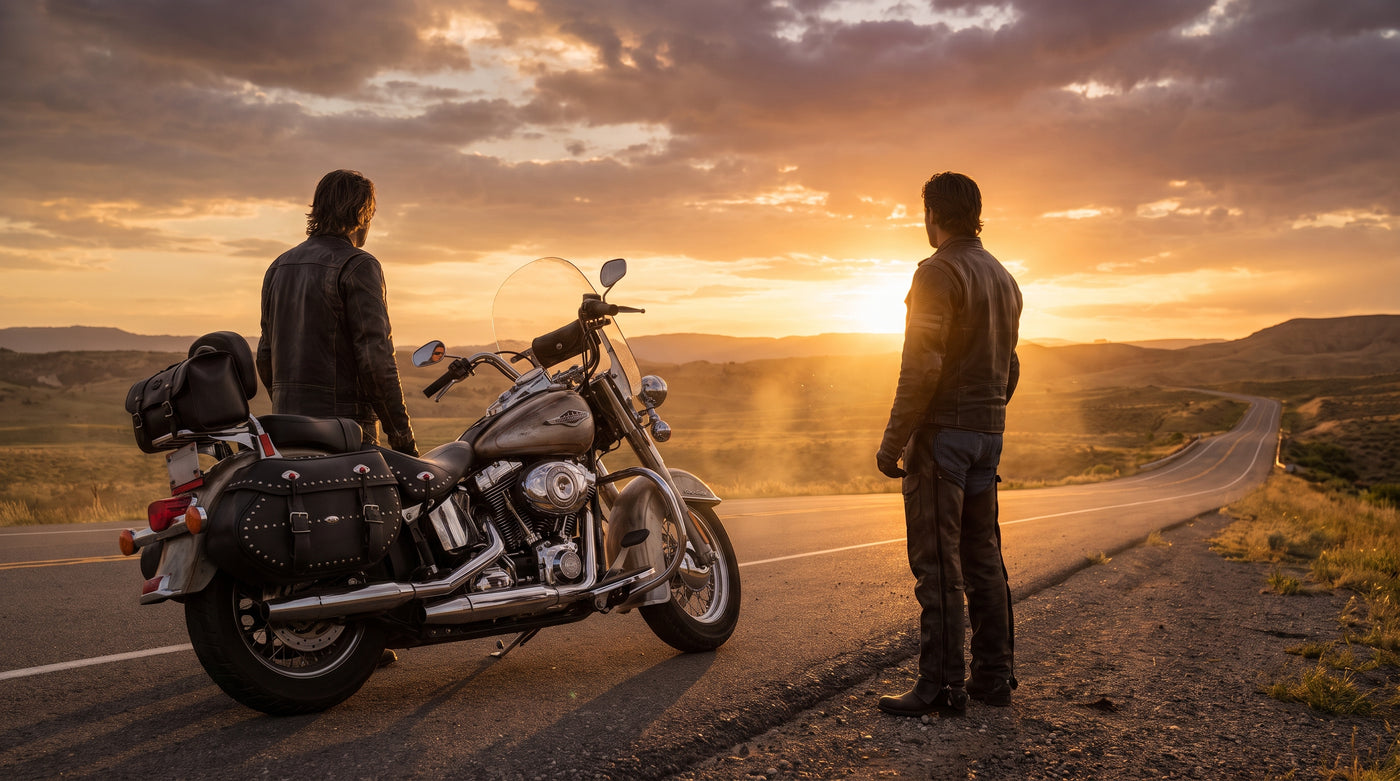
A pair of quality motorcycle chaps can mean the difference between road rash down to the bone and walking away with a scuff on your leather. Most riders buy chaps based on looks alone, end up with the wrong fit or wrong material, and either stop wearing them or replace them within a year. Here's how to get it right the first time.
This guide covers everything you need to know about motorcycle chaps: which leather holds up, how to measure for a fit that stays put at 70 mph, the real protection difference between full-length and half chaps, and the sizing mistakes that leave riders uncomfortable or unsafe. Whether you ride a cruiser or a touring rig, you'll walk away knowing exactly what to look for.
What Motorcycle Chaps Actually Do on the Road
Most riders think chaps are just a style thing. They're not. The primary job of motorcycle chaps is abrasion protection for your legs in a slide.
Cowhide leather between 1.0 and 1.2 mm thick can handle roughly 4.5 seconds of asphalt slide at 30 mph before wearing through. Your jeans? About 0.6 seconds. That's the difference between a bruise and a skin graft.
Beyond slide protection, chaps block wind chill. A 60 mph headwind at 50°F feels like 25°F on bare legs. They also deflect road debris and shield against minor burns from engine heat or exhaust pipes. They won't replace armored pants for track-level protection, but for street and highway riding, they're one of the best investments per dollar you can make.
The catch: chaps only protect the front and sides of your legs. Your backside stays covered only by whatever pants you're wearing underneath. That's by design, so you can sit comfortably on the saddle without bunching. It also means your jeans still matter as a backup layer.
Leather vs Textile Chaps: Which Material Holds Up
Not all motorcycle chaps are built the same. The two main categories are genuine leather and synthetic textile (usually Cordura nylon or polyester blends). Here's how they compare on the things that actually matter for riders.
| Feature | Full-Grain Leather | Textile (Cordura) |
|---|---|---|
| Abrasion resistance | 4-5 sec at 30 mph | 1.5-2.5 sec at 30 mph |
| Wind blocking | Excellent | Moderate |
| Weight per pair | 4-6 lbs | 2-3 lbs |
| Break-in period | 2-4 rides | None |
| Lifespan | 8-15 years | 3-5 years |
| Water resistance | Moderate (needs conditioning) | Better untreated |
| Price range | $120-$350 | $60-$150 |
Full-grain cowhide is the standard for a reason. It's tougher, lasts longer, and molds to your body over time. The break-in period is real (expect 2-4 rides before they stop feeling stiff), but once they're shaped to your legs, nothing fits better.
Textile chaps work for warm-weather commuters who want something lightweight they can throw on and off quickly. They're not bad gear. But they wear faster, protect less in a slide, and won't last a decade the way good leather does. For riders putting in serious miles, leather is the one-time buy that pays for itself.
One material to avoid: bonded leather (sometimes labeled "genuine leather" on budget pairs). It's scraps glued together and coated with a finish. It cracks, peels, and offers almost no slide protection. If the price seems too good to be true, check the spec sheet for "top-grain" or "full-grain" specifically. That distinction matters the same way it does when you're shopping for a leather motorcycle jacket.
Full-Length vs Half Chaps: Which Style Fits Your Ride
This depends on how and where you ride. Both have a job, and picking wrong means you'll either overheat or leave your knees exposed when it counts.
Full-Length Chaps
These run from your waist to your ankles, covering the entire leg. They're the right call for:
- Highway and touring at speeds above 45 mph
- Cold-weather riding below 55°F
- Long-distance trips where road debris is constant
- Any rider who's gone down before and doesn't want to repeat the experience
Half Chaps
Sometimes called "leg warmers" or "knee chaps," these cover from mid-thigh to just below the knee, or from the knee down. They work for:
- Warm-climate riders who only need wind and debris protection on the shins
- Short urban commutes at lower speeds
- Riders who want easy on/off without removing boots
The protection tradeoff is straightforward. Half chaps leave your upper thighs and hips completely exposed. In any slide where you go down on your side (which is most low-side crashes), the hip and upper thigh take the worst of it. Full-length chaps are not overkill if you spend time on the highway.
How to Size Motorcycle Chaps for a Perfect Fit
Bad fit is the number one reason riders stop wearing their chaps. Too tight and you can't swing your leg over the bike. Too loose and they bunch, flap in the wind, and shift out of position during a slide.
Here's how to measure correctly:
Waist: Measure around your natural waist while wearing the pants you'll ride in. Add 1 inch for comfort. Chaps sit at the waist and buckle or snap there, so this measurement determines whether they'll stay up all day.
Inseam: Measure from your crotch to the bottom of your ankle bone. Chaps should hit just at or slightly above the top of your boot. Too long and they bunch at the ankle. Too short and you get a cold gap between chap and boot.
Thigh: Measure the widest part of your thigh (usually about 4 inches below the crotch). This is where most fit problems happen. The chap should wrap around your thigh with the zipper fully closed and about one finger of room inside. If the zipper is straining, go up a size.
A properly fitted pair of motorcycle chaps feels snug when you're standing but doesn't restrict knee bend. Sit on your bike after trying them on. If the waist pulls down hard when you lift your knees to the pegs, the inseam is too short.
Most quality leather chaps will stretch about 0.5 inches in the thigh after break-in. Factor that in, but don't buy them so tight you can't zip them fresh out of the box. If you're between sizes, go with the slightly larger one and use the lace-up adjustments.
How to Wear Motorcycle Chaps the Right Way
This sounds obvious but gets messed up constantly. Here's the correct sequence:
- Put your riding boots on first. Chaps go over the boots, not tucked in.
- Step into the chaps and pull them up to your waist. Buckle or snap the waist closure snugly.
- Zip each leg from the thigh down. Some designs zip from the ankle up. Either way, the zipper should close completely without pulling or gapping.
- Adjust the thigh straps (if your pair has them) so the chaps don't rotate on your legs mid-ride.
- Check the hem: it should overlap your boot by 1-2 inches, covering the top of the boot shaft.
Quick fit check: Walk around for a minute. If the chaps slide down, tighten the waist. If they ride up when you lift your knee, the inseam is too short. If the zippers gap open at the knee, the thigh is too tight and you need a wider cut or a different size.
Wear your chaps over your jeans, never against bare skin. The inner surface can chafe on longer rides, and your jeans add a backup layer of protection underneath. This is the same principle behind wearing a base layer under a leather vest on hot days.
What Separates Quality Biker Chaps from Junk
The market is flooded with cheap biker chaps that look right in photos but fall apart after one season. Here's what to check before you spend money:
Stitching: Look for double or triple stitching at stress points (waist, inner thigh, knee). Single-stitch construction unravels under tension. Quality pairs use bonded nylon thread rated Tex 90 or higher, which won't rot from sweat or rain.
Hardware: YKK zippers are the industry standard for a reason. Generic zippers stick, snag, and fail within months. Snap closures should be heavy-duty brass or stainless steel, not painted pot metal that corrodes after one rainstorm.
Leather thickness: 1.0 to 1.2 mm for standard riding chaps. Anything thinner than 0.8 mm is decorative, not protective. You can feel the difference by bending the leather in your hand. Good stuff has weight and body. Cheap stuff feels floppy and thin, like a handbag.
Lining: A soft inner lining (usually cotton or satin) prevents the raw leather from grabbing your jeans. It also extends the leather's life by absorbing sweat before it reaches the hide. Unlined chaps are cheaper but will stain your pants and develop an odor faster.
Adjustability: The best chaps have lace-up sides or adjustable thigh snaps in addition to the waist buckle. Your legs aren't perfectly cylindrical, and a single zipper can't account for the difference between your quad and your calf. Multiple adjustment points mean a better fit across your whole leg.
Common Mistakes When Buying Motorcycle Chaps
Buying by waist size alone. Your waist might be a 34, but if your thighs are large from riding or general build, a size-34 chap won't zip past your quads. Always check the thigh measurement in the sizing chart before ordering.
Choosing fashion over function. Fringed, studded, and heavily decorated chaps look great hanging in a shop. On the road, anything dangling can catch on pegs, levers, or the bike frame. Keep it clean unless you know exactly where every piece will sit while you're riding.
Ignoring break-in. New leather chaps are stiff. Riders buy them, wear them once, find them uncomfortable, and shove them in a closet. Give a new pair 3-4 rides. The leather will soften and conform to your legs. If they're still uncomfortable after that, the fit was wrong from the start.
Skipping maintenance. Leather dries out. UV exposure and rain accelerate the process. Conditioning your chaps twice a year with Lexol or a similar quality leather conditioner keeps them supple and extends their life by years. Skip this and they'll crack at the knees within 2-3 seasons.
Buying the cheapest option from a random marketplace. There's a measurable difference between $60 no-name chaps and $180 properly built riding chaps. The cheap ones use thin bonded leather, plastic hardware, and single stitching. They won't protect you in a slide and they won't survive a full season of use. Motorcycle chaps are safety gear, not a costume piece.
Picking the Right Pair for Your Riding Style
If you ride highway miles on a cruiser or bagger, full-length cowhide chaps in the 1.0-1.2 mm range are the move. The wind protection alone justifies them on any ride over 30 minutes, and the abrasion coverage could save your skin (literally) in an unexpected lowside.
For weekend riders in warm climates doing sub-45 mph city roads, half chaps in lighter leather give you debris protection and some style without cooking your legs in July heat.
Touring riders who log 5,000+ miles a season should look for chaps with thermal liners or removable insulation, plus reinforced knees. The extra features pay off when you're doing 8-hour days across multiple weather zones.
If you're shopping for a pair built from real full-grain leather with solid hardware and the right fit options, the men's leather chaps collection is where I'd start looking.
No comments yet. Be the first rider to weigh in.