
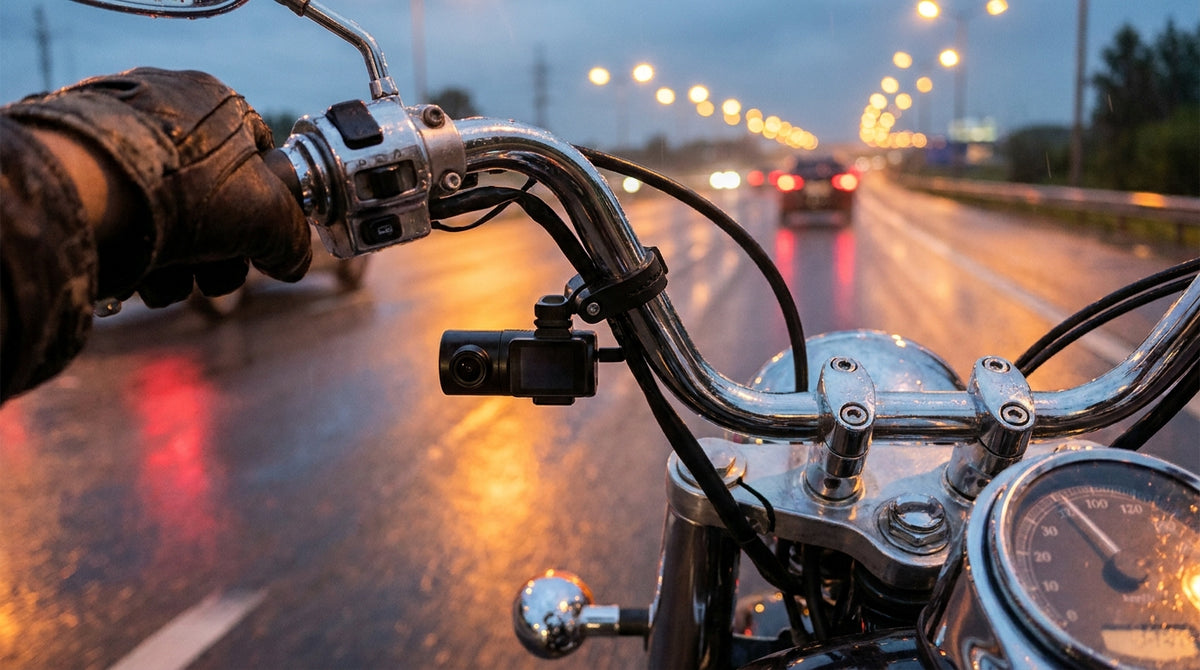
A car drifts across the centre line, cuts the corner on a left turn, and you are hard on the brakes with nowhere to go. You walk away. Then the driver tells the adjuster you came out of nowhere. In two-vehicle fatal motorcycle crashes, NHTSA data shows the other vehicle was turning left in roughly 42% of cases, and almost none of those riders had footage.
A motorcycle dash cam exists for that gap. Not for YouTube edits, not for ride memories, but for the ninety seconds of video that settles who did what. This guide covers what separates a unit that still records in year three from one that quits in the first real downpour: front and rear coverage, sealing rating, power wiring, and the memory card almost nobody thinks about.
What a motorcycle dash cam does that a helmet camera does not
An action camera is something you decide to switch on. A dash cam is wired to the bike and makes no decision at all. Turn the key, it boots in three to five seconds and starts writing. Shut the bike down, it closes the file. There is no moment where you remember the mount but forget the record button.
The second difference is loop recording. A dash cam chops footage into one, three or five minute files and overwrites the oldest once the card is full, so it can run every day for years on a single 32GB to 128GB microSD. An action camera fills up and stops. A dual lens unit with a 3 inch screen also lets you check framing at the pump instead of discovering a week later that the rear lens was aimed at your exhaust.
Third, it survives being left outside. A dash cam body is built to sit in weather on a parked bike. Most action cameras need a case to get there, and the case fogs.

Front and rear beats more megapixels
Given a choice between 4K on one lens and 1080p on two, take the two. Nearly every dispute a rider actually has involves something behind or beside the bike: the tailgater, the lane change into your mirror, the car that taps you at the light and drives off. A front-only camera records the empty road ahead of all of that.
Numbers that matter more than resolution: 1080p at 30fps reads a standard US plate at roughly 15 to 20 feet in daylight. Push past that and the characters mush together no matter what the box claims. Wider is not automatically better either, because a 170 degree lens spreads those same pixels across more road and shrinks the plate. Something near 140 degrees front keeps plates legible while still catching a car coming in from the side.
Low light is where the cheap sensors fall apart. Look for a Sony STARVIS or equivalent sensor and WDR, then test it yourself on a dark street before you need it.

Waterproofing is where cheap units die
A motorcycle dash cam has no cabin. Rain hits the lenses directly, and road spray hits the connectors from below. IP67 means the lens housing handles dust and full immersion in a metre of water for 30 minutes. IP65 only promises a hose spray, which is not the same as 300 miles in rain at 70 mph.
Read the rating carefully, because it usually applies to the camera heads and not the DVR box. The box belongs under the seat or in a fairing pocket, never zip-tied to a frame rail. The weak point on nearly every install is the bullet connector between lens and recorder, so pack it with dielectric grease and wrap it. That single step prevents most of the "rear camera stopped working" complaints.
This is also the line between real gear and marketplace junk. An unrated no-name camera with a generic spec sheet has no published IP figure, no sensor model and nobody to call when the rear lens fogs in month four. Buy the unit that states its sealing rating and its sensor, the same way you would buy a DOT helmet over an unmarked shell.
Power, parking mode and the wiring question
Two ways to power a motorcycle dash cam. Hardwire it to an ignition-switched 12V circuit so it lives and dies with the key, or run it to the battery directly for parking surveillance. The first is the right default for almost everyone.
Here is why. A typical cruiser carries a 12Ah to 19Ah battery. A camera sitting in parking mode pulls somewhere around 150 to 200mA, which works out to about 60 hours on a 12Ah battery before it is flat, and far less before it is too weak to crank. Park the bike for a long weekend with always-on recording and you come back to a click. If you want parking mode, use a unit with motion or vibration triggering plus a low voltage cutoff around 12.0V, and keep a tender on the bike.
Fuse the positive lead within six inches of the battery, route the cable along the existing loom, and leave slack at the steering head so the bars can go lock to lock without tugging a lens. Mount the rear camera above the plate rather than beside the exhaust, where heat soak and vibration shorten its life.
Storage, loop recording and how much footage you keep
Dual channel 1080p writes about 8 to 10GB per hour. A 64GB card therefore holds roughly six to seven hours of riding before it starts overwriting, and a 128GB card about twelve to fourteen. If you commute 40 minutes each way, a 64GB card gives you five days of history. Anything older is gone, which is the part riders learn the hard way after a crash they did not think was worth reporting.
Use a high endurance microSD rated U3 or better. Standard cards are built for photos, not for being rewritten continuously, and they fail silently: the camera looks like it is recording and the files are corrupt. Reformat in the camera once a month, and the day something happens, pull the card or press the lock button so the event file is protected from the loop.
Grab footage the same evening. Sitting it out for two weeks on a 64GB card means the clip has already been written over.
Dash cam, action camera or GPS tracker: what each one proves
These get lumped together as "motorcycle cameras" and they do completely different jobs. A dash cam proves what happened. An action camera on a chin or helmet mount shows what you were looking at. A tracker tells you where the bike is after it is gone. Most riders who think they want a camera for theft actually want a tracker.
| Device | Records when | What it is good at | Weak spot |
|---|---|---|---|
| Dual lens dash cam | Key on, automatically | Fault, plates, hit and run | Needs wiring and a good card |
| Action camera and chin mount | Only when you press record | Rider point of view, rides you plan to film | Battery life, you forget it |
| GPS tracker | Always, no video | Recovery after theft | Proves nothing about a crash |
| Disc lock with alarm | While parked | Stopping the grab in the first place | You have to remember it |
The honest answer for most riders is a dash cam plus one parked-bike device. The camera handles traffic, the second thing handles the parking lot.
What the footage is actually worth when you file
Adjusters work from the police report and two statements. Video changes that conversation in about five minutes, and it changes it most in the cases riders lose by default: the left turn, the lane change, the rider blamed for speeding because a bike was involved. Clear plate and signal footage turns a split liability call into a clean one.
A few practical points. Timestamp accuracy matters, so set the clock and the time zone when you install the camera, because a file dated 2019 invites an argument about whether the clip is from this crash. Some units stamp GPS speed on the video, which cuts both ways: it protects you at the legal limit and it is not your friend if you were well over it. Hand over the original file rather than a phone screen recording, since the file carries its own metadata. And check your state on audio, because a handful of two-party consent states treat a recorded conversation at the roadside differently from the video itself.


Five mistakes riders make with a motorcycle dash cam
- Buying front only to save $40. The rear lens is the one that catches the car that leaves. Skipping it removes the main reason to own the camera.
- Using the bundled memory card. Included cards are frequently low grade and fail within months of continuous rewriting. Spend $15 on a high endurance U3 card on day one.
- Mounting the rear camera next to the exhaust. Heat and vibration are the two things these units hate most, and that spot delivers both.
- Leaving parking mode on a bike that sits. A 200mA draw flattens a 12Ah battery over a long weekend. Use vibration triggering and a battery tender instead.
- Never checking the footage. A camera recording corrupt files looks identical to a camera doing its job. Play back one clip a month on your phone or the unit screen.
If theft is the real worry, the camera is not the answer
A camera on a stolen bike leaves with the bike. If your actual fear is walking out to an empty space, the money goes to deterrence and recovery first: a disc lock with a 110dB alarm that makes a quiet lift loud, and a hidden tracker that keeps reporting after the bike is in a van. Our alarms and lock picks cover both, and the Stealth tracker breakdown goes deeper on recovery.
Run the camera for traffic. Run the lock and tracker for the parking lot. They solve different problems and one does not replace the other.


Where to start
If you ride in traffic every day and want the footage question settled, go front and rear 1080p, IP67 lenses, a hardwire to an ignition-switched circuit, and a high endurance 128GB card. If you mostly want rider point of view video for the weekend, a chin mount and the action camera you already own is the cheaper honest answer. Either way, buy the unit that publishes its sealing rating and its sensor, and test it in the rain before you need it to hold up a claim.
No comments yet. Be the first rider to weigh in.