
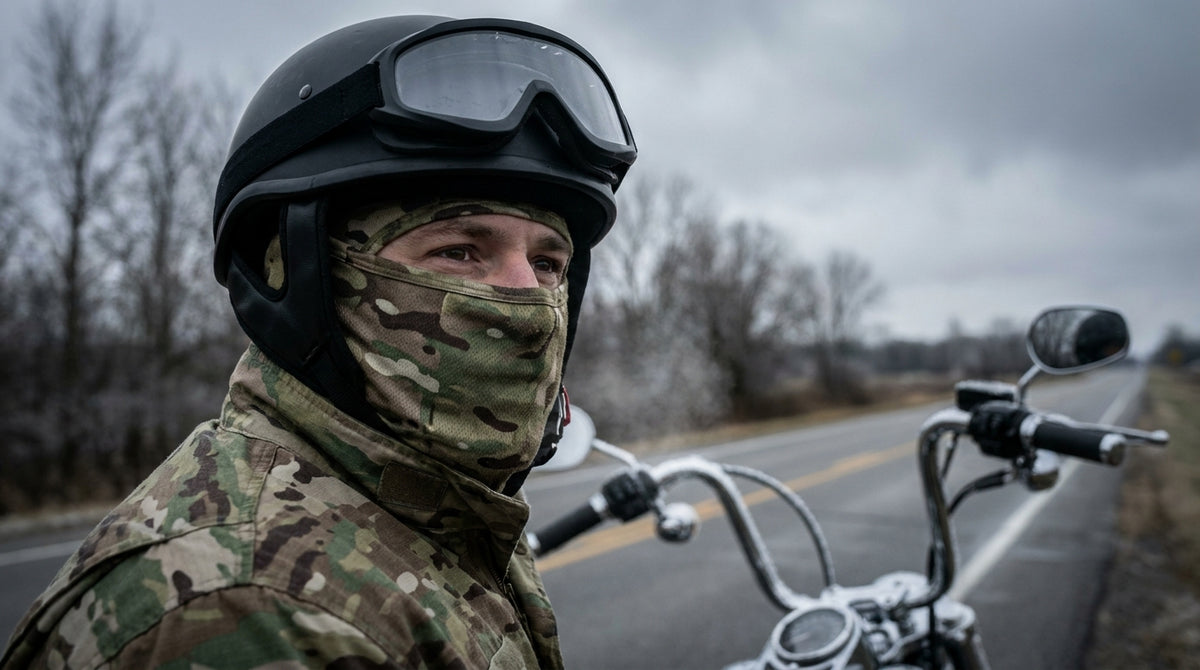
Most riders buy a camo ski mask for the pattern and discover the real problem at the first stop light. The fabric bunches at the jaw, the helmet liner drags it sideways, and by mile ten it has slid down over the chin. The camo was never the issue. Thickness was. A fleece mask that measures 4mm at the seam will fight a helmet that was sized to your bare head.
So this guide sorts a camo ski mask by the two things that decide whether you keep wearing it: fabric weight and seam placement. Below are 8 camo balaclavas that sit flat under a lid, what each pattern is actually good for, and the fit rules that stop a mask from creeping. Hunters walking to a stand get a note too, because cold-and-still is a different job than 60 mph.
Why riders reach for a camo ski mask instead of a plain black one
Wind chill is the honest reason anyone covers their face. At 60 mph in 40°F air, the National Weather Service wind chill chart puts the effective temperature near 25°F. That is a 15-degree penalty for simply riding, and your cheeks and the strip of skin above a collar take all of it.
Camo is what you pick when the mask does double duty. A rider who hunts, works outdoors, or runs trails wants one piece of gear for all of it, and solid black reads tactical in a way some people would rather avoid. A multicam pattern breaks up the shape of the head, which matters in a treestand and matters not at all on pavement. Pattern is preference. Fabric is function.
The fit rule that decides everything: measure the fabric, not the mask
Helmets are sized in centimeters of head circumference, and a mask adds to that number. Thin microfiber adds roughly 1mm per layer. Mid-weight fleece adds 3mm to 4mm, and it doubles at every seam. On a helmet that already fits snug, 4mm of fleece across the forehead is enough to push a size M into feeling like a size S.
Two practical tests before you commit:
- The pinch test. Pinch the fabric at the crown. If you cannot feel your fingertips meet, it is too thick to wear under a close-fitting helmet.
- The seam map. Find the seams. A seam that runs over the ear or across the temple will become a pressure point in 20 minutes. Flatlock seams at the back of the head are what you want.
- The nose gap. Pull the mask up and breathe hard. If the exhale rolls straight up into the eye opening, it will fog a visor or glasses every time you slow down.
Riders who want the longer version of the fabric argument can read our motorbike face mask guide, which covers the full range from tube to balaclava.
8 camo balaclavas worth the money
These are the camo and camouflage ski mask options in the ALR balaclava collection, sorted by the job each one does best rather than by price. All are one-piece hoods, not tube gaiters.
1. Camo Balaclava Ski Mask for Motorcycle Riding and Hunting
This is the one to start with if you are buying a camo ski mask for the first time. It is the thin-knit multicam hood, not a fleece, so it slides under a helmet without changing how the helmet sits. It is also the cheapest way to find out whether you actually like a full hood or whether you want a half mask instead. In 40°F to 55°F it is enough on its own. Below that, it works better as a base under a windproof layer than as your only defense.

2. Camo Balaclava Winter Fleece Face Mask
The camo fleece balaclava is the cold-morning answer. Fleece traps air, so it holds heat far better than knit, and that is exactly why it is the wrong choice above roughly 50°F. It is also the thickest mask here, which means you should try your helmet on with it before the first ride. If the helmet goes from snug to tight, wear this one with an open-face lid and save the knit hood for the full-face.

3. Black MultiCam Balaclava Full Face Mask
Black-based multicam is the low-key pick. The pattern is there when you look but it does not announce itself from across a parking lot, which makes it the easiest camo to wear with a plain black jacket and gloves. It reads closer to a textured dark mask than to hunting camo. If you want camo construction without camo styling, this is the one.

4. MultiCam Full Face Mask Cover, Scorpion Land
Green-and-brown woodland is the most useful camo pattern in most of the United States, because it matches mixed hardwood and brush through three seasons. This is the ski mask camo pattern to pick if the mask will spend weekends in the woods and weekdays under a helmet. In open country or snow, it stands out instead of blending.

5. MultiCam Full Face Mask Cover, Striped Desert
Tan and sand patterns belong in dry, open terrain, and they have one real advantage on the road: a light pattern absorbs less heat than black does in direct sun. On a hot afternoon that difference is small but noticeable on the top of the head. Riders in Arizona, New Mexico, and west Texas get more out of this one than riders in Pennsylvania.

6. MultiCam Full Face Mask Cover, Pure Black
Same cut and same thin construction as the camo versions, in solid black. Worth listing because plenty of riders buy a camo skimask, decide the pattern clashes with the rest of their gear, and then want the fit they already liked in a color that disappears. Buying this alongside a camo hood gives you one for the bike and one for everything else.

7. Breathable Motorcycle Full Face Mask, summer weight
A camo ski mask in August is a mistake, and this is the honest replacement. It is a vented helmet liner built to move air instead of trap it, so it handles sweat and keeps the helmet lining cleaner. It is not camo. It is what you swap to when the knit hood stops being comfortable, which for most riders is somewhere around 75°F.

8. Cooling Motorcycle Neck Gaiter, ice silk
The hot-weather alternative for anyone who wants sun coverage without a hood. A gaiter covers the neck and the lower face and leaves the head open, which is the right call under a vented helmet in summer heat. It will not keep your forehead warm in November. Pair it with the knit camo hood and you have both ends of the year covered for less than most single winter masks.

Camo ski mask comparison: fabric, temperature, and helmet fit
Use this to narrow the list before you look at patterns. The temperature column is a riding range, not a standing-around range, because wind changes everything.
| Type | Added bulk | Riding range | Fits a snug helmet | Best job |
|---|---|---|---|---|
| Thin knit multicam hood | About 1mm | 40°F to 60°F | Yes | Everyday riding, layering base |
| Camo fleece balaclava | 3mm to 4mm | Below 45°F | Often not | Winter, open-face helmets, hunting |
| Windproof-panel balaclava | 2mm to 3mm | 25°F to 45°F | Usually | Highway cold, wind on the chest and neck |
| Vented summer liner | About 1mm | Above 70°F | Yes | Sweat control, keeping a helmet clean |
| Neck gaiter or tube | None on the head | Above 65°F | Yes | Sun and wind on the neck only |
If the mask is also going hunting, read this part
A camo ski mask that works at 60 mph can be the wrong mask in a treestand. Riding generates its own wind, so breathability matters. Sitting still at dawn generates none, so insulation matters and breathability works against you. That is why a lot of people end up owning the thin knit hood for the bike and the fleece for the stand.
One thing worth checking before the season: many states require a set amount of visible hunter orange on upper-body clothing during firearm seasons, and a camouflage face mask does not count toward it. The exact square-inch requirement and which seasons it applies to vary by state, so confirm with your own wildlife agency rather than assuming. The mask is not the problem. Assuming the mask covers your orange requirement is.
Stopping the fog, which is the real reason masks get abandoned
Fogging is a breath-routing problem, not a mask-quality problem. Exhaled air leaves your mouth near 95°F and saturated with moisture. If it travels up the inside of the mask it hits a cold visor and condenses. The fix is to give it somewhere else to go.
- Seat the mask over the nose bridge, not under it. Under the nose aims your exhale straight at the visor.
- Tuck the lower edge inside the collar. Loose fabric at the neck pumps warm air upward every time you turn your head.
- Crack the visor one notch at stops. Fog forms when you slow down, not at speed, because airflow through the helmet drops.
- Skip the double layer over the mouth. Folding a mask twice across the mouth traps moisture against your skin and makes the fabric cold and wet within an hour.
Five mistakes that waste a good camo balaclava
- Buying fleece as a year-round mask. It fails above 50°F. You will sweat, the fabric will stay damp, and damp fabric pulls heat out of you faster than no mask at all.
- Sizing the helmet without the mask on. This is the one that costs real money. Fit the helmet while wearing the thickest mask you intend to use, or you will own a helmet that only fits in July.
- Choosing a pattern for the terrain you never ride. Snow camo looks sharp and matches nothing most of the year. Woodland green works across more of the country for more months.
- Washing it in hot water with fabric softener. Softener coats the fibers and kills the wicking, which is exactly what you paid for. Cold wash, no softener, air dry.
- Treating a mask as impact protection. A balaclava manages wind, sun, and dust. It adds nothing in a crash. That job belongs to a DOT-rated helmet and real gear, which is the whole point of our cold weather riding mask breakdown.
Cheap marketplace camo versus gear built to ride in
The camo mask market is full of three-dollar listings with no fabric weight stated, no seam detail, and no size beyond one-size-fits-all. They work for a weekend. The structural problem is the seams: overlocked seams with a raw edge sit proud against your skin, and under a helmet that edge is directly under 1mm of pressure for the whole ride. That is where the hot spot above the ear comes from.
A mask built for riding uses flatlock seams routed to the back of the head, a stated fabric weight, and real sizing. It costs more than a marketplace three-pack and it is still the cheapest piece of gear on the bike. Budget synthetic masks are fine for occasional rides and short trips, they just wear out and pill faster. For a mask you will wear 100 times a season, buy the one with the seams in the right place.
Which camo ski mask to buy
If you are buying one, get the thin knit multicam hood. It fits under any helmet, covers the widest temperature band, and costs little enough that finding out you prefer a half mask is not an expensive lesson. If you are buying two, add the camo fleece balaclava for winter and keep them in different jackets so you always have the right one.
Riders who hunt should plan on both from the start, because the two jobs genuinely need different fabric. When you are ready to shop, the full face mask collection is where I would start, and if your hands are the next thing to fix, the glove guide covers the same fabric-versus-temperature logic.
No comments yet. Be the first rider to weigh in.