
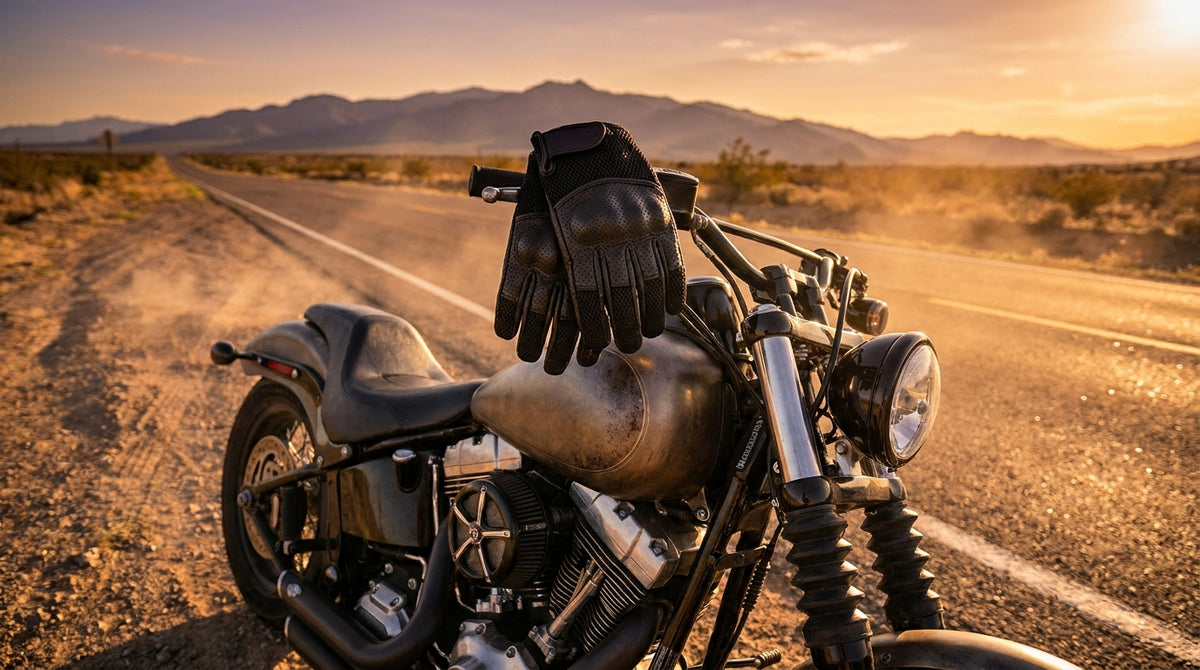
Ninety five degrees, stop light, full leather gauntlets. Your palms go slick, the grip turns greasy, and you catch yourself riding with two fingers hooked over the lever just to feel the bar again. That is not a toughness problem. It is a glove that was built for October being asked to work in July.
Summer motorcycle gloves solve it with airflow instead of insulation, and the good ones give up almost nothing in protection. Below is how mesh, perforated leather and fingerless styles actually differ, which one fits your riding, eight pairs worth buying, and the sizing mistake that ruins most hot weather gloves in the first week.
Why summer gloves are a different build, not just a thinner one
A winter glove traps a layer of still air against your skin. A summer glove does the opposite. It pulls moving air across the back of your hand, where the blood vessels sit closest to the surface, and lets sweat evaporate instead of pooling in the palm.
That is why a cheap unlined leather glove still cooks. Leather is windproof by nature. Until somebody punches holes in it or swaps panels for mesh, it will not breathe no matter how thin it is. The three ways manufacturers actually create airflow:
- Mesh panels: open nylon or polyester weave across the back of the hand and between the fingers. The most airflow of any option.
- Perforation: hundreds of punched holes through the leather itself, usually on the back and the finger tops. Keeps the abrasion surface intact.
- Short cuff: ending at the wrist instead of mid forearm lets air up the sleeve and stops the hot air trap a gauntlet creates.
Most good summer gloves combine two of the three. The Vance Mesh and Leather glove uses mesh on the back and leather on the palm, which is the standard hot weather recipe: vent where you will not slide, armor where you will.
Mesh vs perforated leather vs fingerless
These three get talked about as if they are interchangeable. They are not. Pick by how fast you ride and how much you care about the worst case.
| Style | Airflow | Abrasion protection | Best for | ALR price range |
|---|---|---|---|---|
| Mesh and leather | Highest | Good on palm, weaker on back | Stop and go heat, commuting, slow cruising | $64.95 |
| Perforated leather | Moderate, improves with speed | Best of the three | Highway miles in heat, long day rides | $68.95 to $79.95 |
| Fingerless | High on fingers, none on palm cooling | Lowest, fingers fully exposed | Short town rides, style first | $49.95 |
One honest note on fingerless. They feel incredible at 40 mph and they protect nothing on your fingertips, which are the first thing down in a low side. If you ride them, ride them knowing that. We broke the tradeoff down further in our fingerless glove guide.
Perforated leather is the pick most experienced riders land on. At 60 mph the air pushing through the holes moves more heat than a mesh panel does at 25 mph, and you keep a full cowhide or goatskin abrasion layer. That is the ALR position on it: one pair of real perforated leather outlasts three seasons of thin synthetic gloves that fray at the thumb seam.
The 8 best summer motorcycle gloves for hot weather riding
Everything here is in stock at American Legend Rider, with the price as listed. Picks are grouped by the job you need done, not by a ranking that pretends one glove suits every rider.
1. Best overall mesh: Vance Mesh and Leather Gloves
Mesh across the back and fingers, leather palm with padding, reflective piping and an elastic cuff at $64.95. This is the glove for riders whose summer problem is traffic rather than highway. The elastic cuff matters more than it sounds. It keeps the glove from ballooning with air at speed while still letting you shove it under a jacket sleeve.

2. Best perforated leather: Vance Men's Premium Brown Leather Perforated Gloves
Full premium leather at $70.95 with perforation on the back and finger panels. Brown leather also hides road grime better than black, which matters when a glove lives on your tank bag all summer. Full leather like this takes about 200 miles to stop feeling stiff across the knuckles, then it molds to your hand and stays there.

3. Best lightweight full finger: Vance Burner Lite Motorcycle Gloves
At $79.95 the Burner Lite is the one to grab if you want leather coverage with the least bulk. Lighter weight hide and a slim profile mean better lever feel, which is the real complaint about summer gloves. Riders do not abandon gloves in August because of heat alone. They abandon them because a sweaty, thick glove kills the feedback at the clutch.

4. Best under $40: Motorcycle Gloves with Hard Knuckle Protection
$34.97 and the only pair on this list with a molded hard knuckle shell. For a rider who wants armored protection at a price that does not hurt if a pair gets lost at a gas stop, this is the value entry. The tradeoff is honest: synthetic shell, so it will wear faster than the Vance leather options over several seasons.

5. Best for numb hands: Vance Gel Palm Riding Leather Gloves with Skull
$68.95, with a gel insert sitting over the heel of the palm. Hand numbness on long rides comes from pressure on the ulnar nerve where your palm meets the grip, and a gel pad spreads that load instead of concentrating it. If your fingers go to sleep after 90 minutes of cruising, this is the cheapest fix before you start buying bar risers.

6. Best short cuff: Vance Premium Leather Driving Glove with Snap Cuff
$69.95 and it stops right at the wrist with a snap closure. Short cuff gloves are the quiet summer upgrade. Ending the glove at the wrist bone lets air travel up your jacket sleeve, and the snap keeps the glove from walking off your hand at speed. Also the easiest pair on this list to get on and off at every stop, which you will do a lot in heat.

7. Best fingerless: Steampunk PU Leather Fingerless Compass Gloves
$49.95 with a compass detail on the cuff. Fingerless gloves keep the palm abrasion layer and the knuckle coverage while letting every finger breathe, so you still get the part of the glove that does the most work in a slide. Good for town riding and bike nights. Not what you want for a 400 mile interstate day.

8. Best style pick: Skeleton Motorcycle Gloves
$32.95 for the goth skeleton hand print, and the cheapest full finger pair here. These are a second pair, not a primary. Keep them for short rides and events where the look is the point, and keep a leather pair for the miles. More in that vein sits in the leather motorcycle gloves collection.

Sizing summer gloves: the mistake that ruins the first week
Riders size summer gloves loose on purpose, thinking a little room means more airflow. It does the opposite. A loose glove lets your hand slide inside it, so you grip harder to compensate, which builds heat and blisters the base of your thumb.
Measure around your palm at the widest point, just below the knuckles, with your hand flat. That circumference in inches is your glove size. A 9 inch palm is a large in most brands. Then check two things on the first fit:
- Fingertip gap: no more than about 3 mm of empty space at the end of your middle finger. More than that and the glove will bunch at the lever.
- Closed fist test: make a fist. If the leather pulls your fingers straight back open, size up. If the back of the hand wrinkles into loose folds, size down.
Leather gloves should feel snug and slightly stiff on day one, because full grain hide stretches roughly half a size as it breaks in. Mesh and synthetic gloves do not stretch, so buy those at exactly your measured size. That one difference explains most returns.
The armor that still matters in July
Heat makes it tempting to drop to a thin fashion glove. The problem is that the injury does not change with the season. In a low speed get off, your palm hits first and your hand slides, so the two features worth keeping even in the hottest month:
- A real palm layer. Leather or a reinforced synthetic across the heel of the hand. This is the panel that does the work, and it is why mesh backed gloves still use a leather palm.
- Knuckle coverage. Either a molded shell like the $34.97 hard knuckle pair or padded leather over the joints. Knuckles have almost no soft tissue covering them.
Everything else on a glove is comfort. If you are building a full hot weather kit rather than just fixing your hands, our guide to picking riding gloves for every season covers how summer and winter pairs should split the year, and the heated glove breakdown handles the other end of the calendar.
5 mistakes riders make with hot weather gloves
- Buying one pair for the whole year. A glove that works at 45 degrees is a sauna at 95. Two pairs cost less than the one you stop wearing.
- Going fingerless for highway riding. The exposure is on your fingertips, and fingertips are what you land on. Save them for town.
- Letting sweat dry hard in the leather. Salt from sweat stiffens hide and cracks it. Pull the gloves off the bars and let them dry flat in shade, not in direct sun on the tank, which bakes them.
- Sizing up for airflow. Loose gloves build heat because you grip harder. Snug gloves move more air.
- Trusting no name marketplace gloves with no listed materials. If a listing will not say what the palm is made of, assume it is a glove shaped object. No abrasion rating, unknown backing, and a thumb seam that opens in one season.
Which summer gloves should you actually buy
If you commute and sit in traffic, go mesh and take the $64.95 Vance Mesh and Leather. If you put down highway miles in heat, go perforated leather at $70.95 and get the abrasion layer that holds up. If your hands fall asleep, start with the $68.95 gel palm pair before anything else. And if you just want a cheap armored pair to throw in the saddlebag, the $34.97 hard knuckle gloves do the job.
The honest summary on summer motorcycle gloves is that airflow and protection are not actually at war. Perforation and mesh panels let a real leather glove breathe, and a glove you keep wearing in August protects you far better than the heavy pair sitting in your garage. If you are shopping for a pair, the motorcycle gloves collection is where I would start, filtered by what your summer riding actually looks like.
No comments yet. Be the first rider to weigh in.