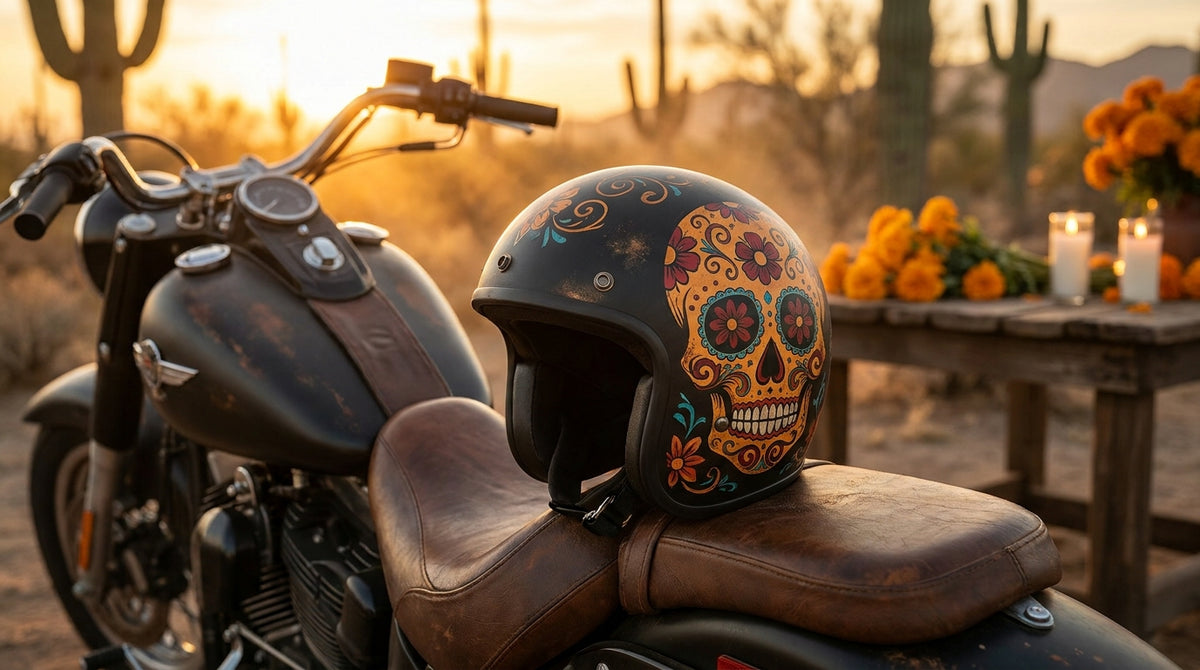
Search for a sugar skull motorcycle helmet and most of what comes back is a costume prop. Thin plastic shells, a printed calavera face, a $29 price tag, and no DOT sticker anywhere on the back. Riders buy one, wear it to a Day of the Dead run, and find out at the first state inspection that it counts as no helmet at all.
The good news: the look is completely reachable. A proper sugar skull motorcycle helmet is built, not bought off a novelty shelf. This guide covers the three real paths riders use, what each one costs, which lids already ship with skull artwork, and how to spot a fake shell before your money leaves your hand.
What a sugar skull motorcycle helmet actually is
A sugar skull is a calavera, the decorated skull of Mexico's Dia de Muertos, observed every November 1 and 2. The style riders copy today traces back to Jose Guadalupe Posada, whose "La Calavera Catrina" etching from the early 1910s turned the bare skull into a grinning, flower-crowned character.
Translated onto a helmet, that means four things: marigold and turquoise color blocking, rose or swirl work around the eye sockets, a stitched-looking grin across the chin bar or jaw line, and symmetry. A plain death's-head skull helmet is monochrome and mean. A calavera lid is loud, colorful, and celebratory. That difference is why "skull helmet" searches and sugar skull searches pull up very different gear.
Why almost no factory sugar skull helmet is DOT rated
Certifying a helmet to FMVSS 218, the US federal standard behind every DOT sticker, costs a manufacturer real money per model. Impact, penetration, and retention testing all have to pass on that exact shell. A full calavera paint scheme is a niche graphic, so the brands that bother with certification put their money into black, chrome, and flames instead.
That leaves the sugar skull space to novelty makers who never test anything. The tell is weight. A certified half shell runs roughly 2 to 3 lbs because it carries a real expanded polystyrene impact liner. A novelty beanie lid often comes in under 1 lb, which means there is almost nothing between the shell and your skull. The NHTSA motorcycle safety guidance is blunt about it: an uncertified helmet is decoration.
Path 1: Start with a DOT skull graphic lid you can actually buy
The fastest route is to buy a certified helmet that already wears skull artwork, then add calavera color yourself if you want it. These ship with a DOT sticker and a real liner, and they are the base nearly every custom sugar skull build starts from.
The Red Knight leans closest to the calavera look straight out of the box. It is a vintage German shell with a red and white skull graphic across the crown, which gives you the color contrast a monochrome lid never will.

If you want the skull built into a German style beanie shape with the certification already sorted, this one carries the DOT approval and the graphic together at $91.45. It is the cheapest certified starting point on this list.

Daytona's Piston Skull cap is the pick if you plan to hand the helmet to an airbrush artist later. The shell is clean, the finish takes primer well, and at $108.97 you are not gambling a $400 lid on your first custom job.

For a blank canvas in matte black, this low profile half helmet is the one riders strip and repaint most. Matte takes masking tape without lifting gloss, which matters when you are laying down the tight line work a calavera grin needs.

Shopping the wider skull helmet collection is worth ten minutes before you commit, and our roundup of skull helmets that actually carry a DOT sticker covers fit and shell sizing in more depth.
Path 2: Build the calavera look with decals for under $20
This is the path most riders should take. A reflective or 3D metal skull decal costs $14.95 to $19.45, goes on in ten minutes, and comes off without touching the shell's certification. You keep the DOT rating you paid for and you can change the design next season.
The 3D metal emblem is the most calavera-friendly of the three because the raised zinc catches light the way painted eye sockets do. At $14.95 it is the cheapest way to break up a plain shell.

The goth skull decal is a heavier zinc piece with deeper relief work. Good choice for the back of a half shell where it sits above your collar and reads clearly to traffic behind you.

If night visibility matters more than ornament, the reflective vinyl decal is the practical pick. It lies flat, survives rain, and lights up under headlights instead of disappearing into black paint.

One rule when you stick anything to a lid: use the adhesive the decal ships with and nothing else. Solvent-based glues and petroleum products attack the polystyrene liner underneath, and that damage is invisible from the outside. Snell and most helmet manufacturers say the same thing in their care documents. Stick it on the outer shell, keep it off the liner, and skip the contact cement.
Path 3: Pay a shop to airbrush it
A full custom calavera, with roses, marigolds, and shaded line work, is airbrush territory. Shops generally quote $300 to $1,200 depending on how many colors and how much detail you ask for, and a two week turnaround is normal.
Two things to get right before you hand over a helmet. First, send a certified shell, not a novelty one, because no amount of paint adds impact protection. Second, tell the shop explicitly that it is a motorcycle helmet so they use helmet-safe paint and keep solvents away from the vents and liner. A shop that paints car panels all day may not know that a standard lacquer thinner can soften an EPS liner.
Ask for the clear coat to be flexible rather than hard-shelled. Helmets flex slightly in a drop, and a brittle clear cracks in long lines across your artwork.
The three paths compared
| Path | Real cost | Time | DOT status | Best for |
|---|---|---|---|---|
| Novelty sugar skull lid | $25 to $60 | Instant | None | Costume only, not riding |
| DOT skull graphic helmet | $74.95 to $169.95 | Instant | Certified | Riders who want it sorted today |
| Decals on a certified lid | $14.95 to $19.45 plus helmet | 10 minutes | Certified, unchanged | Best value and reversible |
| Custom airbrush | $300 to $1,200 plus helmet | About 2 weeks | Certified if paint is safe | One-of-a-kind show builds |
How to spot a novelty lid before you buy
Four checks, thirty seconds, no guesswork:
- Find the DOT sticker. It belongs on the outside rear of the shell and names the manufacturer and model. A sticker sold loose in the box is a red flag.
- Weigh it. Under 1 lb for a half shell means no real liner. Certified half helmets land near 2 to 3 lbs.
- Press the liner. You want firm expanded polystyrene roughly a half inch thick or more. Soft foam that springs back instantly is comfort padding, not impact material.
- Check the strap hardware. Certified lids use steel D-rings or a rated quick release. Plastic snap buckles on a cheap shell usually mean the retention system was never tested.
This is where we take a side. At American Legend Rider the line is simple: a helmet either carries a real DOT certification and a real liner, or it does not belong on your head at highway speed. Budget synthetic gear has its place for short, slow rides. No-name marketplace calavera shells do not, because the one thing they never publish is the standard they were tested against. Buy the certified shell, then spend $15 on a decal to make it yours.
What you wear under the helmet matters
Half of the sugar skull look lives below the lid. A skull balaclava or face mask finishes the calavera jaw line and does the practical work of blocking wind and road grit on an open face helmet.
The full face balaclava at $24.95 is the one that layers cleanly under a half shell without bunching at the ears, and it is thin enough that your helmet still fits the same.

If you ride an open face lid, the mask and goggle combo at $38.95 solves both problems at once. The UV400 lens handles the sun and the skull print covers the jaw, which is the exact silhouette people picture when they hear sugar skull rider.

Our skull balaclava fit guide breaks down which fabric weights work under a tight shell and which ones will push your helmet up a size.
Match the rest of the sugar skull gear
Riders who search for a sugar skull motorcycle helmet almost always end up building the whole look. The calavera style carries further than any other skull motif because it is colorful enough to work off the bike.
The sugar skull studs at $24.95 are the most-bought piece in this group, and the small size means they sit flat under a helmet strap instead of digging in.

The hollow hoop version at $19.95 runs 1.1 by 1.7 inches, so it reads from across a parking lot. Worth knowing: hoops that size can catch on a balaclava, so these are better for off-bike wear.

For warm weather runs, the sugar skull roses tank top at $24.95 carries the same marigold and rose motif as the helmet artwork, which is what ties an outfit together instead of making it look like three separate skulls.

When it turns cold, the Mexican skull hoodie at $74.45 is the heavyweight option. Full calavera graphic, and it layers under a leather vest without adding bulk at the shoulders.

There is a women's cut in the same family, and more of the matching metalwork sits in the skull earrings lineup.

Five mistakes riders make with a sugar skull helmet
- Buying the $29 novelty shell for actual riding. It fails because there is no impact liner. The shell cracks and transfers nearly all the energy straight through.
- Rattle-canning a certified helmet at home. It fails because hardware store lacquer thinner soaks through vents and softens the polystyrene liner. The helmet looks perfect and protects like a bucket.
- Sizing up to fit a thick balaclava. It fails because a loose helmet rotates in a crash and can come off entirely. Buy the right shell size, then buy a thinner liner.
- Using contact cement for decals. It fails for the same reason as paint. Use the decal's own adhesive on the outer shell only.
- Keeping a helmet past five years. It fails because the EPS liner compresses and the glue lines dry out whether you crash or not. Most manufacturers put the replacement window at five years from first use, sooner after any impact.
Where to start
If you want the calavera look on the road this month, the honest answer is a certified skull graphic lid plus a $15 decal. That combination gets you a real DOT rating, a shell that fits, and artwork you can swap next season, for less than a single airbrush deposit. Save the full custom paint for a second helmet once you know which shell shape actually fits your head.
If you are shopping for one, the skull helmets collection is where I would start. Everything in it carries a DOT sticker, so the only decision left is how loud you want the artwork.
No comments yet. Be the first rider to weigh in.