
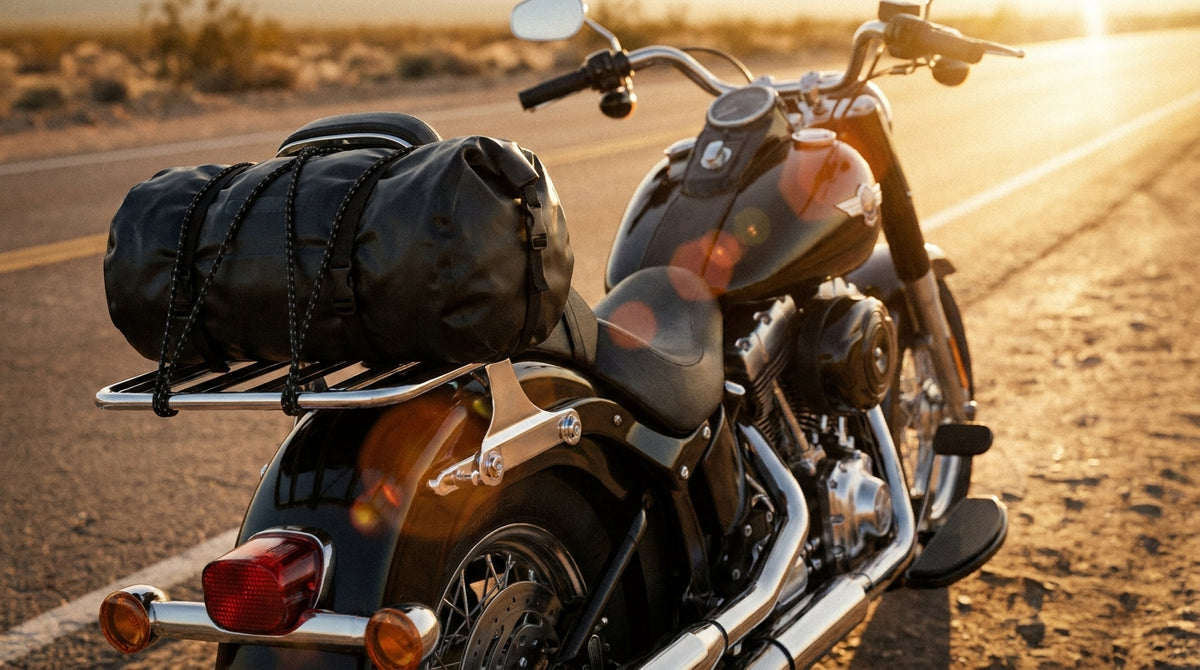
A rider straps a duffel to the passenger seat with two bungees, hits the first hard stop light, and the whole thing slides forward into their back. Second stop light, it goes sideways. By the time they reach the campground the bag has worn a shiny patch into the seat vinyl. A rack would have fixed that for about the price of a tank of gas, and it would have kept the load off the pillion entirely.
A motorcycle luggage rack is the cheapest real storage upgrade on a cruiser, and also the easiest one to get wrong. This guide covers the four rack styles riders actually buy, how to confirm a luggage rack for your motorcycle before you order, what the weight rating really means, the materials worth paying for, and which bags belong on top. Load limits first, chrome second.
What a luggage rack does, and what it does not
A rack gives you a flat, bolted platform behind the seat so cargo rides on the frame instead of on the seat or on a passenger. That matters for two reasons. The load sits on hard mounting points rather than on foam, and it sits lower and further forward than a bag stacked on a sissy bar.
What a rack does not do is add carrying capacity to the motorcycle. Most cruiser racks weigh 3 to 6 lbs on their own, and every pound of rack plus cargo counts against the bike's GVWR, which is printed on the frame sticker near the steering head along with your tire load ratings. A 1,200 lb loaded weight limit disappears faster than riders expect once you add a passenger.
A rack also will not stop a bag from flopping. The platform is only an anchor. Strapping is still on you, and that is where most rack setups fail.
The four motorcycle luggage rack styles riders buy
Almost every rack on the market is one of four shapes. Picking the wrong shape is the number one reason a rack gets bolted on once and then sits in a garage bin.
Solo rack
A small platform, usually 8 to 11 inches wide, that mounts where the passenger seat would go. Best for riders who never carry a pillion. It keeps the load low and tight to the fender, which is the friendliest place for handling.
Two-up or over-seat rack
A longer rack that arcs over the passenger seat and bolts to the rear fender struts. It keeps the pillion seat usable, so you can ride two-up with a bag overhead. The tradeoff is height. Cargo sits several inches higher, and you feel it in slow-speed turns.
Sissy bar rack
A shelf that clamps or bolts to the uprights of a sissy bar. Harley sissy bar uprights are commonly spaced around 9 to 10 inches apart, so measure yours before ordering a clamp-on shelf. This is the setup that pairs with a sissy bar bag, because the backrest stops the bag from sliding rearward under acceleration.
Detachable rack
Harley Touring models use four-point docking hardware, and the same idea shows up on aftermarket cruiser racks. Two latches and the rack comes off in under a minute, which keeps the bike clean when you are not loaded. You pay more for the docking kit, and the docking points have to match your year and model exactly.
Rack styles compared
| Style | Typical platform | Keeps pillion seat | Best for |
|---|---|---|---|
| Solo | 8 to 11 in wide | No | Solo riders, best handling |
| Two-up | 11 to 14 in wide | Yes | Couples who still want cargo space |
| Sissy bar shelf | 9 to 12 in wide | Usually | Bikes that already run a backrest |
| Detachable | Varies by kit | Model dependent | Riders who want the bike clean on weekends |
How to know a luggage rack fits your motorcycle
Riders search this more than any other rack question, and "universal" on the listing is not an answer. Three checks settle it before you spend money.
- Find the mounting points. Most cruiser racks bolt to the two rear fender struts or to the same holes the passenger grab rail uses. Pull the seat, look for threaded bosses, and count them. Four points is the common cruiser pattern.
- Measure the hole spacing, not the fender. Center to center on the bolt holes, in inches, left to right and front to back. A rack sold for a Softail will not line up on a Sportster even though both say Harley on the tank.
- Check the bolt size. Metric cruiser hardware is usually 8 mm or 10 mm. If the kit ships with its own bolts, confirm the thread pitch matches your frame bosses rather than forcing it.
Truly universal racks exist, and they work by clamping to sissy bar tubing instead of bolting to the frame. Measure the tube diameter first. Common sissy bar tube is 5/8 in or 3/4 in, and a clamp sized for the wrong one will either not close or will spin under load.
What motorcycle luggage racks are made from
Three materials cover the whole market, and the difference shows up in year two, not week one.
- Mild steel with chrome plating. The default. Strong, cheap, and the heaviest of the three at roughly 5 to 6 lbs for a two-up rack. Chrome over mild steel will pit and then rust wherever the plating gets chipped, so touch up stone strikes early.
- Stainless steel. Usually 304 grade. It costs more and weighs about the same as mild steel, but it shrugs off road salt, which matters if you ride through winter or near the coast.
- Aluminum. Often 6061, typically 2 to 3 lbs. Lightest option and it never rusts. Aluminum racks need thicker tubing or a cross brace to match steel strength, so a thin, unbraced aluminum rack is the one to walk away from.
The weld quality tells you more than the material. Look for a continuous bead where the uprights meet the platform, not three tack welds. No-name marketplace racks are where this gets skipped, because tacking is faster and the photo looks identical. A thin-wall rack with tack welds can crack at the upright after one loaded summer, and it usually cracks while loaded. Gear built for real riding costs more once, instead of twice.
Load limits: the number nobody reads
This is the part that surprises people. Factory cruiser racks are commonly rated somewhere between 10 and 15 lbs. Not 50. The rating lives in the fitting instructions or on a sticker under the platform, and it exists because the load is cantilevered off two fender struts that were designed to hold a fender.
Three practical rules come out of that number:
- Heavy and low beats heavy and high. A 20 lb load in motorcycle saddlebags sits beside the axle and barely changes how the bike steers. The same 20 lbs on an over-seat rack sits above and behind the rear axle, and it will make the bike feel loose and slow to turn in.
- Put weight forward on the platform. The further back the mass sits, the more leverage it has on those struts and the more the back end wallows at highway speed.
- Soft bags, dense items at the bottom. A tool roll and a chain lock go against the platform. Clothes go on top.
If you need to carry more than 15 lbs regularly, the answer is not a bigger rack. It is a rack plus side bags, so the load splits across three mounting systems instead of hanging off one.
The best motorcycle luggage rack bags
A rack is half a setup. The bag is the half you actually touch every day, and the ones that work on a rack share three traits: a flat bottom, real tie-down loops at all four corners, and a waterproof layer you do not have to think about. Here is what pairs well with each rack style.
Waterproof tail bag: the all-rounder
An expandable waterproof tail bag is the default choice for a solo or two-up rack. The flat base sits on the platform instead of balling up, the zip expansion lets you run it slim on a day ride and full for a weekend, and the waterproof shell means a surprise storm does not end with wet clothes.

Retro tail bag: a rack bag that matches a cruiser
If your bike is all chrome and black leather, a ballistic nylon box bag looks wrong on it. A retro tail bag with a separate waterproof rain cover gets you the classic look and keeps the rain answer in the bag's own pocket.

Sissy bar travel luggage: for bikes with a backrest
Run a sissy bar and the backrest becomes a wall your load cannot slide past. Purpose-built sissy bar luggage straps to the uprights and the rack at the same time, and a map pocket on the lid is where the registration and the ferry tickets live.

Sissy bar bag set: three bags, one footprint
A three-piece set is the quiet upgrade for touring. The big bag stays strapped to the bike all trip, and the two smaller pieces come off for the hotel, so you are not unstrapping everything for a toothbrush.

Throw-over saddlebags: where the weight should go
Once a load passes 15 lbs, split it. Universal waterproof saddlebags hang low beside the rear wheel, which keeps the mass near the axle and leaves the rack free for the bulky, light items like a jacket or a sleeping bag.

Single universal saddlebag: the commuter answer
Not every rider needs a pair. One waterproof universal saddlebag with strap mounts takes a laptop, a lunch and a rain shell, and the rack above it stays empty for whatever the day throws at you.

Leather sissy bar bag: the one that looks right
PU leather with an eagle emblem is the cruiser answer when a nylon bag ruins the lines. It mounts off the sissy bar, and the hard shape holds its form empty, which a soft duffel never does.

Leather tool bag: the small one that earns its space
A round leather tool bag mounts on the fork or the sissy bar and holds the things you want on the bike permanently. A tire plug kit, two tire irons, zip ties and a small multi-tool fit in one, and it never has to be unpacked.

Cooler bag: the rack job nobody plans for
A rack turns a motorcycle into a grocery run and a tailgate. A 12-pack cooler bag strapped flat to the platform is the use case riders discover in month two and then never give up.

How to strap a load so it never moves
Four tie-down points, cross pattern, every time. A bag with two straps pivots. A bag with four cannot.
- Use cam buckle straps for anything dense. A 1 in cam strap holds tension at a fixed length. A bungee stretches, which is exactly what you do not want under a hard stop.
- Cross the straps underneath the bag. Front-left loop to rear-right rack rail and back again. Crossing kills the side-to-side slide that straight straps allow.
- Add a cargo net over the top. A 15 by 15 in bungee net that stretches to roughly 30 in catches the small things and stops a half-empty bag from breathing open at speed.
- Tuck every loose end. A dangling strap can reach a chain or a rear sprocket, and that stops being a luggage problem instantly.
- Push the bag before you ride. Shove it hard, forward and sideways. If it moves now, it moves at 70 mph.
Still deciding where your gear should live? The saddlebags vs tail bags comparison breaks down which load goes where on a cruiser.
Rack and trunk combos
A luggage rack and trunk combo is the standard way to add locking storage. The rack becomes the base plate and the trunk, often 30 to 45 liters, bolts to it. Done right you get a dry, lockable box and a backrest for the passenger in one part.
Two things to check before you buy the combo. First, the trunk's mounting pattern has to match the rack, so buy them as a pair unless the listing names your exact rack. Second, add the weights. A 45 liter trunk can weigh 10 lbs empty, which eats most of a 15 lb rack rating before you put a helmet in it. Riders who load a trunk heavy want a rack rated specifically for trunk duty, not a flat shelf with a trunk bolted on.
Mounting a flag on a luggage rack
A rack rail is a natural flag spot, and it needs one thing bungees cannot give: a clamp that grips the tube and holds the pole square. Most rack-mount kits use a 1/2 in pole socket with a set screw and a stainless clamp sized to 5/8 in or 3/4 in tubing.
Keep the flag small. A 6 by 9 in flag survives highway speed. A 12 by 18 in flag flogs itself apart above 70 mph and drags on the bike's stability while it does. Mount it on the side away from your mirror sightline, and check the set screw every few fuel stops, because vibration walks it loose. The flag mount guide covers pole lengths and clamp styles in more detail.
Five mistakes that ruin a rack setup
- Buying by photo instead of by bolt pattern. Two racks can look identical and have hole spacing an inch apart. Why it fails: you end up drilling a fender strut, which is the part holding your fender and your load.
- Treating the weight rating as a suggestion. Why it fails: the rating protects the struts, not the rack. Overload it and the crack shows up in the fender mount, which is a far more expensive part than the rack.
- Using bungees alone for dense cargo. Why it fails: a bungee stores energy and gives it back. Under braking the load lunges forward, the hook unloads, and one hook off means the whole thing is off.
- Loading tall. Why it fails: mass high and behind the rear axle acts like a pendulum. The bike feels fine at 30 mph and weaves at 75 mph, which is the worst possible place to learn it.
- Skipping a loctite check on the mounting bolts. Why it fails: a cruiser vibrates constantly, and unthreadlocked rack bolts back out over a few hundred miles. Blue threadlocker and a re-torque after the first ride solves it permanently.
Where to start
Get the order right. Measure your mounting points, buy the rack style that matches how you actually ride, respect the 10 to 15 lb number, then buy the bag. A rack with the right bag on it outperforms an expensive rack with a duffel bungeed sideways on top, every single time.
If you are shopping for the bag half of the setup, the saddlebag and tail bag collection is where I would start, and riders running a backrest should look at the sissy bar bag lineup first. Real leather and waterproof construction, built to stay on the bike for years rather than one season.


No comments yet. Be the first rider to weigh in.