
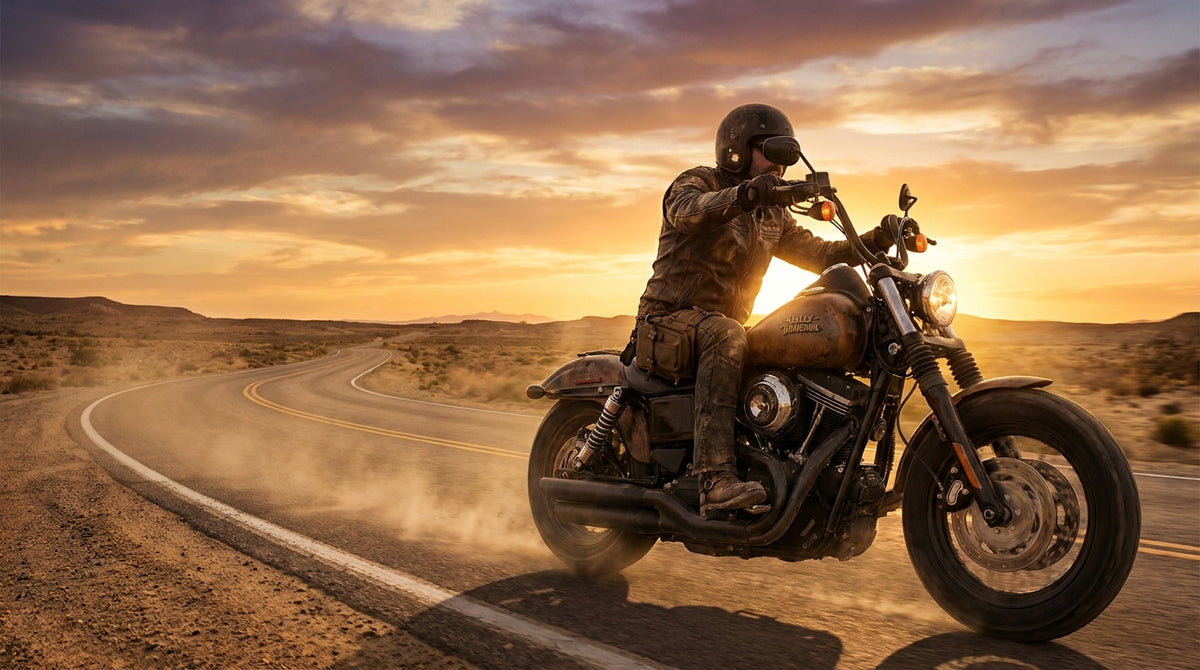
You pull over at a gas stop, reach for your phone, and your leg bag has twisted halfway around your thigh. The zipper faces your knee. Your wallet is somewhere behind your calf. This is what happens when a rider picks the wrong motorcycle leg bag or mounts it incorrectly. Based on the threads in every rider forum, it happens more often than you would think.
This guide breaks down every type of biker leg bag available: drop-leg rigs, thigh wraps, leather, nylon, and waxed canvas. You will learn how to size one, mount it so it stays locked at highway speed, and avoid the five mistakes that ruin most riders' first bag. If you ride with anything in your pockets right now, keep reading.
What Is a Motorcycle Leg Bag and Why Riders Use One
A motorcycle leg bag is a small pouch that straps to your upper thigh and connects to your belt or waist strap. It keeps essentials like your phone, wallet, keys, and toll cash within arm's reach while riding. No digging through jacket pockets. No pulling over to access a saddlebag.
Most leg bags hold between 1.5 and 3 liters of storage. That is roughly the size of a large water bottle. Enough for a phone (up to 6.7 inches fits in most pouches), a slim wallet, a multi-tool, and some cash. Riders on Harley Softails and touring bikes made leg bags popular in the early 2000s, but sport and ADV riders have picked them up too, especially for day rides where a full luggage setup is overkill.
The real advantage over a jacket pocket is vibration isolation. At 65 mph, a phone in your jeans pocket bounces against your thigh with every pavement crack. A leg bag with a padded compartment keeps it secure and scratch-free. And unlike a tank bag, a leg bag does not interfere with your riding position or your ability to lean into turns.

Drop Leg Bag vs. Thigh Bag: Which Style Fits Your Ride
These two terms show up interchangeably in product listings, but they are different designs built for different riding styles.
A drop leg bag hangs from a belt loop or waist strap and drops down to mid-thigh on two adjustable leg straps. The design comes from military tactical gear. It swings slightly when you walk, but on the bike, wind pressure pins it flat against your leg. Most drop leg bags position the main compartment 4 to 6 inches below the waistline.
A thigh bag wraps directly around the upper thigh with wider straps, usually Velcro or snap buckles. It sits higher than a drop leg bag, closer to the hip joint. Less movement, more stability during stop-and-go city riding.
| Feature | Drop Leg Bag | Thigh Bag |
|---|---|---|
| Mounting | Belt loop + 2 leg straps | Wide thigh wrap, optional belt clip |
| Position on leg | Mid-thigh, 4-6 inches below belt | Upper thigh, near hip crease |
| Stability at 60+ mph | Good (wind pins it flat) | Better (tighter wrap) |
| Walking comfort | Some swing when off the bike | Stays snug |
| Typical capacity | 2-3 liters | 1.5-2.5 liters |
| Best for | Highway cruising, touring | City commuting, short rides |
If you log mostly highway miles, go with a drop leg bag. The wind does the work of holding it against your leg, and the extra capacity handles a full day's essentials. For stop-and-go city riding, a thigh bag is the smarter pick. Its tighter wrap prevents shifting every time you plant a foot at a stoplight.

Leather vs. Nylon: The Material That Makes or Breaks a Motorcycle Leg Bag
This is where the quality gap between a $25 bag and a $75 bag becomes obvious.
Genuine leather (cowhide, typically 1.0 to 1.2mm thick) lasts for years. Leather molds to your thigh shape after three or four rides, which reduces shifting and hot spots. It handles wind abrasion far better than any synthetic material. The weight trade-off is real though: a quality leather motorcycle leg bag runs 12 to 16 ounces empty, compared to 6 to 10 ounces for nylon.
Cordura nylon (1000D is the motorcycle industry standard) is lighter and handles rain better straight out of the box. It will never develop a leather bag's character or patina. And cheap nylon, the kind you find on no-name marketplace listings, tears at the stitch points within a single season. If you go the nylon route, look for two things: bar-tacked stress points at the strap attachments and YKK zippers. That combination is the difference between a bag that lasts one summer and one that lasts five years.
Waxed canvas is a third option worth knowing about. Tougher than standard nylon, lighter than leather, and naturally water-resistant when treated with wax. Brands like Filson and Frost River make excellent waxed-canvas bags for general use, though motorcycle-specific designs in this material are harder to find.
Here is the bottom line on materials: genuine leather from a known maker will outlast synthetic alternatives every time. No-name bags labeled "PU leather" use polyurethane-coated fabric that cracks and peels within weeks of sun and wind exposure. Real cowhide does not peel. When browsing leather motorcycle leg bags, confirm the listing says "genuine leather" or "full grain" before you buy.

How to Wear a Motorcycle Leg Bag So It Never Slips
Slipping is the most common complaint riders have. Nearly every negative review on leg bags traces back to one thing: incorrect mounting. Here is a step-by-step that fixes it.
1. Set the drop length first. The center of the bag should sit at mid-thigh, roughly 6 to 8 inches above your kneecap. Too low and it catches wind at speed and flaps around. Too high and it digs into your hip flexor when you bend your leg on the pegs.
2. Thread the waist connection before the leg straps. Whether it is a belt loop, snap hook, or dedicated waist belt, secure the top attachment first. The waist holds the bag's weight. The thigh straps only prevent rotation. Getting this backward is the number-one cause of slipping.
3. Mount on your non-kickstand leg. For most bikes, that means the right thigh. When you stop and lean the bike left onto the kickstand, your right leg plants freely without the bag catching on the seat edge. Riders who mount on the left leg learn this lesson the hard way, usually by snagging the bag while dismounting at a gas station.
4. Route the lower strap under knee armor. If you wear armored pants or external knee guards, threading the lower leg strap beneath the armor creates a much tighter anchor point and stops the bag from bouncing on rough roads.
5. Cinch snug, not tight. You should be able to slide two fingers between the strap and your leg. Tighter than that cuts circulation on rides longer than 30 minutes and leads to numbness or tingling in your lower leg.
6. Check the hardware material before you buy. Plastic snap buckles crack under vibration after a few months on the road. Metal D-rings and cam buckles hold up for years. If the bag you are looking at uses all-plastic buckles on the thigh straps, pick something else.
What Separates a Good Motorcycle Leg Bag from a Bad One
Five features, ranked by how much they actually affect your ride:
1. Three-point strap system. Two independent thigh straps plus one waist connection is the minimum. One strap rotates. Two stay put. A single-strap bag with no waist anchor will end up behind your knee in 15 minutes of riding.
2. Zipper brand. YKK or SBS zippers last through years of dust and weather. Generic pot-metal zippers seize after a few months of road grime and rain exposure. This is the first component that fails on cheap bags.
3. Compartment layout. One main pocket plus one quick-access front pocket is the sweet spot. More than three compartments just means everything is harder to find with gloves on. Simplicity wins here.
4. Reflective elements. Even a small reflective strip on the front panel improves night visibility. Your thigh sits at headlight height for the car behind you, which makes it surprisingly effective placement for a safety feature.
5. Water resistance. Leather bags need mink oil or a separate rain cover. Nylon bags should have taped seams and water-resistant zippers. If you ride in any weather at all, this is a feature you should not skip.
The ALR motorcycle bags collection covers everything from drop leg rigs to saddlebags and tool rolls if you want to compare the full range side by side.

Are Motorcycle Leg Bags Waterproof?
Most motorcycle leg bags are water-resistant at best, not fully waterproof. There is a meaningful difference between the two.
Nylon and Cordura bags with taped seams and coated zippers will handle a light drizzle for 20 to 30 minutes. A sustained downpour soaks through at the stitch points. For serious rain protection, you need either a bag with welded seams and a roll-top closure, or a separate rain cover that fits snugly over the bag.
Leather is naturally water-resistant for short exposure. But prolonged rain saturates untreated leather and causes stiffening or warping as it dries. Treating your leather leg bag with mink oil or a beeswax-based protector every 4 to 6 weeks adds a solid waterproof layer. Obenauf's Heavy Duty LP is one of the best products for motorcycle leather. One application seals the grain and repels water without changing the leather's color significantly.
If you ride year-round in a wet climate, a nylon bag with a dedicated rain cover is the practical choice. For fair-weather and occasional-rain riders, properly treated leather handles everything fine.
Motorcycle Leg Bags for Women Riders
The main design difference between men's and women's motorcycle leg bags comes down to strap range and bag profile.
Standard leg bags ship with straps sized for a 22 to 28 inch thigh circumference. That works for most men but leaves many women riders with straps that are too long and excess webbing flopping in the wind. Look for bags with at least 8 inches of strap adjustment per side, or unisex designs with tri-glide buckles that adjust from 18 to 30 inches.
A smaller capacity bag in the 1.5 to 2 liter range generally works better for women riders. Anything wider than 6 inches can rub the tank on sport bikes during turns. The Kawasaki Ninja 400 and Yamaha MT-07, for example, have tight tank-to-knee clearance where a bulky leg bag gets in the way of cornering inputs.
If the straps on a standard bag run too long, you can trim the excess nylon webbing and seal the cut end with a lighter flame. Most nylon webbing seals cleanly this way without fraying. Leave about 2 inches of strap past the buckle for future adjustment.
5 Common Mistakes That Ruin a Motorcycle Leg Bag
1. Buying too big. A 5-liter leg bag seems practical until it is loaded and swinging against your knee at every red light. The extra weight pulls straps downward and causes inner-thigh chafing. For daily carry, 2 to 3 liters is all you need.
2. Mounting on the kickstand leg. Your left leg supports the bike when you park. A bag on that thigh catches the seat edge every time you swing off. Right thigh is the standard mounting side for good reason.
3. Skipping the waist strap. Some riders attach only the thigh straps and ignore the belt connection. Within 20 minutes the bag slides down past the knee. The waist strap carries the weight. The leg straps are anti-rotation anchors, not load-bearers.
4. Choosing PU over real leather. "PU leather" is polyurethane coating sprayed on fabric. It looks convincing for about three weeks, then cracks, peels, and flakes everywhere. Genuine cowhide costs more upfront but outlasts PU by a factor of 10. If the listing does not specify "genuine leather" or "full grain," it is almost certainly PU.
5. Overloading the front pocket. The quick-access pocket is for your phone or a toll card, not a jangling pile of keys, coins, and a lighter. Cramming it causes zipper failure and scratched phone screens. Keep it to one flat item.
Finding the Right Motorcycle Leg Bag for You
A good motorcycle leg bag is one of those small upgrades that makes every ride noticeably better. No more digging through layers at gas stops. No more worrying about your phone vibrating out of a shallow pocket at highway speed. Get the right size (2 to 3 liters), pick the right material (real leather or quality 1000D nylon), and mount it correctly. That is really all there is to it.
If you are shopping for one, the ALR motorcycle leg bag collection is a solid starting point. Genuine leather, quality strap hardware, and built for riders who actually ride.

No comments yet. Be the first rider to weigh in.