
Most motorcycle crashes happen within the first five miles of a ride. That stat from the Motorcycle Safety Foundation catches new riders off guard. The gear you wear on a quick run to the gas station matters just as much as the gear you pack for a cross-state tour.
This guide breaks down every piece of motorcycle safety gear worth owning, from DOT-rated helmets to CE-armored jackets. You will know exactly what to buy, what certifications to look for, and which corners to never cut.
Helmets: The Single Most Important Piece of Motorcycle Safety Gear
A DOT-certified helmet reduces the risk of fatal head injury by 37%, according to NHTSA crash data. That alone makes it the first thing to buy before anything else touches your body.
Three certifications matter:
- DOT (Department of Transportation): the U.S. minimum legal standard. Every helmet sold in the States must carry this sticker inside the liner.
- ECE 22.06: the European standard, slightly more rigorous in impact testing than DOT. Many premium helmets carry both.
- Snell M2020D: a voluntary standard with the toughest impact testing of the three. Race-grade protection for riders who want the absolute best.
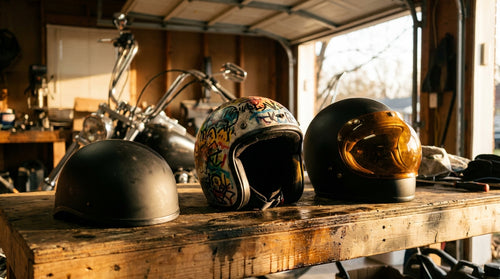
Half-shell helmets (the classic biker look) weigh around 2 to 3 lbs and offer DOT coverage across the crown. Full-face helmets like the Shoei RF-1400 add chin bar protection and run 3.5 to 4 lbs. The tradeoff is airflow and style versus total coverage.
For cruiser riders who want the open-face feel, a 3/4 shell gives solid crown and temple protection while keeping the face open. Just know that roughly 35% of all helmet impacts hit the chin bar area, per the Dietmar Otte crash study out of Hannover Medical School.
Fit matters more than brand. A helmet should sit snug around your forehead without pressure points. It should not rotate when you shake your head side to side. If you can fit more than one finger between your forehead and the liner, size down. Most shops will let you wear a helmet around the store for 15 minutes to check comfort.
Pick the helmet that you will actually wear every ride. The safest helmet is the one on your head, not the one sitting in your garage.

Motorcycle Jackets and CE-Rated Armor
A leather jacket does more than look good on the bike. Cowhide at 1.2mm thickness can slide across asphalt for roughly 4 to 6 seconds before wearing through. A cotton t-shirt lasts less than half a second in the same test.
The real upgrade is CE-rated armor inserts at the shoulders, elbows, and back. CE Level 1 armor absorbs impacts up to 35 kN of transmitted force. CE Level 2 (what you want for serious riding) cuts that number to under 20 kN. Brands like D3O and Knox make armor that stays flexible when you move and hardens on impact.
Leather vs. textile is a personal call. Full-grain leather wins on abrasion resistance and lasts decades with proper care. Textile jackets with Cordura 600D offer better ventilation and rain resistance. Riders in hot climates often go textile for daily commuting and save the leather for longer hauls.
What to look for in any motorcycle jacket:
- Armor at shoulders, elbows, and a back protector pocket (many jackets ship without the back insert, so check before you buy)
- Double or triple stitching at every seam
- A snug fit that does not ride up when you lean forward in the saddle
A quality leather jacket is a one-time investment. Cheap synthetic jackets wear out in a season or two. Real leather breaks in and gets better with every ride. That is the difference between gear built for real riding and disposable marketplace knockoffs with no safety rating and unknown materials.

Riding Gloves and Hand Protection
Your hands hit the ground first in almost every low-side crash. Instinct takes over, and your palms go down before your brain catches up. Without gloves, that means road rash from fingertip to wrist in under a second.
A quality pair of motorcycle riding gloves should have:
- Knuckle armor (hard shell or molded TPU)
- Reinforced palm with a slider or double leather layer
- Wrist closure that keeps the glove from pulling off in a slide
- Pre-curved fingers that match your natural grip on the bars
Full-grain leather gloves outperform synthetic options on abrasion. A cowhide palm lasts 3 to 4 seconds of asphalt slide, while most synthetic materials shred in under 2 seconds. For winter riding, look for gloves with Thinsulate or similar insulation rated to at least 40g.
One thing riders skip: proper sizing. Gloves that are too loose bunch up and reduce grip strength on the throttle. Too tight, and your fingers go numb after 30 minutes. Measure your dominant hand across the knuckles with a cloth tape. Most manufacturers list sizing charts based on that circumference in inches.

Boots That Actually Protect Your Ankles
A standard pair of sneakers offers zero ankle protection. In a tip-over at parking-lot speed (under 10 mph), the weight of a 600 lb cruiser can fracture an unprotected ankle on contact.
Motorcycle-specific boots have four features that street shoes lack:
- Reinforced ankle cups, either internal or external
- Oil-resistant soles with flat profiles for solid foot-peg grip
- Shift pads on the left toe to prevent wear from the gear lever
- A shaft height of at least 8 inches to cover the ankle bone completely
The TCX X-Blend is a popular choice in the cruiser world. It runs about 1.8 lbs per boot and carries CE EN 13634 certification. For riders who prefer a taller profile, classic engineer boots (like the Chippewa 11-inch) give calf coverage without looking like motocross gear.
The mistake riders make with boots is choosing fashion over function. Western-style cowboy boots look great off the bike, but smooth leather soles slip on wet pegs. If you ride in cowboy boots, at least swap to a pair with rubber-composite soles and a proper heel block.
Visibility Gear and Motorcycle Safety Lights
About 37% of multi-vehicle motorcycle crashes involve a car turning left into a rider's path, per NHTSA data. The driver did not see the bike. Visibility gear is cheap insurance against the most common crash type on public roads.
Options that actually work:
- Reflective vest or jacket strips: a $20 ANSI-rated vest over your jacket makes you visible at night from 500+ feet. During the day, hi-vis yellow or orange does the same job.
- LED auxiliary lights: a pair of Denali DM LED pods mounted to the crash bars adds 2,700 lumens. Oncoming drivers see a wider light signature and register "motorcycle" instead of "single headlight, probably far away."
- Helmet-mounted LEDs: brake-activated LED strips on the back of a helmet give following drivers a second brake light at eye level. The Brake Free unit runs about $150 and mounts with adhesive.
You do not need all three. A reflective vest plus upgraded headlights covers most riding situations. The point is to break the outline that makes motorcycles disappear against headlight glare or busy backgrounds.
Full Motorcycle Safety Equipment Checklist
Here is a straightforward motorcycle safety gear list broken down by priority and certification:
| Gear | Certification | Why It Matters | Price Range |
|---|---|---|---|
| Helmet | DOT / ECE / Snell | Reduces fatal head injury risk by 37% | $80 - $700 |
| Jacket with armor | CE Level 1 or 2 | Abrasion + impact protection for torso | $150 - $600 |
| Gloves | CE EN 13594 | Hands are the first point of contact | $40 - $150 |
| Boots | CE EN 13634 | Ankle support and oil-resistant sole | $100 - $350 |
| Riding pants | CE armor at knees/hips | Covers the largest skin area on the body | $80 - $400 |
| High-vis vest | ANSI/ISEA 107 | 37% of crashes involve a turning vehicle | $15 - $60 |
| Back protector | CE Level 2 | Spine protection if jacket has no insert | $60 - $200 |
The Motorcycle Safety Foundation recommends all seven items for every ride. At minimum, helmet, gloves, jacket, and boots should be non-negotiable. Riding pants and a standalone back protector round out the full motorcycle safety equipment kit.
Best Motorcycle Safety Gear for Beginners
New riders often spend big on the bike and skimp on protection. That is backwards. A $300 DOT helmet and a $200 armored jacket do more for your survival odds than any aftermarket exhaust or chrome upgrade.
Here is how to prioritize your first gear budget:
- Helmet first, always. Get a DOT-certified lid that fits properly. The Biltwell Gringo and the Bell Qualifier are solid entry points under $200.
- Gloves second. Even a $40 pair of leather gloves saves your palms in a parking-lot drop.
- Jacket third. Look for CE Level 1 armor at minimum. Leather lasts longer, but an armored textile jacket works if budget is tight.
- Boots fourth. Ankle-covering, non-slip sole. You can flex on budget here, but never ride in sandals or sneakers.
Total starter kit cost: $400 to $700 if you shop smart. That is less than most riders spend on their first set of saddlebags. Start with protection, then worry about accessories.
5 Gear Mistakes That Cost Riders
1. Buying a helmet based on looks alone. A novelty helmet with no DOT sticker might look cool at a rally, but it will not absorb a highway-speed impact. Always check the DOT label molded inside the liner, not just a sticker on the outside. Counterfeit DOT stickers are a real problem on cheap imported lids.
2. Wearing a jacket two sizes too large. Armor only works when it sits directly over the joint it is meant to protect. If your shoulder armor slides down to your upper arm during a crash, it is protecting nothing. Try the jacket on while seated in a riding position, not just standing in the store.
3. Skipping gloves on short rides. Over 40% of motorcycle crashes happen within 5 miles of the starting point. That "quick trip" to grab coffee is statistically the most dangerous part of your week on two wheels.
4. Choosing cowboy boots for regular riding. Smooth leather soles, no ankle reinforcement, and a heel profile that can catch on controls. Real motorcycle boots exist for a reason. If you love the Western look, at least get a pair with rubber-composite soles and ankle cups.
5. Never replacing your helmet. UV exposure and normal wear degrade the EPS foam liner over time. After 5 years of regular use, Snell Foundation recommends replacing any helmet regardless of visible damage. A helmet that looks fine on the outside may have compressed foam that will not absorb the next impact properly.
Gear Up, Then Ride
The right motorcycle safety gear does one job: it keeps you riding. Every piece on this list exists because real crash data proves it works. DOT, ECE, and CE ratings represent thousands of hours of impact testing so you do not have to learn the hard way.
If you are building your kit from scratch or replacing worn-out gear, the rider deals collection is a good place to start. Quality leather, DOT-rated lids, and gear built to last more than one season. Stay protected. Ride far.

No comments yet. Be the first rider to weigh in.