
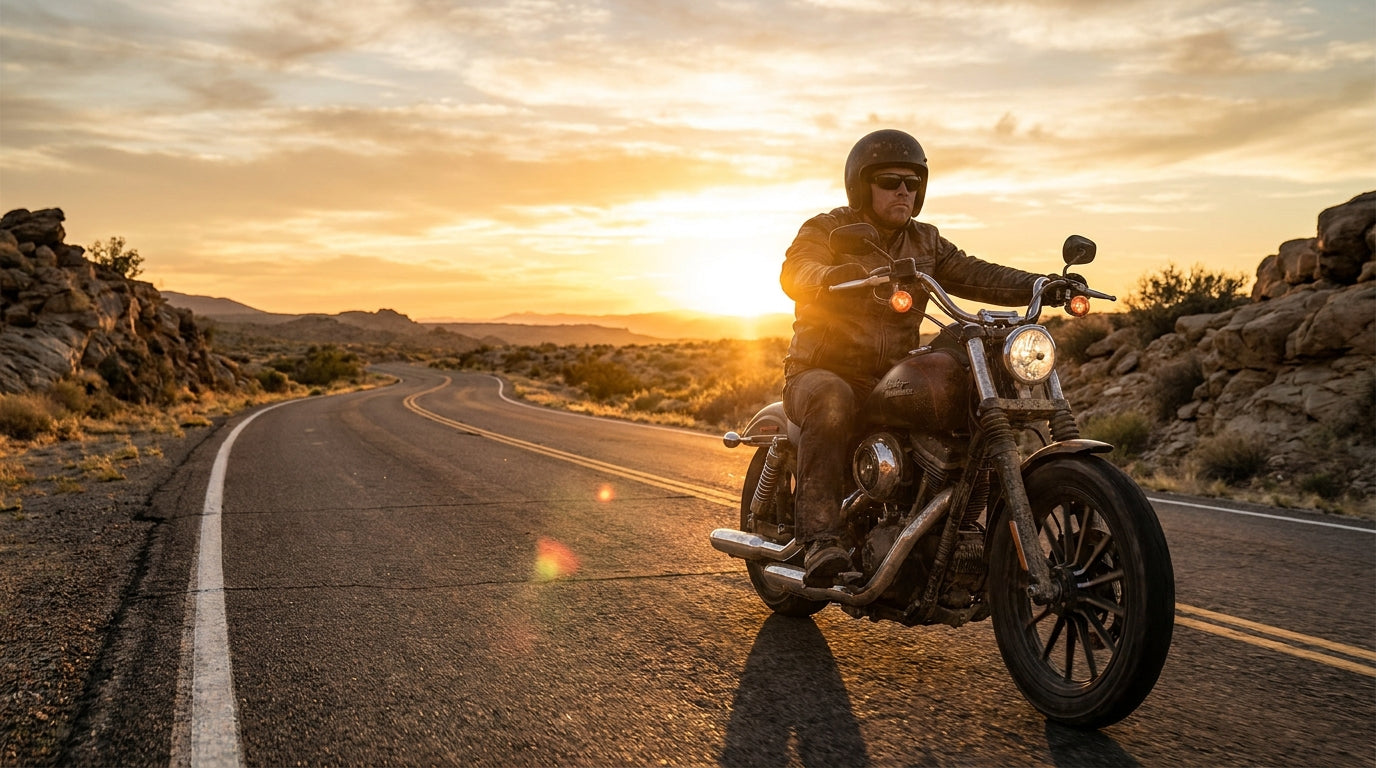
A pair of regular sunglasses works fine until you hit 55 mph. Then the wind catches the frame, the temples lift off your ears, and your expensive Ray-Bans end up bouncing down the interstate behind you. Gas station shades are worse. One kicked-up pebble at highway speed can shatter a cheap acrylic lens right in front of your eye. Motorcycle sunglasses for men solve both problems, but only if you pick the right pair.
This guide breaks down what separates riding sunglasses from fashion eyewear. You will learn which lens types block UV and wind, which frame styles fit under a helmet, and which features are worth paying for. Every recommendation comes from what actually works on the road, not marketing copy.
What Makes Motorcycle Sunglasses Different from Regular Shades
Three things separate motorcycle sunglasses from the pair sitting on your dashboard. First, impact resistance. Riding sunglasses built to the ANSI Z87.1 safety standard use polycarbonate lenses that withstand a 1-inch steel ball dropped from 50 inches without cracking. Regular fashion sunglasses have no impact requirement at all.
Second, wind protection. Most motorcycle sunglasses for men wrap around the face or include foam gaskets along the brow and cheeks. That seal blocks the 60+ mph airstream that dries out your eyes and blurs your forward vision on longer rides. Fashion frames leave a wide gap between the lens edge and your face. At highway speed, that gap becomes a wind tunnel aimed directly at your cornea.
Third, UV coverage. Every pair worth buying carries a UV400 rating, which blocks 99.9% of UVA and UVB rays up to 400 nanometers. Cheaper sunglasses sometimes tint the lens dark without adding UV filtering, which is actually worse than wearing nothing. The dark tint forces your pupils to dilate, letting in more unfiltered UV than bare eyes would.

Polarized Motorcycle Sunglasses: When They Help and When They Hurt
Polarized lenses contain a chemical filter that blocks horizontal light waves, the kind that bounce off flat surfaces like wet pavement, car hoods, and puddles. A polarized lens cuts that reflected glare by up to 98%, which makes a real difference on bright days when every surface around you is throwing light at your face.
That sounds like a clear win, but there is a trade-off riders need to know about. Polarization can make oil slicks and wet patches on the road harder to spot. The rainbow sheen you normally see on a gas-station oil spill disappears through a polarized lens because that sheen is reflected light, exactly what the filter removes. On dry roads in bright sun, polarized motorcycle sunglasses are excellent. In mixed conditions with rain or around gas stations, they remove a visual cue you might need.
Polarized lenses also interfere with some LCD screens. If your bike has a digital dash or you use a phone mount for GPS, a polarized lens can black out parts of the display at certain angles. Tilt your head slightly and it comes back, but it is annoying enough that some riders prefer non-polarized for bikes with LCD instrumentation. The Harley-Davidson Road Glide's Boom Box GTS screen, for example, dims noticeably through certain polarized filters.
Best Lens Colors for Different Riding Conditions
Lens color is not cosmetic. Each tint filters a different portion of the light spectrum, and the right choice depends on when and where you ride most. Here is what each color actually does:
| Lens Color | Light Blocked | Best Conditions | Drawback |
|---|---|---|---|
| Smoke/Gray | 85% visible light | Bright sun, highway cruising | Too dark for overcast or dusk |
| Amber/Bronze | 50 to 60% | Mixed sun and cloud, afternoon rides | Shifts color perception slightly |
| Yellow | 15 to 25% | Dawn, dusk, overcast, fog | Almost no UV filtering on its own |
| Clear | 0% | Night riding, wind and debris protection only | No sun protection at all |
| Photochromic | 15 to 80% (auto-adjusting) | All-day rides with changing light | Slower transition in cold, costs $20 to $40 more |
For most riders who are out in full daylight, smoke or gray lenses are the standard. If you ride mainly in the late afternoon or early morning, amber gives you contrast enhancement that helps you spot road hazards better than a dark lens. Photochromic lenses are the all-rounder. They darken in bright sun and lighten as the day fades, but they take 30 to 90 seconds to adjust fully, so riding through tunnels or sudden shade can leave you temporarily over-tinted.
One detail most buyers miss: lens category ratings. European CE-rated motorcycle sunglasses use a 0 to 4 scale, where Category 3 (blocking 82 to 92% of light) covers most daytime riding. Category 4 is for extreme alpine or desert glare and is too dark for road use in most states.

Wraparound vs Aviator vs Retro: Picking the Right Frame Style
Frame shape determines how much wind and debris protection you get, how well the sunglasses fit under a helmet, and whether they stay on your face at speed. Here is how the three main styles compare for motorcycle use:
| Frame Style | Wind Protection | Helmet Fit | Best Paired With |
|---|---|---|---|
| Wraparound | Excellent (full seal) | Good with thin temples | Sport bikes, touring, highway cruisers |
| Aviator | Low (open sides) | Tight under full-face | Open-face helmets, cruisers, short rides |
| Retro Round | Low to moderate | Good (small frame) | Bobbers, cafe racers, vintage builds |
Wraparound frames are the functional choice. Brands like Bobster and Wiley X build their entire motorcycle line around this shape because it blocks peripheral wind while keeping the lens close to your face. The Bobster Enforcer, one of the most popular men's motorcycle sunglasses, uses a foam-padded wraparound frame that converts to goggles by swapping the temples for an elastic strap.
Aviators look great on a cruiser, especially paired with an open-face helmet and a leather jacket. But the flat lens sits far from your face, which lets wind rush in from every angle. For city riding and short trips under 40 mph, aviators work fine. For highway use, you will end up squinting within 20 minutes. If you love the aviator look, search for motorcycle-specific aviators that add side shields or foam gaskets to the frame.
Retro round frames fit the vintage aesthetic and work surprisingly well under helmets because of their compact size. They pair naturally with open-face and half-shell helmets. The smaller lens means slightly less coverage, so add foam gaskets or pick a pair with built-in side shields if you plan to ride above 50 mph regularly.

How to Wear Motorcycle Sunglasses Under a Helmet
Fit is where most riders get frustrated. A pair of sunglasses that feels perfect on its own can become painful after 30 minutes under a snug helmet. The pressure points are always the same: the temples press against the foam lining above your ears, and the arms push the helmet padding into your skull.
The fix is temple thickness. Standard fashion sunglasses have temple arms 6 to 8 millimeters thick. Motorcycle-specific frames from brands like Wiley X, Bobster, and 7eye keep their temples under 4 millimeters. That extra 3 or 4 millimeters of clearance makes the difference between a comfortable 200-mile day and a headache by mile 40.
For full-face helmet riders, put the helmet on first, then slide the sunglasses in through the visor opening. Trying to put a helmet on over sunglasses bends the frames and misaligns the lenses. With half-shell and open-face helmets, you have more room, but thin temples still matter because the helmet edge sits right above your ear.
If you wear prescription glasses and ride, look for OTG (over-the-glasses) motorcycle sunglasses. These have an oversized frame cavity that fits a standard pair of corrective lenses inside. Bobster makes several OTG models specifically for this purpose, with foam-sealed edges and anti-fog venting built in. The alternative is prescription riding inserts, which clip inside standard motorcycle sunglasses and run $80 to $150 through your optometrist.
5 Mistakes When Buying Motorcycle Sunglasses for Men
- Buying by looks instead of fit. An aviator frame looks sharp in the mirror but lets wind pour in from both sides at 55 mph. Try the sunglasses with your helmet before you commit. If the temples create pressure points under the padding, they are too thick for riding use.
- Skipping UV400 verification. A dark lens without UV filtering is worse than no sunglasses at all. The tint makes your pupils open wider, and without UV400 protection, more ultraviolet light reaches your retina than it would with bare eyes. Check the spec sheet, not just the sticker.
- Ignoring the foam gasket. Foam-sealed edges are not a gimmick. They block the constant 60 mph airstream that dries your eyes and causes fatigue on rides longer than 30 minutes. Wind-induced dry eye is the reason most riders stop wearing sunglasses and switch to goggles. A foam gasket solves it without the bulk.
- Choosing glass lenses over polycarbonate. Glass is optically clearer, but polycarbonate is 10 times more impact resistant. On a motorcycle, one kicked-up pebble at highway speed can crack a glass lens. Polycarbonate flexes on impact instead of shattering. Every ANSI Z87.1 rated pair uses polycarbonate for exactly this reason.
- Wearing the same lens in every condition. Smoke lenses on an overcast day cut too much light, making it harder to spot road hazards. Yellow lenses in bright sun provide almost no glare reduction. If you ride in varied conditions, either carry a second pair or invest in photochromic lenses that adjust automatically.
What to Look for Before You Buy
A good pair of men's motorcycle sunglasses costs between $25 and $80 for non-prescription options. Below $25, you are almost certainly getting fashion frames repackaged with a "motorcycle" label. Above $80, you are paying for brand name or premium lens coatings that most riders will not notice on a daily ride.
Here is the quick checklist before you add anything to cart:
- UV400 rating printed on the lens or listed in specs, not just on the tag
- Polycarbonate lenses (ANSI Z87.1 impact rated is ideal)
- Temple thickness under 5mm if you ride with a helmet
- Foam gasket or close-fitting wraparound for highway wind protection
- Shatterproof certification from ANSI, CE, or equivalent
Interchangeable lens systems deserve a mention. Several brands sell motorcycle sunglasses for men with snap-out lenses, so one frame covers bright sun, overcast, and night riding. You get a smoke, amber, and clear lens in one kit, usually priced between $35 and $65. It is cheaper and more practical than buying three separate pairs, and you can swap lenses in about 15 seconds at a rest stop.
If you are ready to shop for a pair that checks all these boxes, the motorcycle sunglasses collection has styles from wraparound to retro, all with UV400 lenses and frames built for riding. Worth browsing if you want something that stays on your face past 50 mph.


No comments yet. Be the first rider to weigh in.