
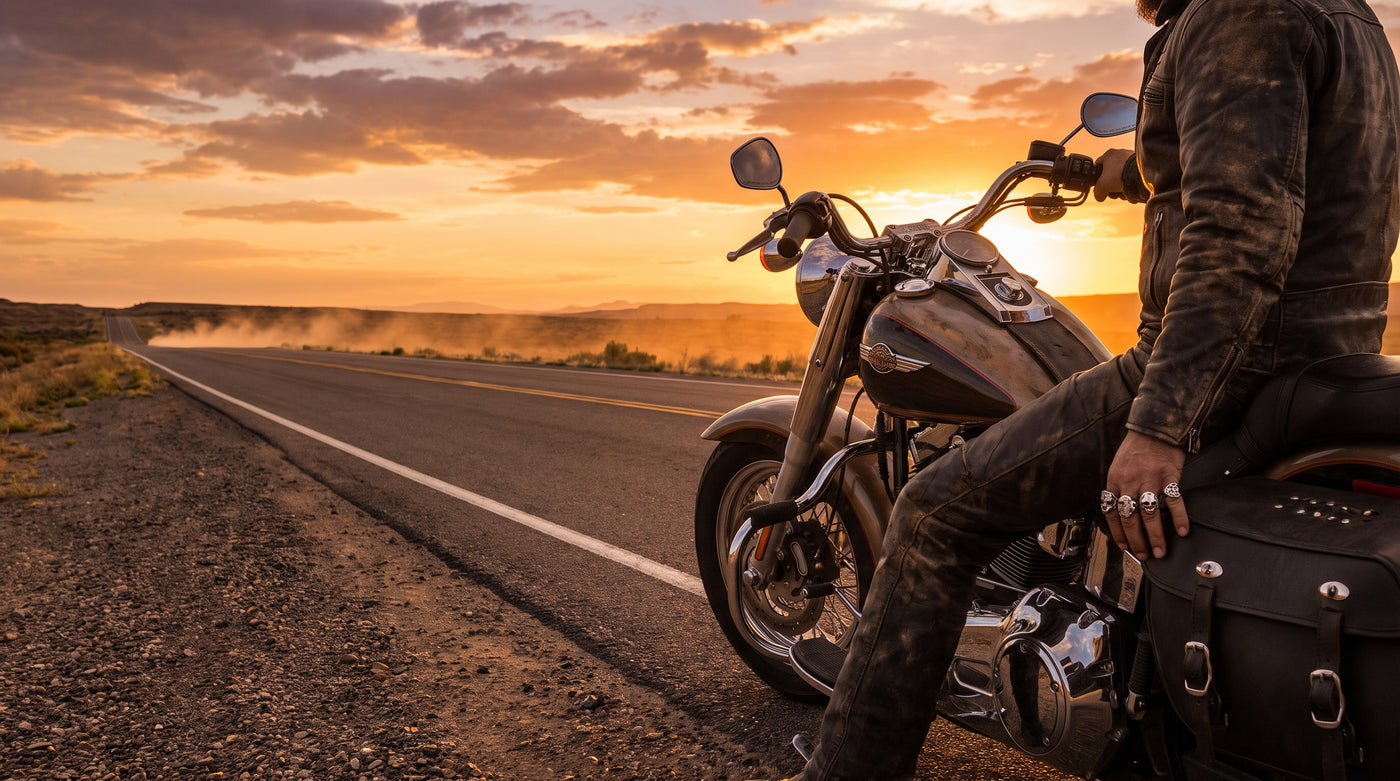
Walk into any biker rally and you'll notice the jewelry before the bikes. A thick skull ring catching the light. A chain bracelet heavy enough to double as a weapon. Outlaw biker jewelry isn't decoration. Every piece signals something, from club rank to personal code, and wearing the wrong symbol around the wrong crowd can start a conversation you don't want to have.
This guide breaks down the most common outlaw biker jewelry styles, what each symbol actually means, which metals survive years of daily riding, and where to find authentic pieces. Whether you're building your first collection or replacing some cheap import that fell apart, here's what matters.
What Sets Outlaw Biker Jewelry Apart from Fashion Jewelry
Most fashion jewelry is built to photograph well. Outlaw biker jewelry is built to survive a 600-mile weekend ride, a dropped wrench, and twenty years of daily wear without breaking down. That difference shows up in three areas: weight, material, and meaning.
A typical biker ring weighs 25 to 45 grams. Compare that to a standard fashion ring at 5 to 8 grams. The heft is intentional. Heavy rings sit firm on the finger inside a glove, they don't spin, and they make a clear statement when you shake someone's hand.
Materials lean toward 316L surgical stainless steel or .925 sterling silver. Both resist corrosion from rain, road grime, and the sweat that builds up during August rides. Zinc alloy and brass plating, the base metals in cheap costume jewelry, tarnish in weeks and leave green stains on your skin after a few long rides.
Then there's symbolism. Outlaw jewelry carries meaning tied to MC culture, personal milestones, or riding philosophy. A skull isn't random. An iron cross isn't just a shape. Wearing certain symbols without understanding them can cause real friction at club events and rallies. Knowing what each piece communicates is as important as knowing how it's made. For a broader look at what's out there, the men's biker jewelry guide covers the full range of styles.
Skull Rings and Their Place in Outlaw Biker Culture
The skull is the single most recognized symbol in outlaw biker jewelry, dating back to the 1940s when the Hells Angels adopted the winged death's head as their primary emblem. In MC culture, the skull represents mortality, fearlessness, and an acceptance of risk that comes with riding. It spread through biker culture worldwide and now appears on everything from rings to belt buckles to jacket snaps.
Outlaw biker rings come in several distinct skull styles, each with its own visual weight:
- Death's head skulls: Full skull face, often flanked by wings or crossed bones. The most classic outlaw look.
- Sugar skulls: Day of the Dead influence with detailed floral engravings. More common in West Coast and Southwest riding culture.
- Horned skulls: Demon or Viking inspired, usually heavier and more detailed. These pieces often weigh 40 grams or more.
- Skull and wrench/piston: Signals the rider works on their own bike. Mechanics and custom builders wear these.
A well-made 316L stainless steel skull ring runs $15 to $45 for a solid piece. Sterling silver versions with hand-finished detail start around $60 and climb from there depending on craftsmanship. The key indicator of quality is weight. If a skull ring looks massive but feels like plastic, it's hollow-cast junk that'll crack within a month.
One important rule: don't wear a club-specific skull design (like the Hells Angels death's head or the Outlaws MC "Charlie" skull) unless you're a patched member. Generic skull designs are open territory and account for the vast majority of outlaw biker rings sold today.

Chain Bracelets and Wallet Chains: Function That Became Identity
Chain jewelry in biker culture started as purely functional gear. Wallet chains kept a rider's billfold attached to their belt during rides. Chain bracelets doubled as emergency tow loops or improvised tools. By the 1970s, they became identity markers. The heavier and more intricate the chain, the more committed the rider.
The most common chain styles in outlaw biker jewelry:
- Cuban link: Smooth, flat interlocking links that sit close to the wrist. Width matters here. Under 8mm reads more fashion. Over 12mm reads biker.
- Box chain: Square cross-section links with an industrial, mechanical look. The go-to style for wallet chains.
- Byzantine: A complex woven pattern that catches light from every angle. Hardest to manufacture, which makes fakes easy to spot by their sloppy, uneven links.
Weight is what separates real outlaw chain jewelry from costume pieces. A genuine 316L stainless steel chain bracelet at 9 inches and 14mm width weighs roughly 120 to 160 grams. If a bracelet looks that heavy but feels light in your hand, it's hollow or plated over zinc. Put it back.
Wallet chains range from 12 inches (tight to the hip, minimal swing) to 24 inches (full drape, classic outlaw silhouette). Most riders settle on 18 inches as the working sweet spot. Long enough to reach a rear pocket comfortably, short enough not to snag on the seat or exhaust. If you're looking for chain bracelet options that hold up, the biker bracelet guide has a solid breakdown.

Iron Cross, Dagger and Other Outlaw Symbols
Beyond skulls and chains, outlaw biker jewelry uses a specific visual vocabulary. Each symbol carries a distinct meaning, and some carry risks if worn without the right context.
- Iron Cross (Maltese Cross): Originally a Prussian military decoration from 1813, adopted by riders in the 1960s as a rebellion symbol. Many independent riders and Christian MCs wear it. It does not automatically signal any extremist affiliation, though context and setting matter.
- 1%ER diamond: In 1947, the American Motorcycle Association reportedly said 99% of motorcyclists are law-abiding. Outlaw clubs claimed the remaining 1% label. A 1%ER ring or pendant signals outlaw identity. Wearing this around a real MC without membership is asking for serious trouble.
- Daggers and swords: Represent combat readiness and self-reliance. Common on rings and larger pendants. The dagger pointing downward is a traditional outlaw symbol across multiple clubs.
- Wings: Different wing configurations carry different meanings in different clubs. Some indicate specific accomplishments or rank. Never assume you know what someone's wings mean.
- Number 13 (or XIII): Refers to the 13th letter of the alphabet, "M." In MC culture, this has been interpreted as standing for marijuana, methamphetamine, or simply "motorcycle" depending on the club and era.
The safest approach for riders who aren't patched into a club: stick to universal symbols. Skulls, flames, wrenches, pistons, eagles, and general Americana imagery carry no club affiliation. They look just as sharp and won't create problems at Sturgis or your local bike night.
Stainless Steel vs Sterling Silver: Which Metal Holds Up on the Road
The two dominant metals in outlaw biker jewelry are 316L surgical stainless steel and .925 sterling silver. Both are legitimate choices, but they serve different types of riders and different situations.
| Feature | 316L Stainless Steel | .925 Sterling Silver |
|---|---|---|
| Typical ring price | $15 to $45 | $60 to $200+ |
| Weight feel | Heavy, dense, solid | Medium, more refined |
| Corrosion resistance | Excellent, zero maintenance | Good, needs periodic polishing |
| Scratch resistance | High (Mohs hardness 6.5) | Moderate (Mohs hardness 2.5) |
| Tarnish | Never | Yes, worse in humid climates |
| Detail quality | Cast, bold lines | Cast or hand-finished, finer detail |
| Best for | Daily riding, rough conditions | Show pieces, rally days |
For daily wear on the road, stainless steel wins every time. It handles sweat, rain, gasoline splashes, and chain grease without showing damage. Sterling silver looks sharper at a sit-down dinner, but it will tarnish if you leave it exposed to humidity, and it scratches more easily during mechanical work. Most riders start their collection with stainless and add silver pieces later for specific occasions.
One thing to watch: "surgical steel" and "stainless steel" are not always the same grade. Look specifically for "316L" on the listing. Lower grades like 304 corrode faster, feel lighter, and can cause skin reactions in riders with nickel sensitivity. If a seller won't list the exact alloy, that's a red flag.
5 Common Mistakes When Buying Outlaw Biker Jewelry
These are the errors that lead to wasted money, broken jewelry, and occasionally real problems at events.
- Buying hollow-cast pieces. If a ring or bracelet looks massive but weighs almost nothing, it's hollow. Hollow stainless steel cracks under impact, and hollow silver dents if you grip a handlebar too hard. Always check gram weight before buying. A solid skull ring should weigh at least 20 grams.
- Wearing club-specific symbols without membership. This gets repeated because it's that important. A Hells Angels death's head, Outlaws Charlie, Bandidos fat Mexican, or Mongols logo on a ring or pendant is club property. Wearing it as a non-member at any event where actual members are present will cause a confrontation. No piece of jewelry is worth that.
- Ignoring ring sizing for gloves. Outlaw biker rings need to fit under riding gloves. Measure your finger with the glove on, not bare-handed. Most riders go up one full size from their normal ring measurement. A ring that fits perfectly bare-handed will pinch and cut off circulation inside a snug leather glove on a hot day.
- Choosing plated over solid metal. Gold-plated or silver-plated biker jewelry photographs well. After two months of riding, the plating chips off and the base metal underneath, usually zinc or tin, shows through. It looks terrible and can irritate skin. Spend more once on solid 316L or .925 and you'll never replace it.
- Ordering from faceless overseas marketplaces. The ring shows up 30% lighter than described, made from unlisted mystery metal, and sized wrong. Returns take six weeks if they're honored at all. Buy from a seller that lists the exact alloy, publishes real product weights, and offers domestic returns. The biker rings collection at ALR lists specs for every piece and ships from a real warehouse.
Building an Outlaw Collection That Lasts
The best outlaw biker jewelry is bought one piece at a time. Start with a solid skull ring in 316L stainless steel. It's the foundation of any biker jewelry collection and the piece you'll wear most. Add a chain bracelet next, something heavy enough to feel present but not so bulky it catches on your throttle housing. From there, a pendant or a biker necklace rounds things out.
Skip the matching sets. Real outlaw jewelry is accumulated, not purchased as a coordinated package. Each piece should have its own weight and history. And buy quality once rather than replacing cheap imports every few months.
If you're ready to start, the biker rings collection is where I'd look first. Every piece is solid metal with listed specs, no mystery alloys, no hollow junk.
No comments yet. Be the first rider to weigh in.