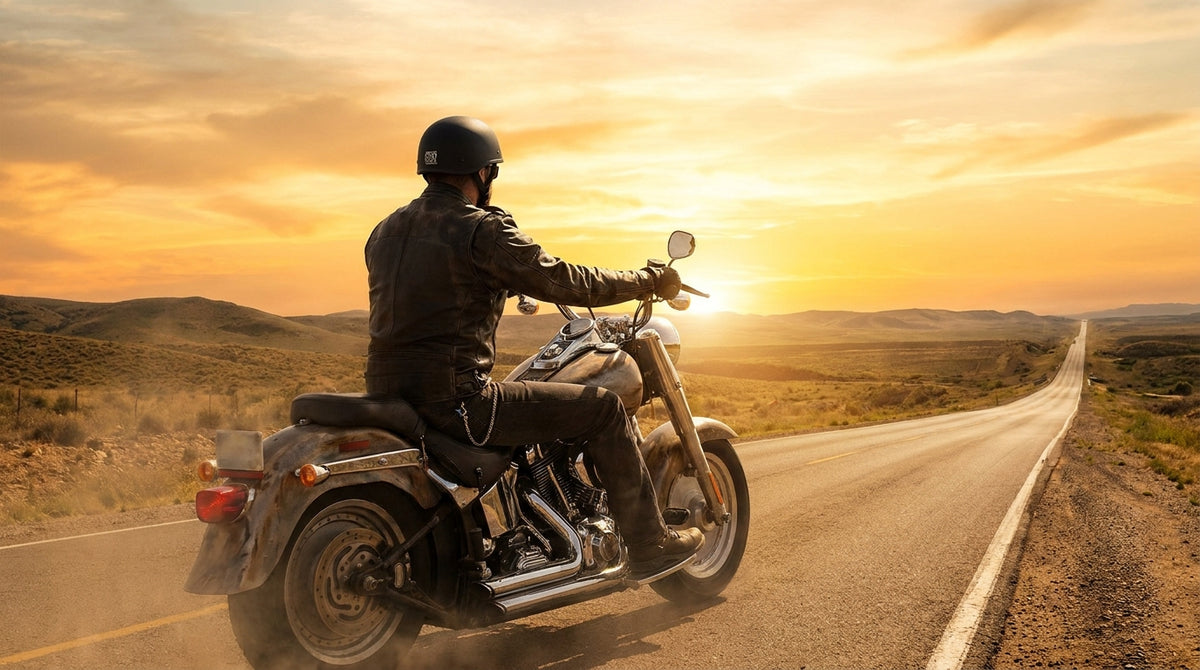
Most riders buy a skull cap helmet for the wrong reason. They pick the smallest shell on the shelf because it looks clean on a cruiser, then discover at 60 mph that the thing lifts off their forehead like a sail. A proper skull cap weighs about 2 lbs against roughly 3.5 lbs for a full face lid, and that weight saving is real. But it only works if the shell sits low and the strap pulls straight down behind your jaw.
This guide covers what a skull cap helmet legally is, what the DOT sticker does and does not promise, how shell sizes run, and 9 DOT-rated picks from $79 to $169 that riders actually keep on the shelf. By the end you will know which shell shape fits your head and which one to skip.
What a skull cap helmet actually is
A skull cap helmet, also called a beanie or half helmet, is a shell that covers the top of your skull and stops above the ears. Nothing wraps the jaw, nothing covers the back of the neck. It is the smallest profile you can legally ride in a helmet-law state.
The legal line in the US is FMVSS 218, the federal motor vehicle safety standard. A helmet that meets it carries a DOT sticker on the back of the shell. The standard tests impact absorption, penetration resistance and retention strength, which is the strap and buckle system. It does not test the area the helmet never covers, so a skull cap passes the same drop tests as a full face while protecting far less surface area.
Two shell families dominate this category. The round beanie shell, which hugs the crown and leaves the ears open, and the slightly deeper German style shell, which drops a lip down over the back of the neck. Both are DOT rated when built right. The German shell adds roughly half an inch of rear coverage and about 3 oz of weight.
- Beanie / skull cap: lowest profile, ears fully open, best in heat.
- German style: same low front, extra rear lip, classic WWII silhouette.
- Novelty shell: no DOT sticker, no impact foam worth the name. Avoid.
That third line matters more than anything else on this page. Marketplace novelty lids look identical in a photo and cost $35. They use a thin plastic shell with a foam pad glued inside instead of a real EPS liner. They are decoration, not protection, and they fail a traffic stop in a helmet-law state.
Are skull cap helmets safe? The honest answer
A DOT-rated skull cap is safe in the specific way the standard defines. It absorbs a crown impact and the strap holds. What it cannot do is protect your face, jaw or temples, and those take a large share of real-world motorcycle head injuries. Riders who want maximum coverage wear a full face. Riders who want the lightest legal lid wear a skull cap and accept the trade.
Where the safety argument usually goes wrong is the strap, not the shell. A skull cap has almost no surface for the wind to grab on the sides, so the only thing keeping it in place is retention. A D-ring or quick-release buckle pulled snug under the jaw holds. A loose nylon strap with 2 inches of slack lets the shell rotate back on the first hard stop, which is the single most common complaint riders have about half helmets.
The practical rule: if you can slide two fingers flat between the strap and your throat, it is too loose. One finger is correct. For a wider look at coverage levels, our motorcycle helmet types and DOT safety guide breaks down every shell style side by side. You can also read the federal position directly at NHTSA.
9 best skull cap helmets riders actually buy
These are all DOT-rated shells with real EPS liners, sorted by what they do best rather than by price. Prices run from $79.90 to $169.95.
1. Daytona Skull Cap Half Helmet with Guns graphic
Daytona builds the thinnest DOT shell most riders will find, and the Guns version is the one people stop you about in parking lots. At $139.97 it is not the cheapest, but the shell profile sits noticeably lower than the generic beanie shape, which is exactly what riders chasing a clean cruiser look want. Made in the USA with a hand-painted finish.

2. Born to Ride DOT skull cap half shell, matte black
The all-rounder. Matte black hides road film better than any gloss finish, and at $169.95 this is the premium pick in the lineup with a half shell that still reads as a skull cap rather than a bowl. If you only own one half helmet and ride year round, this is the one to buy once.

3. Daytona Piston skull cap helmet
Same low Daytona shell as the Guns model at $108.97, with a piston and flame graphic instead. This is the value entry into the Daytona shell shape, and it is the pick for riders who want the thin profile without the hand-painted premium.

4. Daytona USA Flag skull cap half shell
Flag graphics are the most requested finish in this category, and at $129.95 this one puts the stars and stripes on the same DOT shell. It photographs well on chrome and black bikes alike, and the paint holds up to sun better than the vinyl-wrapped versions sold elsewhere.

5. German style half helmet with skull graphic
At $91.45 this is the crossover pick. You get the German shell with its extra rear lip plus a skull graphic, so it covers the back of your neck in cold air while still reading as a skull cap from the front. The best choice if you ride into fall and winter and want a little more shell behind your ears.

6. Tank 13 DOT half helmet with drop-down sun visor
The only lid here with an internal sun visor, at $129.95. Flip it down and you stop squinting into low afternoon sun without carrying a second pair of sunglasses. The visor mechanism adds a few millimetres to the shell, so this one sits slightly taller than a true beanie.

7. Retro vintage German half helmet, matte black
At $79.95 this is the budget workhorse of the group and the cheapest DOT shell on the list. Matte black, no graphics, nothing to fade. Buy it as a spare for a passenger or as a knock-around lid for short errand rides.

8. ALR Patriot DOT-certified vintage half helmet
Leather-wrapped shell at $99.95 for riders on vintage and bobber builds where a painted plastic shell looks wrong. The leather finish ages instead of chipping, which is the opposite of what gloss paint does after two summers.

9. Red Knight skull vintage German helmet
The loudest shell in the lineup at $79.95, with a red knight skull across a vintage German profile. This is a statement lid for rallies and bike nights rather than a daily commuter, and the price makes it easy to own alongside a plain black one.

If none of these shapes suit your head, the full skull motorcycle helmet collection and the German helmet lineup carry more shell profiles in the same DOT-rated builds.
How to size a skull cap helmet so it stays put
Half helmets are less forgiving than full face lids because there is no cheek pad holding your head in place. The shell either matches your skull shape or it rocks. Measure before you buy.
- Run a soft tape around your head about 1 inch above your eyebrows, across the widest point.
- Write the number in both inches and centimetres. A 22.5 inch head is 57 cm, which is a size Medium in most DOT half shells.
- Pick the shell that matches, and if you land between sizes go down, not up. The liner compresses about 3 mm in the first month of riding.
- Buckle it, then try to roll the helmet forward off your head with both hands. If it moves more than an inch, the shell is too big.
Head shape matters as much as circumference. Most beanie shells are built round-oval. If your head is long front to back, which is called long-oval, a round shell will press on your forehead and crown while leaving gaps at the sides. German shells generally run a little longer and suit that shape better.
Skull cap vs half helmet vs open face vs full face
Four shell styles, four very different trade-offs. The weights below are typical for a size Medium DOT shell.
| Style | Weight | Coverage | Wind noise | Typical price |
|---|---|---|---|---|
| Skull cap / beanie | ~2 lbs | Crown only | High | $79 to $170 |
| German half helmet | ~2.2 lbs | Crown plus rear lip | High | $79 to $130 |
| Open face (3/4) | ~3 lbs | Crown, ears, back of head | Medium | $150 and up |
| Full face | ~3.5 lbs | Full head and jaw | Low | $150 and up |
Read that table as a map, not a ranking. A full face protects the most. A skull cap is the lightest legal option and the one you will actually wear on a 95 degree afternoon. The worst helmet is the one sitting at home because it is too hot and too heavy.
Gear that works with an open shell
A skull cap leaves your eyes, ears and face exposed, so three accessories do real work here instead of being optional extras.
Eye protection. There is no visor, so goggles or wraparound glasses are not negotiable. Most half helmet riders end up with a pair of vintage-style goggles that sit under the shell edge.
Face cover. Below about 50 degrees, wind on bare skin ends rides early. A thin balaclava or half mask fits under a beanie shell without pushing it up.
Comms. Clip-on headsets are hard to mount on a half shell because there is no ear pocket. The ALR Y10 at $69.95 is built to run on half and full face shells, which is why it shows up in this category.

If you want to change the look of a shell you already own instead of buying another, helmet covers are the cheap way to do it.
5 mistakes riders make buying a skull cap helmet
- Buying a novelty shell because the photo looked DOT. No sticker on the back of the shell means no FMVSS 218 testing. A $35 lid with a glued foam pad does not absorb a crown impact, and it will not pass inspection in a helmet-law state.
- Sizing up for comfort. A half shell with no cheek pads relies entirely on circumference fit. Going one size up feels better in the driveway and rocks backward at highway speed.
- Leaving slack in the strap. More than one finger of room under the jaw and the shell can rotate off the forehead under braking. This is the number one half helmet failure complaint.
- Ignoring head shape. A round-oval beanie shell on a long-oval head presses on the forehead and leaves side gaps. The German profile usually fits long-oval heads better.
- Skipping eye protection. No visor means no wind management. One bug or stone at 55 mph with bare eyes ends the ride, and that is a cheap problem to solve before it happens.
Which skull cap helmet should you buy
If you want the lowest profile and the cleanest look, go Daytona. The Piston at $108.97 gets you the thin shell at the lowest price in that family. If you ride year round and want one lid that handles everything, the Born to Ride matte black at $169.95 is the buy-once option. If you ride in cold air, take the German shell with its rear lip. If you just need a spare, the $79.95 matte black retro shell does the job without pretending to be anything else.
The one thing not worth saving money on is the sticker. A real DOT shell with an EPS liner is the difference between gear and costume. If you are shopping for one, the skull cap and half helmet collection is where we would start, and every shell in it carries the rating on the back.

No comments yet. Be the first rider to weigh in.