
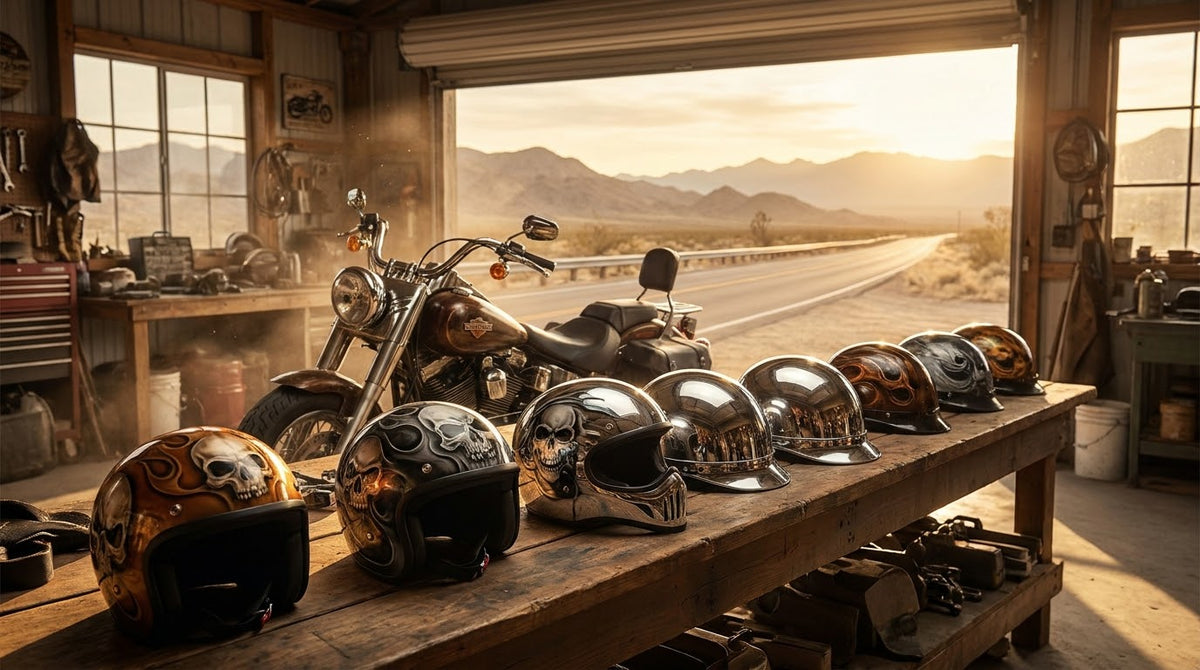
A fresh airbrushed flame job can cost more than the helmet under it. Plenty of riders spend $600 on paint for a $90 lid, then find out the solvent softened the shell. Custom does not have to mean fragile or expensive.
This guide covers the four real ways to get a custom look: paint, vinyl wrap, slip-on covers, and factory-made custom styles like skull or chrome helmets. You will see what each costs, what each does to DOT protection, and which option fits a daily rider versus a rally-only bike. If you came here searching for the best custom motorcycle helmets, start with the comparison table and work down.
What Makes a Custom Motorcycle Helmet "Custom"
There are two families. The first is a stock helmet you change after purchase: paint, wrap, decals, a cover. The second is a helmet built with a custom look from the factory: skull shells, chrome finishes, leather-wrapped half helmets, retro open-face lids with contrast stripes.
The difference matters for safety. A factory helmet keeps its DOT certification exactly as sold. A repainted helmet is still legal to wear, but the shell may no longer match what passed the FMVSS 218 test. The Department of Transportation standard requires a 10-foot drop onto a flat anvil and a penetration test. Any change to the shell chemistry can change that result.
- Aftermarket custom: paint, wrap, decals, covers, bolt-on spikes or mohawks.
- Factory custom: graphic shells, skull molds, chrome plating, leather or denim outer wraps.
- Full bespoke: one-off painted shells from a custom painter, usually built on a Bell Custom 500 or a blank half helmet.
Custom Paint: Looks Best, Costs Most, Carries the Most Risk
A quality airbrushed helmet from a known painter runs $400 to $1,500 depending on the artwork. Flames, candy colors and pinstripes sit at the low end. Portrait work and multi-layer skull art climb fast. Turnaround is often four to eight weeks.
The risk is the shell. Polycarbonate shells, which most helmets under $150 use, react badly to solvent-based paints and lacquer thinner. The solvent causes microcracks you cannot see. Fiberglass and composite shells tolerate paint far better, which is why painters prefer them.
If you do paint, follow these rules
- Water-based paint only on polycarbonate. Ask the painter what base they use before you ship the lid.
- Never sand through the clear coat into the shell. Scuff only.
- Keep the DOT sticker or have it reapplied over clear. Some states ticket for a missing sticker.
- Paint a new helmet, not your five-year-old daily. Snell recommends replacement every five years anyway.
Check your manufacturer's care page first. Shoei and Arai both publish warnings against repainting their shells, and those warnings void the warranty.
Vinyl Wraps: The Cheapest Way to a One-Off Look
A helmet wrap uses the same cast vinyl film as car wraps, usually 2 to 3.5 mil thick. A pro wrap on a full-face helmet costs $150 to $300. A DIY roll of 3M 2080 or Avery Dennison film in a single color runs $20 to $40 for enough material to cover one helmet.
Wraps win on safety because nothing touches the shell chemistry. Adhesive sits on top of the clear coat and peels off clean, so you can change the look every season. The downside is seams. Helmets have deep curves around the vents and chin bar, and vinyl stretches only so far before it lifts.
| Wrap type | Cost | Lifespan | Best for |
|---|---|---|---|
| Single-color cast vinyl | $20 to $40 DIY | 3 to 5 years | Matte black, satin, color shift |
| Printed graphic wrap | $150 to $300 pro | 2 to 4 years | Logos, camo, patterns |
| Chrome vinyl | $60 to $120 material | 1 to 3 years | Show bikes, low sun exposure |
Chrome vinyl looks great under lights and fades fastest in sun. If you want chrome on a daily rider, a factory chrome helmet holds up longer than any film.
Helmet Covers: Custom in 30 Seconds, Zero Shell Risk
Covers are fabric shells with an elastic hem that stretch over a half helmet or a full face. Most weigh under 4 ounces and cost $20 to $45. They are the only custom option you can take off before a ride in the rain and put back on at the meet.
The classic covers are mohawks, spikes, animal ears and character designs. Riders also use plain covers to protect paint on a custom helmet during transport. A cover changes nothing about the shell, so DOT status stays exactly as sold.
Fit is the one thing to check. A cover sized for a full face will sag on a half helmet, and loose fabric flaps at highway speed. Match the cover to your helmet type, not just "one size." Our motorcycle helmet covers list the helmet type each one fits.

Factory Custom Helmets: Skull, Chrome, Leather and Retro
If you want a custom look with full DOT certification intact, buy a helmet built that way. Factory custom helmets pass testing with the graphic already on the shell. Prices start around $70 for a graphic half helmet and run to $250 for a leather-wrapped or chrome-finished lid.
Skull helmets
Skull designs come two ways. A printed skull graphic on a standard shell, or a molded skull shape on a half helmet. Molded skull half helmets weigh about 2 to 3 pounds and carry a DOT stamp on the back. Our skull motorcycle helmets collection covers both styles.

Chrome helmets
A true chrome helmet is electroplated or vacuum-metallized over the shell, then clear coated. It will not peel like vinyl, but it scratches and shows every fingerprint. Chrome half helmets are the standard choice for cruiser riders who want a mirror finish that survives sun.

Leather-wrapped half helmets
A leather outer wrap over a DOT shell gives the vintage bobber look without any paint work. Real leather darkens with age and takes conditioner like a jacket. Synthetic wraps stay uniform but can crack after two or three summers.
Retro open-face and three-quarter
Open-face helmets with racing stripes, contrast trim and metal flake are the closest factory match to a 1970s custom paint job. Pair one with a bubble shield or vintage goggles and you have the full look for under $200.

Custom Options Compared: Cost, Safety and Lifespan
Here is the whole decision in one table. Safety column refers to whether the shell stays exactly as it was when it passed DOT testing.
| Method | Typical cost | DOT shell unchanged? | Lifespan | Reversible? |
|---|---|---|---|---|
| Custom airbrush paint | $400 to $1,500 | No (solvent risk on polycarbonate) | Life of helmet | No |
| Vinyl wrap | $20 to $300 | Yes | 2 to 5 years | Yes |
| Slip-on cover | $20 to $45 | Yes | 1 to 3 seasons | Yes, instantly |
| Factory custom helmet | $70 to $250 | Yes (certified as sold) | 5 years (Snell guidance) | N/A |
| No-name marketplace "custom" lid | $30 to $60 | Unknown, often no DOT stamp | Unknown | N/A |
For a daily rider, a factory custom helmet or a wrap over a DOT lid gives the best mix of look and protection. For a show bike that never sees traffic, paint is fine. The marketplace knockoff row is the one to skip. A helmet with a printed "DOT" logo but no manufacturer name on the label has no record of testing, and the fine for a novelty helmet in a mandatory-helmet state like California is a moving violation, not a fix-it ticket.
How to Spot a Fake DOT Custom Helmet
Custom skull and chrome helmets are the most faked style online because the look sells. A real DOT helmet carries a label with the manufacturer name, model, the word DOT and "FMVSS No. 218 Certified" in the current label format. The liner is at least an inch of stiff EPS foam, not soft comfort padding glued to a thin shell.
- Weight check: a legit half helmet weighs 2 pounds or more. Novelty beanies weigh under a pound.
- Strap check: real D-rings or a metal quick release, riveted through the shell. Plastic snap buckles are a red flag.
- Edge check: the shell edge should be at least a quarter inch thick with foam visible behind it.
- Seller check: a brand name you can look up. If the listing says "DOT style" or "novelty," it is not certified.
The NHTSA publishes its helmet buying guide with the same tests. It takes one minute and it is the difference between a helmet and a hat.
Keeping a Custom Helmet Looking New
Paint and wraps both die from the same two things: sun and solvents. Park the helmet out of direct sun, and never clean it with bug spray, brake cleaner or anything containing acetone. Warm water with a drop of dish soap and a microfiber towel handles road grime on any finish.
Wax a painted or chrome helmet twice a season with a non-abrasive carnauba wax. Skip wax on matte wraps, since it leaves shiny patches. Store the helmet in its bag, not on the mirror, where exhaust heat softens vinyl adhesive within a few rides. A $15 helmet bag adds years to a $400 paint job.
Common Mistakes With Custom Helmets
- Painting a polycarbonate shell with rattle-can lacquer. Why it fails: the solvent weakens the shell where you cannot see it, and the first drop can crack it.
- Wrapping over a cracked clear coat. Why it fails: the vinyl pulls flakes of clear with it when it lifts, and you end up repainting anyway.
- Buying a $35 chrome skull helmet with no brand label. Why it fails: no test record, thin shell, and most states treat it as no helmet at all.
- Drilling the shell for spikes or a mohawk. Why it fails: every hole is a stress point. Use adhesive or a cover instead.
- Keeping a custom-painted helmet past five years because it looks good. Why it fails: EPS foam hardens with age and sweat regardless of the paint on top.
Which Custom Motorcycle Helmet Should You Pick
If you ride every week, buy a factory custom helmet and treat it as the base. Add a wrap or a cover for variety and keep the shell untouched. If you ride a show bike or a bar hopper, custom paint on a fiberglass shell is the move, and budget at least $400 for someone who paints helmets for a living.
If you are shopping for one now, our cool motorcycle helmets collection is where I would start. Every helmet there is DOT certified as sold, so the custom look is already built in and you never touch the shell. For the half-helmet side of things, the skull cap helmet guide walks through fit and the DOT picks in more detail.
No comments yet. Be the first rider to weigh in.