
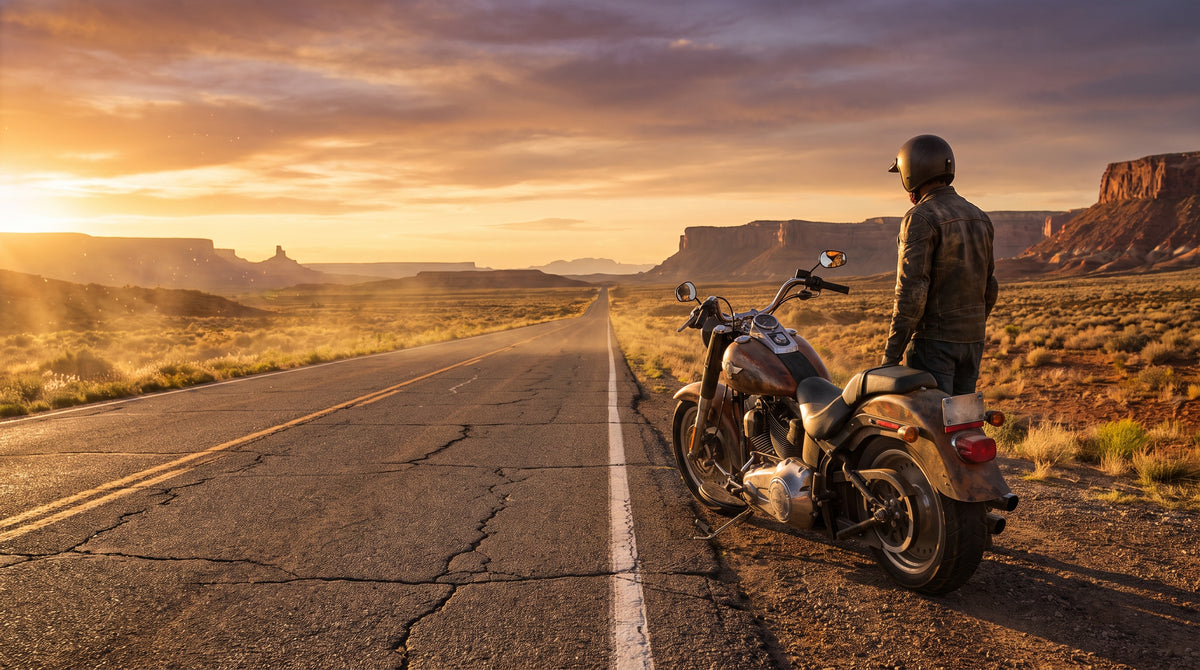
Walk into any motorcycle rally and you can spot the gear that came from a random marketplace listing from across the parking lot. The zipper pulls are already tarnishing. The "leather" jacket is peeling where the rider's arm rests against the tank. The helmet visor flaps loose above 40 mph. Good American biker gear does the opposite. It fits the bike, fits the rider, and looks better after two seasons than it did on delivery day.
This guide covers every category of riding gear that matters, from helmets and jackets to boots and accessories. You will know exactly what construction details to check, which materials hold up under real riding conditions, and where most buyers waste money on gear that falls apart before the first oil change.
What Counts as Real Biker Gear (and What Doesn't)
Biker gear is not costume wear. Real riding gear serves three jobs: impact protection, weather resistance, and abrasion protection if you go down. Everything else is a style choice layered on top.
A DOT-rated half helmet that weighs 2.1 pounds and meets FMVSS 218 is biker gear. A painted novelty shell with no internal EPS foam liner is not. A cowhide leather jacket with 1.0 to 1.2 mm hide thickness stops road rash at speeds that would shred a polyester windbreaker in under one second of slide. That thickness matters because every 0.1 mm of cowhide adds roughly half a second of slide protection on asphalt.
The same logic applies to boots. A riding boot with an oil-resistant sole and reinforced ankle box keeps your foot from folding sideways in a low-speed drop. A fashion boot that says "biker" on the tag but has a thin rubber sole and zero ankle support is a walking shoe with metal rings on it.
When shopping for American biker gear, look for three markers: a safety certification on hard goods (DOT for helmets), real material specs in the product description (actual leather thickness, not just "genuine leather"), and construction designed for riding. Shift pads on boots, armor pockets in jackets, reinforced palms in gloves.

Helmets: The Non-Negotiable Starting Point
Every state except Illinois, Iowa, and New Hampshire has some form of helmet law on the books. But legality aside, a helmet is the one piece of gear that stands between a minor incident and permanent damage.
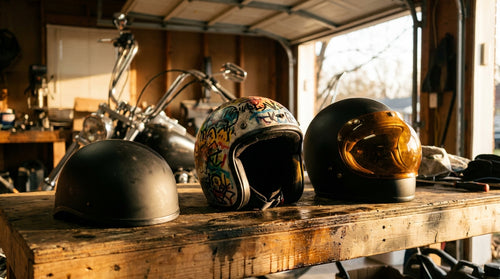
For cruiser and touring riders, three styles dominate American biker culture. The half helmet covers the crown only and weighs 1.8 to 2.4 pounds depending on the shell material. The three-quarter open-face adds ear and back-of-head coverage, typically weighing 2.2 to 2.8 pounds. The full-face wraps the entire head including a chin bar and runs 3.0 to 3.5 pounds.
DOT FMVSS 218 is the minimum standard worth accepting. It tests for impact absorption, penetration resistance, chin strap retention, and peripheral vision at a minimum of 210 degrees. ECE 22.06, the European standard, tests at more impact angles and is considered the tougher certification. A helmet that carries both has been verified more thoroughly than one with DOT alone.
Shell material affects both weight and protection. ABS plastic is the most common, and it works fine for general riding. Fiberglass composite shells absorb impacts more efficiently and shave roughly 100 to 150 grams at the same coverage level. Carbon fiber is the lightest option, but pricing starts above $300 for even a basic half shell.
A DOT half shell from a reputable brand runs $50 to $120. A DOT open-face sits in the $80 to $200 range. Full-face helmets for cruiser riding start around $120 and top out near $350 for composite or carbon fiber builds. The full face motorcycle helmets section is a solid place to compare options.

Leather Jackets: Why Material Matters More Than Brand
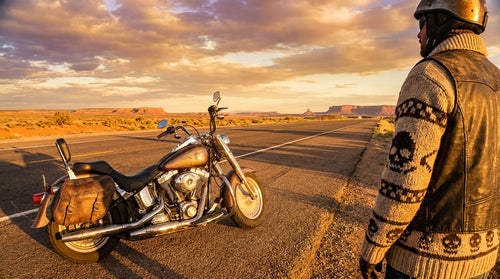
A leather motorcycle jacket is the most iconic piece of American biker gear. It is also the piece where quality differences matter most. The gap between a $400 full-grain cowhide jacket and a $79 bonded leather lookalike is not about brand prestige. It is about whether the jacket protects you or disintegrates on contact with pavement.
Full-grain cowhide at 1.0 to 1.2 mm thickness is the standard for serious riding jackets. At that thickness, leather provides roughly 4 to 6 seconds of slide protection at highway speeds. Bonded leather, which is ground-up scraps pressed together with adhesive, offers about half a second before it shreds apart. Split leather falls in between but wears faster in rain and sun.
The construction details that separate a riding jacket from a fashion jacket:
- CE-rated armor pockets at shoulders, elbows, and a spine pocket for removable back armor
- Double or triple stitched seams at stress points, especially shoulders and armpits
- A kidney panel or belt loop system that keeps the jacket from riding up during a slide
- Ventilation zippers or perforated panels for warm-weather riding above 85 degrees
- A zip-in insulated liner for cold mornings and fall rides
Textile jackets work for touring and commuting. Cordura 500D nylon handles abrasion at about 60 to 70 percent of leather's level at the same weight, and it dries faster after rain. For riders who put on 10,000-plus miles per year in mixed weather, a textile jacket with removable waterproof and thermal liners is more practical. But for pure cruiser style and maximum protection per ounce, leather wins. The men's leather jackets section has classic and modern cuts in genuine hide.

Biker Boots Built for Riding and Walking
Motorcycle boots protect the ankle, the most commonly injured joint in low-speed drops. A reinforced ankle box or external cup built into the boot's structure keeps the joint from folding past its natural range of motion during a simple parking lot tip-over at 5 mph.
Three boot styles make up most of the American biker gear market:
Engineer boots use a pull-on design with a ring strap and a steel or composite toe. The Red Wing 2268, at $320 retail, is the heritage benchmark. The sole is usually Vibram or a similar oil-resistant compound rated for fuel and solvent contact. Weight runs 3.0 to 3.6 pounds per boot.
Strap boots have a decorative or functional buckle around the ankle with a square or round toe. The look originated with Harley-Davidson's El Paso line in the 1970s. Modern versions weigh 2.8 to 3.4 pounds per boot and break in over about 40 to 60 hours of wear.
Combat-style boots have lace-up fronts and aggressive tread patterns. They run lighter than engineer or strap boots at 1.8 to 2.4 pounds per boot. Riders who walk a lot at rallies or commute on foot from a parking garage favor these for all-day comfort.
All three styles should have a shift pad reinforcement on the left toe box, where the gear shifter contacts the boot thousands of times per ride. Without it, the leather wears through within a few months of daily shifting. A molded toe cap, not just an extra layer of leather glued on, is the construction detail to check for. The biker boots guide covers sizing, break-in, and specific model comparisons.

Gloves, Eyewear and the Pieces Most Riders Skip
Hands hit the pavement first in most falls. That is how the body's protective reflex works. Arms extend, palms face down, and pavement strips skin from the heel of the hand in under half a second of slide. A pair of leather riding gloves with reinforced palms stops that entirely.
Look for hard knuckle armor or at minimum a double-layer leather panel across the knuckle ridge. A palm slider, a smooth piece of leather or reinforced plastic that lets the hand glide rather than catch on pavement, is the single most important feature in a riding glove. A Velcro or snap wrist closure keeps the glove from pulling off during impact. Quality riding gloves with these features run $35 to $80. Anything under $20 typically skips the palm reinforcement and uses a single layer of thin leather that wears through fast.
Eyewear gets overlooked, but it matters. At 60 mph, a small piece of road debris hits with enough force to cause serious eye damage. Riding sunglasses should be ANSI Z87.1 rated, which means the lenses have been impact-tested at high velocity. Polycarbonate lenses are the standard. Glass lenses should be avoided because they can shatter on impact. Wrap-around frames that seal against the face block side wind that dries out eyes and blurs vision at highway speeds.

American Biker Gear vs Marketplace Knockoffs
The price gap between quality biker gear and marketplace alternatives is real, but so is the gap in protection and lifespan. Here is how they compare across each category:
| Category | Quality American Gear | Marketplace Knockoff |
|---|---|---|
| Half helmet | DOT FMVSS 218, EPS liner, 2.1 lbs | No DOT sticker, no EPS, 1.4 lbs |
| Leather jacket | 1.0-1.2 mm cowhide, CE armor pockets | Bonded leather, no armor pockets |
| Boots | Oil-resistant sole, reinforced ankle, shift pad | Thin rubber sole, no ankle support |
| Gloves | Double-layer palm, knuckle armor, $40-$80 | Single-layer synthetic, no armor, $12-$18 |
| Vest | Full-grain leather, bar-tacked seams | Split or bonded leather, single-stitch seams |
| Typical lifespan | 3 to 7 riding seasons | 6 to 12 months before visible wear |
The pattern repeats across every category. The marketplace version photographs well, arrives fast, and fails within one riding season. The quality version costs more up front but lasts three to seven times longer, which makes it cheaper per ride over any reasonable ownership period. A $200 cowhide jacket worn for five years costs $40 per season. A $79 bonded jacket replaced every year costs $79 per season.
5 Common Gear Mistakes That Cost Riders Money
- Buying a "genuine leather" jacket without checking hide thickness. The label "genuine leather" is the lowest grade of real leather. It often means a thin split hide that cracks and peels after a few months of sun exposure. Ask for full-grain or top-grain cowhide with a stated thickness of 1.0 mm or higher.
- Ordering a helmet without measuring head circumference. Hat sizes are unreliable for helmets. Measure with a flexible tape at the widest point, one inch above the eyebrows. Most adults fall between 21 and 25 inches. A helmet that feels comfortable in the store will be too loose after the liner breaks in, so buy snug.
- Skipping gloves because the ride is short. Most motorcycle accidents happen within five miles of home. A 10-minute ride to the store at 35 mph produces the same palm injuries as a highway crash if the bike goes down. Gloves take three seconds to put on.
- Choosing boots by style instead of ankle protection. The most common motorcycle injury below the waist is a fractured or dislocated ankle. A boot with no reinforced ankle box offers zero protection in even a slow-speed drop. Check for a rigid ankle cup or internal frame before worrying about the strap design.
- Buying all gear at once from the cheapest source. A $199 "complete biker gear set" from a marketplace listing typically includes the lowest-quality version of everything. Buy one piece at a time, starting with the helmet and jacket, and spend the money where protection matters most.
If you are putting together your first set of riding gear, or upgrading from marketplace pieces that did not hold up, the full gear catalog is where most riders start. Every helmet ships DOT-certified, every jacket uses real leather, and returns are free if the fit is not right.

No comments yet. Be the first rider to weigh in.