
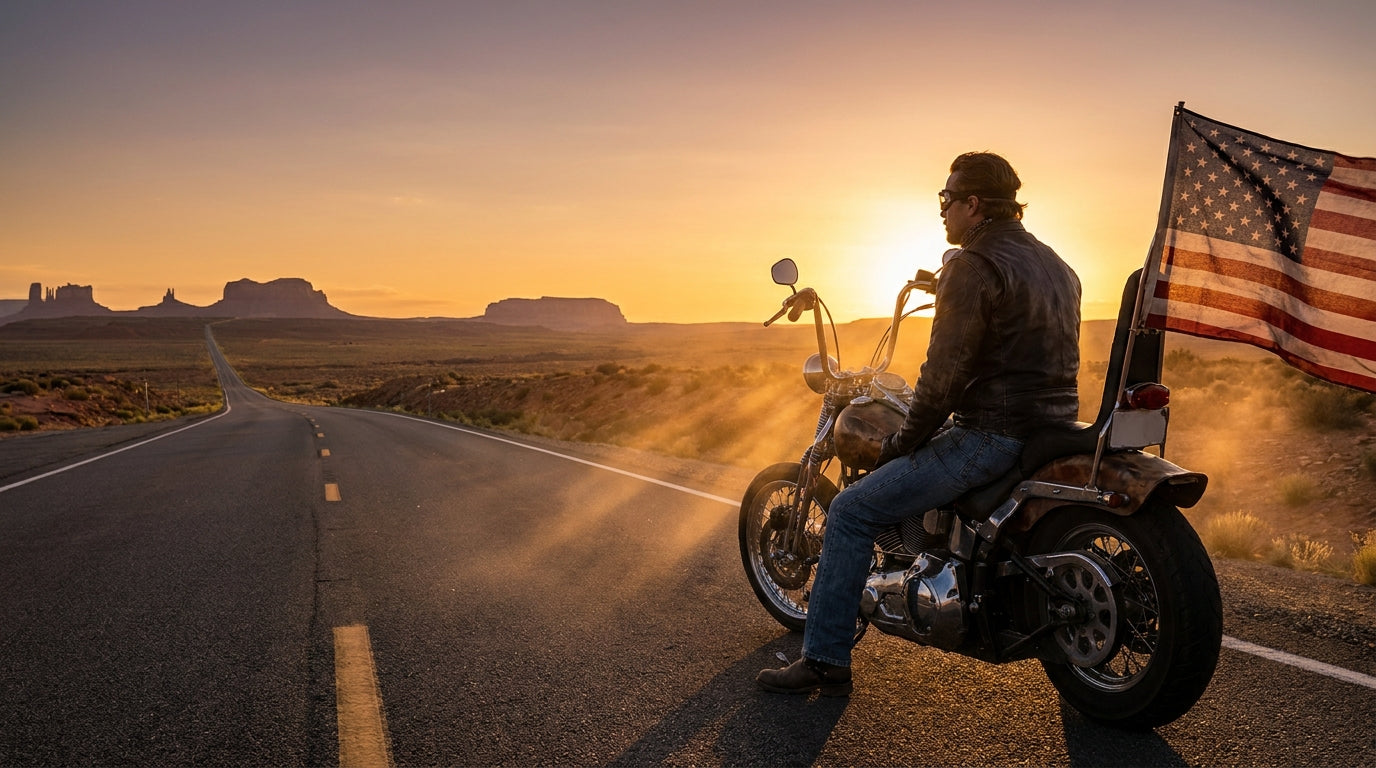
You are doing 70 on an open two-lane, the sun sitting low enough to blind you through every curve. You reach for your regular Ray-Bans and the wind rips them sideways before you hit the next straightaway. That pair cost you $180 and it is now gravel dust somewhere on Route 66.
Biker sunglasses exist to solve that exact problem. They wrap tighter, sit closer, seal out wind, and stay put when a regular frame would launch off your face. This guide covers the 7 styles worth considering, what separates a riding frame from a fashion frame, and where riders keep getting the purchase wrong.
What Makes Biker Sunglasses Different from Regular Shades
A standard pair of sunglasses sits loosely on the nose and temples, held in place by gravity and a gentle squeeze. That works fine at a sidewalk cafe. On a motorcycle at 60+ mph, gravity loses to aerodynamics in about three seconds.
Biker sunglasses fix this with a few specific engineering choices:
- Wraparound geometry. The lens curve (called the "base curve") is typically 8 to 9 on riding frames, compared to 4 to 6 on street sunglasses. That deeper wrap blocks peripheral wind and debris.
- Foam gaskets. Many riding frames add a removable foam lining along the top and sides. This blocks wind updraft that causes watery eyes at highway speed.
- Polycarbonate lenses. Impact-rated polycarbonate (ANSI Z87.1) handles a kicked-up rock without shattering. Glass and CR-39 lenses are not rated for that.
- Rubberized grip. Temple tips and nose pads use soft rubber or silicone instead of smooth acetate so they grip skin even when you sweat.
The difference is not just cosmetic. A pair of Oakley Flak 2.0 sport wraps weighs 30 grams and hugs a 8.75 base curve. A classic Wayfarer sits at a 6 curve and 45 grams. That gap matters at speed. If you ride with a half-shell or open-face helmet, sunglasses are your only eye protection, and a loose pair is worse than none because it becomes a distraction.
Wraparound Frames: The Standard for Cruiser and Touring Riders
Wraparound biker sunglasses for men and women are the most popular style for a reason. They cover the widest field of vision, deflect the most wind, and fit under nearly every helmet type from half-shell to modular.
What to look for in a solid wraparound riding frame:
- Full temple coverage. The arms should curve behind the ear, not just rest on top of it. Straight temples slide under helmet pressure.
- Shatterproof lens certification. ANSI Z87.1 is the baseline. Some brands (like Wiley X and Bobster) carry mil-spec ANSI Z87.1+ which means they passed a high-velocity impact test at 150 fps.
- Anti-fog coating. When you stop at a light with a foam-gasketed frame, trapped body heat can fog the lens in seconds. A hydrophilic anti-fog coat buys you an extra 20 to 30 seconds before it fogs.
For riders who want the steampunk-meets-biker look without losing wind protection, alloy wraparound frames with side shields offer a unique middle ground. Brands like Bobster and 7eye have built their entire lines around this concept, and even budget options in the $25 to $40 range now include foam-padded wraparounds with interchangeable lenses.
One more thing: lens color matters more than most riders realize. Gray lenses preserve true color perception, which is critical for reading brake lights in traffic. Brown and amber lenses boost contrast on overcast days but shift reds slightly. For an all-purpose cruiser lens, neutral gray is the safest bet.

Old School and Vintage Biker Sunglasses
Before wraparound sport frames took over, bikers wore aviators, round metal frames, and simple square acetate shades. That old school biker sunglasses look never really went away. It is still the dominant style at rallies from Sturgis to Daytona.
The vintage aesthetic works, but only if the frame is built for riding. A true vintage motorcycle sunglasses frame should have:
- Spring hinges. These absorb helmet squeeze instead of snapping at the screw.
- UV 400 protection. Vintage reproduction frames sometimes skip real UV filtering. Always confirm UV 400 or equivalent, which blocks wavelengths up to 400 nanometers, covering both UVA and UVB.
- Metal-core temples. Thin all-plastic temples flex too much at speed. A metal core inside a plastic sleeve keeps the fit locked.
Round metal frames in the style of 1960s and 1970s riding culture are making a serious comeback. The look pairs especially well with classic leather jackets and open-face lids.

Round Steampunk Riding Glasses
Steampunk riding glasses sit in the overlap between vintage style and functional protection. The defining feature is a double-wall side shield, usually perforated or spring-loaded, that wraps the lens edges and blocks lateral wind without killing your peripheral vision.
The flip-up lens design is another steampunk staple. It lets you lift the tinted lens indoors or at night without removing the whole frame. That is a practical advantage most fashion-first frames cannot match.
One thing to watch: decorative steampunk frames from costume shops are not riding gear. They use thin stamped metal, uncoated lenses, and weak hinges. A proper riding-grade steampunk frame uses spring-loaded temples, polycarbonate or Triacetate lenses, and alloy construction rated for vibration.
For a solid entry point, retro round frames with UV400 polycarbonate lenses run in the $25 to $35 range and hold up season after season.

Flip-Up Double Lens Frames: Day-to-Night Versatility
If you ride through changing light conditions (morning commute into sunrise, evening rides through tunnels, forest canopy to open desert) a flip-up frame saves you from carrying two pairs.
The design stacks a tinted outer lens over a clear inner lens. Flip the dark lens up when light drops, flip it down when the sun returns. The transition takes one hand and about half a second.
This is not the same as photochromic lenses (which auto-darken). Photochromic transitions are slower, typically 30 to 60 seconds for a full shift, and many struggle in cold weather. A manual flip is instant and consistent regardless of temperature.
Double-lens flip frames weigh slightly more than single-lens designs, usually 35 to 42 grams versus 28 to 32 grams for a standard frame. That extra weight is barely noticeable under a helmet strap, and the convenience pays for itself on the first ride that crosses sunset.

Polarized vs. Standard Lenses: Which One for Riding?
Polarized lenses reduce glare from flat reflective surfaces like wet pavement, car hoods, and lake water. For riders, the big benefit is cutting the white-out effect on a rain-soaked highway or when the afternoon sun bounces off a line of parked cars.
But polarization has a trade-off on a motorcycle. It can make LCD screens harder to read. If your bike has a digital dash or you run a GPS unit, a polarized lens can darken or rainbow those displays at certain angles. Harley's Boom Box GTS screen, for example, washes out behind polarized lenses when viewed from a slight tilt.
The practical breakdown:
| Lens Type | Best For | Watch Out For |
|---|---|---|
| Polarized | Wet roads, bright sun, beach/lake rides | LCD dash readability, GPS screens |
| Standard tinted | General riding, digital dash bikes | More glare on wet surfaces |
| Photochromic | Mixed-light rides, tunnel-heavy routes | Slow transition in cold weather |
| Yellow/amber | Overcast days, dawn/dusk, fog | Too bright in full sun |
If you ride a bike with an analog gauge cluster, go polarized and enjoy the glare reduction. If your bike runs all-digital, test the display angle with polarized lenses before committing.

Biker Sunglasses Comparison: 6 Styles Head to Head
| Style | Wind Protection | Weight | Best Helmet Pairing | Price Range |
|---|---|---|---|---|
| Sport Wraparound | Excellent (foam gasket) | 28-32g | Half-shell, open-face | $25-$80 |
| Classic Aviator | Low (open sides) | 32-40g | No helmet / novelty | $15-$60 |
| Round Vintage | Moderate | 30-36g | Half-shell, open-face | $20-$40 |
| Steampunk w/ Shield | Good (side shields) | 34-42g | Half-shell, beanie | $25-$45 |
| Flip-Up Double Lens | Good | 35-42g | Open-face, modular | $28-$50 |
| OTG (Over-the-Glasses) | Excellent | 40-50g | Any open helmet | $20-$45 |
Weight differences of 10 to 15 grams sound trivial until you wear them for a 6-hour ride. Lighter frames cause less pressure on the nose bridge and leave fewer red marks from the temple tips. If long-haul comfort matters, lean toward the lighter sport wraps or round frames.
5 Mistakes Riders Make When Buying Biker Sunglasses
- Buying for looks first, fit second. A frame that looks right in the mirror but wobbles under a helmet strap is useless at speed. Always test with your helmet on, chin strap buckled, before deciding.
- Ignoring lens material. Glass lenses are optically superior but shatter on impact. CR-39 resin is better but still cracks. Polycarbonate is the only lens material rated for riding. Check the spec sheet, not the marketing.
- Skipping UV protection. Dark tint does not equal UV blocking. A dark lens without UV coating actually makes things worse: your pupils dilate behind the dark tint, letting in more unfiltered UV radiation. Confirm UV 400 or ANSI Z80.3 compliance.
- Forgetting about prescription needs. About 64% of American adults need vision correction (Vision Council, 2023). If you need Rx lenses, look for frames with Rx-compatible inserts or order from a brand like 7eye or Wiley X that offers direct Rx cuts into the riding frame.
- Buying ultra-cheap marketplace frames with no safety rating. A no-name $8 pair from a random online seller might use injection-molded acrylic instead of polycarbonate. Acrylic cracks into sharp shards on impact. At $25 to $35, you can get a properly rated frame from a brand that stands behind the product. The ALR sunglasses collection runs in that range with UV400 polycarbonate across the line.
Picking the Right Pair
The best biker sunglasses are the ones that match your helmet, your riding style, and the light conditions you ride in most. Cruiser riders in half-shells need maximum wrap and wind protection. Touring riders in modulars need a slim enough profile to fit under the chin bar. Weekend riders in mild weather can get away with vintage rounds or aviators and still look the part.
Whatever you pick, check three things before you hand over money: UV 400 rating, polycarbonate lenses, and a snug fit under your helmet. Everything else is personal preference. If you are still deciding, the riding sunglasses collection is a good place to compare styles side by side.


No comments yet. Be the first rider to weigh in.