
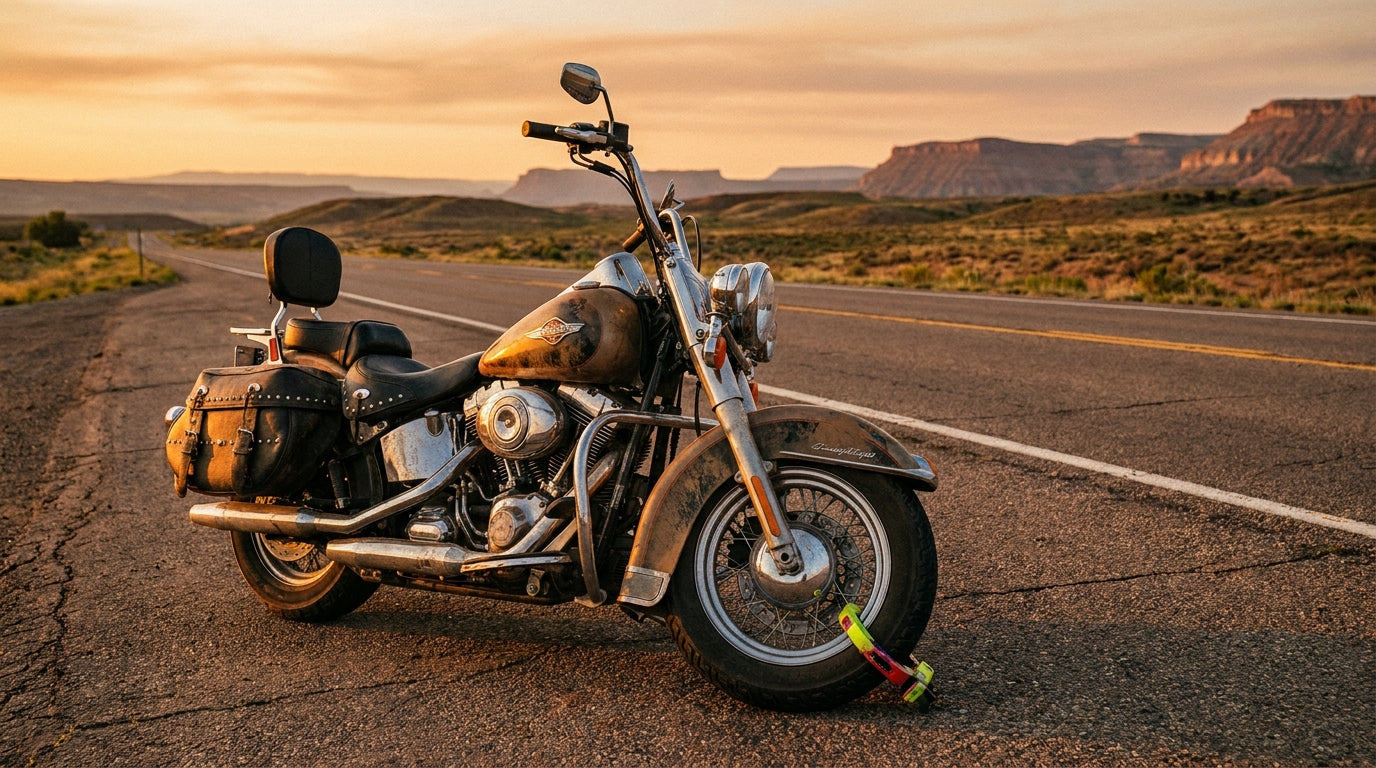
A motorcycle gets stolen in the United States roughly every 11 minutes. The National Insurance Crime Bureau logged over 52,000 motorcycle thefts in its most recent annual report, and recovery rates sit around 46%. Most thefts take less than 60 seconds. A disc lock will not make your bike theft-proof, but it adds resistance that sends most opportunistic thieves looking for an easier target.

This guide covers the best motorcycle disc locks by pin thickness, alarm quality, and real-world durability. You will see how to place one correctly, which mistakes waste your money, and why even the best lock has one critical blind spot. If you park on the street or at rallies, this is the breakdown you need before buying.
What a Disc Lock Actually Does
A disc lock is a compact clamp that fits over your motorcycle's brake rotor. Once locked, the pin sits inside a rotor slot and prevents the wheel from spinning. The bike cannot roll, so it cannot be pushed or ridden away.
The design is intentionally simple. No chains to thread, no ground anchors to bolt in. You pull up, clamp it on, pocket the key, and walk away. That portability is the main advantage over heavier security options like the Kryptonite New York Fahgettaboudit chain, which weighs over 15 lbs.
But portability comes with a tradeoff. A disc lock only blocks one wheel. A thief can still lift the bike into a van. And if the lock body is made from cheap materials, it can be pried off with basic tools. That is why the specs matter. A well-built disc lock with a thick hardened pin and a loud alarm turns your parking spot into a problem for any thief. A cheap one from an unknown marketplace seller gives you a false sense of security and nothing more.

Three Specs That Separate a Good Disc Lock from a Paperweight
Not all disc locks are equal. These three specs tell you whether you are buying real protection or a shiny toy.
Pin Diameter
This is the single most important number. A 7mm pin is entry-level. Bolt cutters can handle it in about 15 seconds. A 10mm hardened steel pin raises the bar, requiring an angle grinder or a hydraulic cutter. A 14mm pin, like the one in the Abus Granit Detecto 8077, takes real commitment and loud tools to defeat.
If you ride anything worth more than $3,000, start at 10mm. For a Harley, touring bike, or any motorcycle that sits outside overnight, 14mm is worth the extra cost and weight.
Body Material
Look for "hardened steel" or "specially hardened" in the product description. If a listing says "alloy" without specifying which alloy, it is usually zinc or pot metal. Both crack under a hammer strike. Stainless steel resists corrosion better but is softer than hardened carbon steel. For pure theft resistance, hardened carbon steel wins. For coastal riders dealing with salt air, stainless with a corrosion-resistant coating is the practical choice.
Alarm Decibels (If Alarmed)
A useful alarm starts at 100dB. For reference, a car horn is about 110dB. The Xena XX14 hits 120dB, which is physically uncomfortable to stand next to. Anything below 85dB is background noise in a city and will not draw attention.
Check how the alarm activates, too. Motion-triggered is standard. Some cheaper models use vibration sensors so sensitive they fire off in a breeze, draining the battery and training you to ignore the alarm. That defeats the entire point.

Alarmed vs Non-Alarmed Disc Locks
The alarmed vs non-alarmed question comes down to where you park.
When an alarmed lock makes sense:
- Street parking in urban areas
- Rally and event parking lots
- Apartment complex lots where your bike sits unattended for hours
- Anywhere out of your direct line of sight
The siren draws attention. Most thieves work quietly and quickly. A 110dB alarm going off next to them is the opposite of quiet. Even if nobody intervenes, the noise creates pressure to abandon the job.
When non-alarmed works fine:
- Your locked garage at home
- A well-monitored parking structure with cameras
- Short stops where you can see your bike from where you are sitting
Non-alarmed locks are lighter, cheaper (often $30 to $50 vs $80 to $150 for alarmed), and have no batteries to maintain. The Oxford Boss is a popular non-alarmed option at around $40 with a 14mm shackle, which is thicker than many alarmed models at twice the price.
One detail worth noting: alarmed locks need battery replacements. Most use CR2 or LR44 batteries that last 6 to 12 months depending on false alarm frequency. Set a reminder every six months. A dead alarm is just a heavy paperweight with a pin.
What to Spend on a Motorcycle Disc Lock
Disc lock prices range from about $15 to $200. Here is what each tier gets you.
Under $30: Basic pin locks, usually 7mm pins, no alarm. Fine as a visible deterrent on an inexpensive scooter. Not recommended for any motorcycle worth insuring.
$30 to $60: Non-alarmed locks with 10mm or larger pins and hardened steel bodies. This is the sweet spot for riders who park in garages but want a backup layer. The Kryptonite Keeper 5-S2 sits in this range and is widely available.
$60 to $120: Alarmed disc locks with 10 to 14mm pins and 100dB or louder sirens. Best value for street parkers. The Xena XX6, with a 10mm pin and 120dB alarm, runs about $80 and is a solid middle-ground pick.
$120 and up: Premium alarmed locks with 14mm or larger pins, advanced motion sensors, and anti-drill protection. The Abus Granit Detecto X-Plus 8077 is the benchmark at around $150. If you are locking up a $15,000 or more motorcycle, this tier makes financial sense.
A useful rule of thumb: spend at least 5% of your bike's value on security. For a $10,000 motorcycle, that is $500 across all layers including a lock, chain, cover, and tracker.
How to Place a Disc Lock the Right Way
Placement matters more than most riders realize.
Use the front disc, not the rear. A thief can lift the front wheel and roll the bike backward on the rear wheel if the lock is on the back. Locking the front rotor means both wheels are functionally immobilized.
Position the lock at the bottom of the rotor (6 o'clock). This makes it harder to reach with cutting tools and reduces the leverage a thief can apply to pry it off.
Always use a reminder cable. These bright orange or yellow cables loop from the lock to your handlebar grip. Without one, you will eventually try to ride away with the lock still clamped on. That mistake bends your brake rotor, and a replacement costs $200 to $400 depending on the bike. The Xena XBP-1 reminder cable costs about $6 and is the best per-dollar investment in motorcycle security.
Consider doubling up. A disc lock on the front plus a chain through the rear wheel and a fixed object covers both attack methods. No single lock is a complete solution, and layering is how professionals protect high-value bikes.
If your bike has dual front rotors, lock the one facing the road. A thief approaching from the sidewalk side will not spot it immediately, buying a few extra seconds of confusion.

Disc Locks vs Chain Locks vs Ground Anchors
Each lock type has a different strength. Here is where disc locks fit in the bigger picture.
| Feature | Disc Lock | Chain Lock | Ground Anchor |
|---|---|---|---|
| Portability | Fits in a jacket pocket | 3 to 8 lbs, needs a bag | Permanently installed |
| Setup time | 5 seconds | 30 to 60 seconds | 10 seconds (once installed) |
| Theft resistance (solo) | Medium | Medium-High | High |
| Street parking | Yes | Yes | No |
| Home parking | Yes | Yes | Yes |
| Prevents van lift | No | Yes (if chained to object) | Yes |
| Price range | $25 to $150 | $40 to $200 | $50 to $120 + install |
The takeaway: a disc lock is the best portable option. Light, fast, and effective against roll-away theft. But it does not solve the "lift into a van" problem. For home use, a ground anchor bolted into concrete is the strongest single option. For riders who want maximum street security, the combination of a disc lock (stops rolling) plus a short chain to a fixed object (stops lifting) covers the two main attack methods.
If you are building a full security setup, the motorcycle alarms guide breaks down electronic options that pair well with physical locks.
5 Disc Lock Mistakes That Cost Riders Money
These come up constantly, and every single one is avoidable.
1. Buying a lock with a sub-10mm pin. A 7mm pin is marketing security. It looks like protection but folds under basic tools. Start at 10mm or do not bother locking up at all.
2. Skipping the reminder cable. Riding off with a disc lock on bends your rotor. It is a $200 or more mistake that happens to everyone who thinks they will remember. You will not.
3. Relying on the lock alone. A disc lock is one layer. Pair it with a motorcycle cover (hides the bike's value), a chain (prevents lifting), or a GPS tracker (enables recovery after theft).
4. Ignoring the alarm battery. If your alarmed lock uses CR2 batteries, check them twice a year. Replace them on schedule, not after the alarm fails to trigger when you actually need it.
5. Locking the rear wheel instead of the front. Front wheel locks immobilize the bike more effectively. The rear wheel can be lifted, and the bike can still be pushed forward on the front tire alone.
The One Thing No Lock Can Do
Here is the hard truth: every physical lock is a delay tool. A thief with an angle grinder can cut through a 14mm hardened steel pin in about 30 to 60 seconds. The lock's job is to buy time and attract attention, not to be unbreakable.
What no disc lock, chain, or anchor can do is tell you where your bike went after it is gone. If someone loads your motorcycle into a van at 3 AM, you will find an empty parking spot in the morning and zero leads to follow.
That is where a GPS tracker changes the equation. It does not prevent the theft. It tells you exactly where your bike is, in real time, so you or the police can recover it. Recovery rates for GPS-equipped bikes run dramatically higher than the national 46% average.
The most effective anti-theft setup combines a disc lock (deters the opportunistic thief) with a GPS tracker (enables recovery if a professional gets past the lock). One handles prevention, the other handles response. If you want the full picture, the motorcycle theft prevention guide covers the layered approach in detail.
A good disc lock is the first piece of a real security setup. Pair it with a tracker, use a cover, and park smart. If you are shopping for locks and chains, the motorcycle locks and chains collection at American Legend Rider is a solid place to start.



No comments yet. Be the first rider to weigh in.