
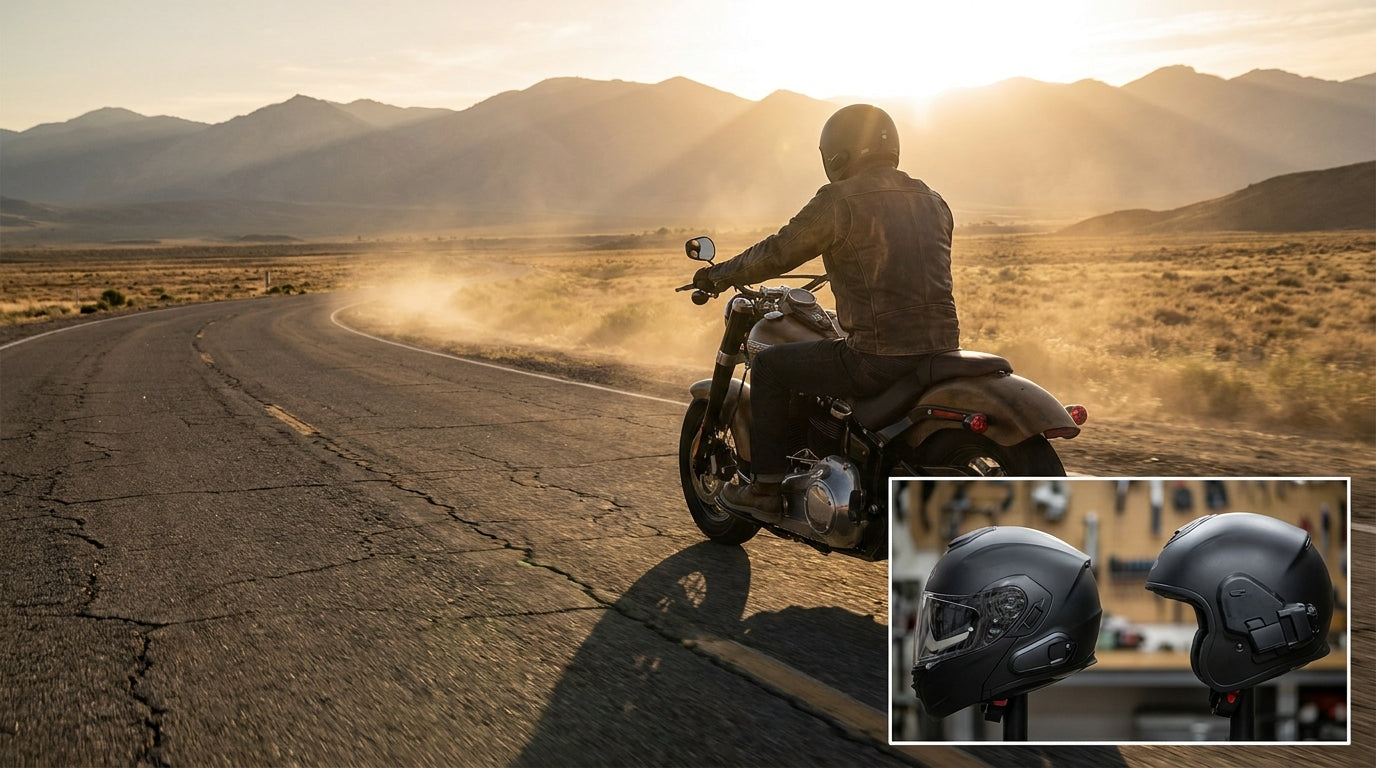
Every bluetooth motorcycle helmet listing promises crystal-clear calls at highway speed, 6-rider intercom, and music that sounds like a concert. Then you hit 65 mph and cannot hear your riding buddy two bike lengths ahead. The problem is not always the helmet. It is usually the wrong type of bluetooth system for the way you actually ride. There are two approaches, and picking the wrong one wastes $200 to $600.
This guide breaks down built-in bluetooth helmets versus add-on headset systems. You will learn what specs actually affect audio at speed, which battery claims hold up on real rides, and how to avoid the most common bluetooth motorcycle helmet mistakes. By the end, you will know which setup fits your riding style and budget.
Built-In vs Add-On Bluetooth: What Is the Real Difference
A bluetooth motorcycle helmet comes in two forms. Understanding the difference before you shop saves you from buying the wrong one.
A built-in bluetooth helmet has speakers, microphone, and control buttons permanently installed inside the helmet shell. The electronics ship from the factory already wired in. Speaker pockets are molded into the EPS liner, and wiring runs through internal channels. This creates a clean exterior with no module sticking out from the side. The ILM Bluetooth Integrated Modular Flip-Up helmet is one of the more common examples, typically priced around $120 to $160 depending on the model.
An add-on bluetooth headset is a separate device that clamps to the outside of any compatible helmet. The Sena 50S and Cardo Packtalk Edge are the two dominant models in this space. You install thin speaker inserts into the helmet's existing speaker pockets and mount the control module on the left side of the shell. Add-on units weigh about 2.5 to 3.5 oz and can move between helmets when you upgrade.
The key trade-off is longevity. Built-in systems are simpler and cheaper, but if the bluetooth unit fails, you replace the entire helmet. Add-on systems cost more upfront ($250 to $400 for a premium unit) but last across multiple helmets. They also receive firmware updates that improve audio processing and noise handling over time. A Cardo Packtalk Edge running its 2026 firmware handles wind noise noticeably better than the same unit did at launch.

How Audio Performs in a Bluetooth Motorcycle Helmet at Highway Speed
This is where most bluetooth motorcycle helmet marketing falls apart. A spec sheet looks great in a showroom. The highway tells a different story.
At 65 mph, wind noise inside a full-face helmet measures between 85 and 95 dB depending on the helmet's aerodynamic design and visor seal quality. Most bluetooth helmet speakers max out around 105 to 110 dB. That leaves a gap of only 10 to 20 dB between the noise floor and the speaker output. It is why music sounds muffled and phone calls become a shouting match above 55 mph.
Three things improve audio quality at speed more than raw speaker wattage.
First, helmet fit. A helmet that lets air leak around the chin bar or visor seal introduces turbulence noise directly into the ear cavity. A snug, properly sealed full-face helmet drops the noise floor by 5 to 10 dB compared to a loose-fitting one. The full face motorcycle helmet guide covers fit and seal quality in detail.
Second, speaker placement. The speakers should sit directly over the ear canal without pressing against the ear. If the speaker pockets are too shallow, the speakers push against your earlobes and cause fatigue on rides over an hour. If the pockets are too deep, volume drops because sound has to travel further before reaching the ear.
Third, microphone type. Boom mics (the kind that extend toward the chin bar) pick up less wind noise than button mics embedded in the chin area. For riders who take calls frequently, a boom mic setup makes calls usable at speeds where a button mic turns into static. The Sena 50S includes both a wired boom mic and a button mic so riders can choose based on their helmet type.
Bluetooth Helmet Specs That Actually Matter
Not every number on the box matters equally. Here is what to focus on and what to skip when shopping for a bluetooth motorcycle helmet.
| Spec | Why It Matters | What to Look For |
|---|---|---|
| Speaker diameter | Larger drivers produce more bass and volume | 40mm minimum, 45mm for better clarity |
| Bluetooth version | Newer versions connect faster and use less battery | Bluetooth 5.0 or higher |
| Battery life (talk time) | Determines how long intercom and calls last | 10+ hours rated (expect 7-8 real world) |
| Intercom range (rated) | Almost always overstated by 50-70% | 1+ mile rated, expect 0.3-0.5 miles in terrain |
| Noise cancellation | Helps calls but does little for music | Active noise cancellation on the microphone |
| Mesh vs traditional intercom | Mesh keeps the group connected if one rider leaves | Mesh for groups of 3+, traditional for pairs |
| Water resistance | Matters for commuters and touring riders | IP67 or higher for rain riding |
Ignore the "number of simultaneous riders" marketing. A 15-rider mesh network sounds impressive, but audio quality degrades noticeably after 4 to 5 active connections. Most riding groups work fine with 3 to 4 riders on a single mesh channel.

Built-In vs Add-On Bluetooth Helmet Comparison
This table puts the two approaches side by side so you can see the real trade-offs at a glance.
| Feature | Built-In Bluetooth Helmet | Premium Add-On (Sena/Cardo) | Budget Add-On |
|---|---|---|---|
| Price range | $100-$250 | $250-$400 (headset only) | $40-$100 |
| Weight added | 0 oz (integrated) | 2.5-3.5 oz | 1.5-2.5 oz |
| Audio quality | Moderate | High (40-45mm HD speakers) | Low to moderate |
| Intercom range | 300-500 meters | 1-2 km rated (0.3-0.8 km real) | 100-300 meters |
| Battery life | 6-10 hours | 10-13 hours | 4-8 hours |
| Firmware updates | Rare or none | Regular via manufacturer app | Rare |
| Helmet transfer | One helmet only | Moves between helmets | Moves between helmets |
| DOT certification | Included (full helmet) | Depends on host helmet | Depends on host helmet |
The built-in route makes sense for riders who want a single purchase, do not need premium audio, and ride mostly solo or with one partner at short range. The add-on route makes sense for riders who already own a helmet they like, ride in groups, or want the best audio and firmware support available.
One point worth repeating: a built-in bluetooth helmet still needs to meet DOT (FMVSS 218) or ECE 22.06 standards for the helmet itself. The bluetooth hardware does not affect the safety certification. Always verify the DOT sticker on the back before buying. Some cheap imports include bluetooth electronics but skip proper impact testing on the shell and liner.
Battery Life and Charging on Real Rides
Manufacturers rate battery life under ideal conditions: moderate volume, no intercom, room temperature. Real-world riding cuts those numbers by 20 to 35 percent.
A Sena 50S rated at 13 hours of talk time delivers about 8 to 9 hours with music streaming and occasional intercom use at highway speed. A budget built-in bluetooth helmet rated at 8 hours often drops to 5 to 6 hours in cold weather (below 45 degrees Fahrenheit) because lithium-ion batteries lose capacity in the cold.
Charging matters for long days. Most modern bluetooth systems use USB-C and charge fully in 1.5 to 2 hours from empty. Some units allow pass-through charging, meaning you can run a cable from a phone mount or tank bag to the helmet and charge while riding. This feature matters for touring riders covering 400+ mile days. Without it, you plan fuel stops around your helmet's battery gauge.
If you ride in groups regularly, mesh intercom drains battery faster than one-on-one connections. A 4-rider mesh channel cuts battery life by an extra 15 to 20 percent compared to solo music playback. Plan accordingly on long group rides and carry a compact USB-C cable in your tank bag or jacket pocket.
The cool motorcycle helmets guide covers several DOT-certified models that pair well with add-on bluetooth systems if you want to pick your helmet and headset separately.
Which Helmet Types Work Best with Bluetooth
Not every helmet type pairs equally well with bluetooth systems. The helmet's shell design directly affects how well you hear audio at speed.
Full-face helmets are the best match for bluetooth. The closed chin bar and sealed visor create a quieter interior that lets speakers compete with wind noise. A full-face helmet at 70 mph is roughly 10 dB quieter than a half-shell at the same speed. That difference makes phone calls usable and music enjoyable instead of just background noise.
Modular (flip-up) helmets work well when the chin bar is locked down. Most built-in bluetooth helmets are actually modular designs because the flip-up chin bar gives riders easy access for gas station stops without removing the helmet. The trade-off is that modular helmets weigh 3.5 to 4.5 lbs on average, about half a pound more than a comparable full-face shell.
Three-quarter (3/4) helmets are a tougher fit for bluetooth. The open face lets wind hit the microphone directly, making phone calls difficult above 45 mph. Music still works at moderate speeds, but wind noise dominates on the highway. Riders who prefer 3/4 helmets and want bluetooth should prioritize a boom mic that tucks behind a chin curtain or face shield.
Half-shell helmets are the weakest match for bluetooth audio. With no chin bar, visor, or ear coverage, wind noise overwhelms the speakers at any highway speed. Bluetooth works for short city rides under 40 mph, but long highway runs make calls and music impractical. If you ride a half-shell and want communication, wired earbuds under the helmet often outperform a bluetooth headset at speed.

4 Mistakes Riders Make with Bluetooth Motorcycle Helmets
- Buying based on intercom range claims. Every bluetooth helmet box shows a range of 1 to 2 miles. That number comes from open-field, line-of-sight testing with no obstacles. In real riding conditions with hills, buildings, trees, and other traffic, expect 0.3 to 0.5 miles maximum. If your group rides tight, this works fine. If riders spread out over a mile of highway, no consumer bluetooth intercom holds a reliable connection at that distance.
- Ignoring helmet safety for bluetooth features. Some budget bluetooth helmets spend the budget on electronics and cut corners on the shell and liner. A DOT sticker is the minimum legal standard, not a quality guarantee. Check the shell material (polycarbonate at minimum, fiberglass composite for better impact distribution) and the EPS liner thickness. A $120 bluetooth helmet with a thin EPS liner protects less than an $80 non-bluetooth helmet with proper liner density. The motorcycle safety gear guide explains what to look for in protective equipment beyond the DOT label.
- Not testing speaker pocket fit before a long ride. Every helmet has different speaker pocket dimensions. An add-on bluetooth system includes universal speaker inserts, but "universal" means "fits most, not all." Install the speakers, wear the helmet for 15 to 20 minutes at home, and check for pressure points on the ears. If the speakers press against your earlobes, you need thinner speaker inserts or a helmet with deeper speaker pockets. Five minutes of testing at home prevents an hour of discomfort on the road.
- Skipping firmware updates on premium systems. Premium bluetooth systems from Sena and Cardo receive firmware updates that fix bugs, improve noise cancellation algorithms, and sometimes add entirely new features. A Cardo Packtalk Edge running two-year-old firmware handles wind noise and voice clarity noticeably worse than the same unit with the latest update. Connect to the manufacturer's app every few months and install whatever is available. It takes 5 minutes and the improvement is free.
If you are looking for a helmet that pairs well with bluetooth systems, the full face motorcycle helmets collection has DOT-certified options with roomy speaker pockets designed for aftermarket headset installs.



No comments yet. Be the first rider to weigh in.